Quartermaster Raises $140M to Build Real-Time Data Network for the Ocean
Top Picks
Submit PR
Stay Ahead of the Market
Get the latest startup funding, hiring trends and global opportunities delivered to your inbox every week.
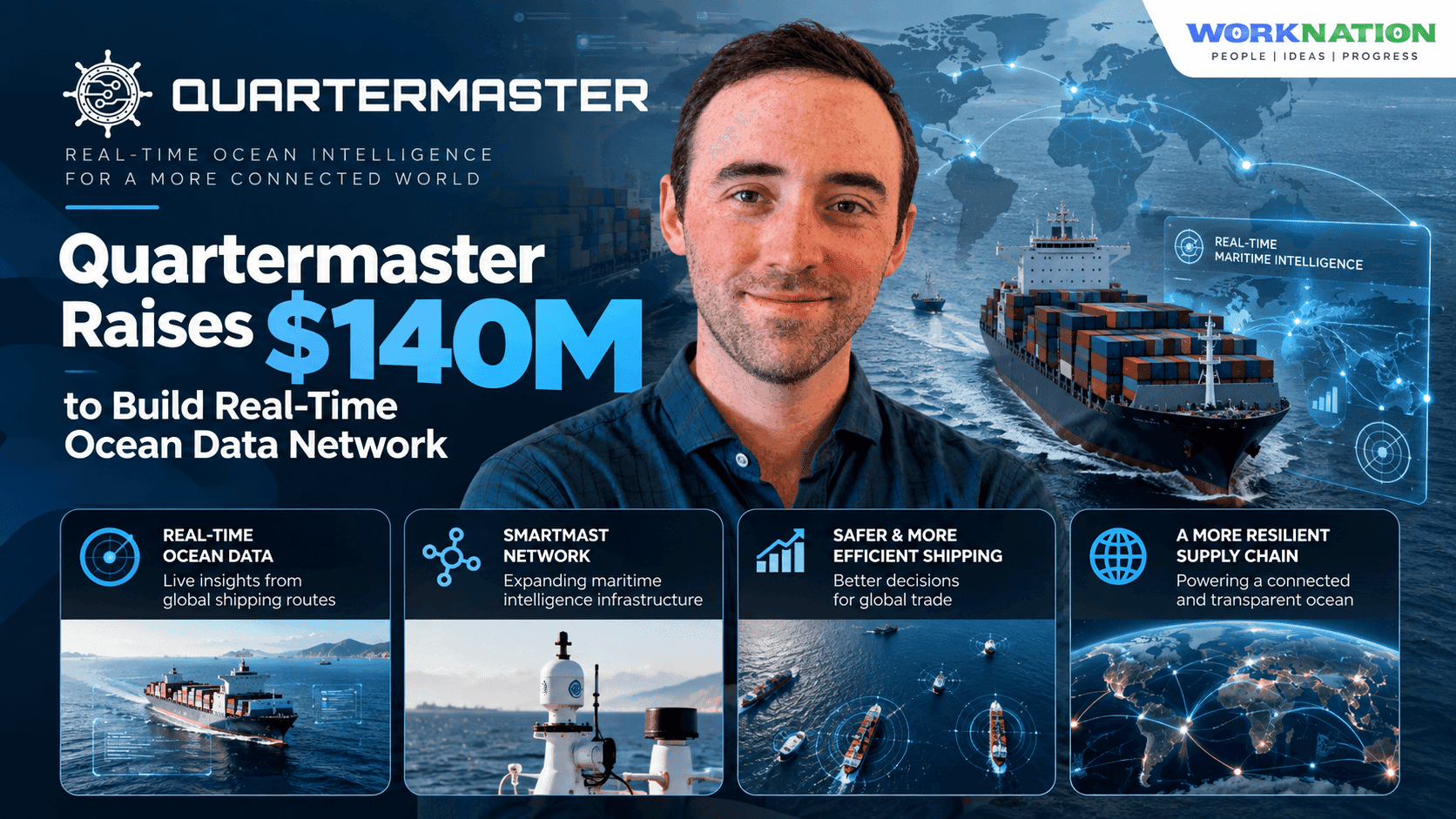
Arlington, Virginia-based maritime intelligence startup Quartermaster has raised $140 million in new funding to expand its real-time data network for the ocean.
The financing consists of a $100 million Series B led by Insight Partners and a $40 million venture debt facility from Stifel. Defence-focused investor Overmatch Ventures joined the company as a new investor, while First Round Capital, Quiet Capital, Steel Atlas, TMV Logistics, BoxGroup and Operator Partners returned.
The latest financing follows Quartermaster's $43 million Series A announced in May 2026. Including the new debt facility, the company has disclosed at least $183 million in funding.
Quartermaster is building a distributed maritime intelligence network using sensor systems installed on commercial vessels. Its SmartMast technology combines cameras and radios mounted on ship masts to collect information about conditions at sea and provide data for insurers, shipping companies and energy operators.
Turning commercial vessels into ocean data nodes
The ocean remains one of the world's largest environments with limited real-time visibility.
Quartermaster's strategy is to use ships that are already operating across the world's oceans as mobile data collection points.
The company's SmartMast system is designed to withstand maritime conditions while collecting information through cameras and radio systems mounted on vessels.
More than 650 vessels across 25 countries currently carry SmartMast systems, according to Quartermaster. The company has shipped more than 800 units.
The network's coverage has reached almost 46 million square kilometres, with coverage increasing 77% since May, according to Smart Maritime Network.
Quartermaster provides the hardware, installation and ongoing support. It also provides vessel operators with route hazard alerts and broadband internet at sea.
In exchange, the sensors installed on participating vessels contribute information to Quartermaster's shared maritime data network.
The company can then provide that data to organizations that need greater visibility into maritime conditions.
A distributed data layer for the ocean
Quartermaster's broader ambition is to create what it describes as a distributed network for the ocean.
The concept resembles other large-scale sensor networks where equipment is distributed across vehicles or infrastructure that is already moving through the environment.
Instead of building an entirely new fleet of vessels to collect data, Quartermaster installs sensors on commercial ships that are already traveling through major shipping routes and other areas of interest.
The approach allows the company to increase geographic coverage as more vessels join the network.
The company was founded in 2023 and is led by CEO Neil Sobin.
Sobin previously helped build Hivemapper's vehicle-based mapping network, according to the source. Hivemapper used sensors mounted on everyday vehicles to build a distributed mapping network.
Quartermaster applies a similar network concept to maritime environments.
Its chief growth officer, Steve Ribaudo, previously served as vice president of growth at Anduril, according to Quartermaster's website.
Insurance is a key use case
One of Quartermaster's strongest use cases is maritime insurance.
The company points to disruption around the Strait of Hormuz as an example of what can happen when insurers and shipping operators have limited visibility into conditions at sea.
Quartermaster says military operations in the region caused navigation signals to be jammed and spoofed, creating uncertainty around vessel locations.
The company says several major underwriters subsequently stopped writing insurance for the region and traffic through the Strait of Hormuz declined significantly.
The underlying argument is that insurers need reliable, real-time information to assess maritime risk.
Quartermaster's network can provide additional information about vessel movements and conditions that may help organizations understand risks in specific geographic areas.
On July 2, Neil Sobin said the first SmartMast-equipped vessel had transited the Strait of Hormuz.
S&P Global reported in July, citing a senior manager at insurance broker Marsh, that war-risk premiums for Hormuz transits had reached as much as 10% of hull value.
The example illustrates the potential economic value of better maritime intelligence.
When insurance costs change dramatically based on perceived risk, even incremental improvements in visibility can become important to insurers, ship operators and other stakeholders.
More than 650 vessels across 25 countries
Quartermaster's network has already reached significant scale.
The company says more than 650 vessels across 25 countries carry SmartMast equipment.
More than 800 units have been shipped, with fleet-wide deployments expected to increase.
The network currently covers almost 46 million square kilometres.
Quartermaster's customers and users can access route hazard alerts, maritime data and connectivity services, while the company aggregates information from participating vessels into its broader network.
The model creates a potential network effect.
As more vessels install SmartMast systems, Quartermaster can collect data across a larger geographic area and potentially provide more useful information to organizations relying on the network.
A market beyond insurance
Although insurance is an important application, Quartermaster's potential customer base extends beyond insurers.
Shipping companies can use maritime intelligence to understand route conditions and hazards.
Energy operators can use information about offshore environments and shipping activity.
Other organizations involved in maritime security and logistics can also benefit from more real-time visibility.
The company therefore has the opportunity to build a data platform rather than simply sell individual sensors.
Precedence Research estimates that the global maritime surveillance market will reach $50.93 billion by 2035, compared with $28.36 billion in 2026. Market definitions vary across research firms, however.
The broader growth of maritime intelligence is also being driven by increasing interest in autonomous vessels, offshore infrastructure, shipping security and real-time monitoring.
Competing approaches to ocean intelligence
Quartermaster is operating in an increasingly active maritime technology market.
Several companies are developing new ways to collect information from the ocean.
Oshen raised $5 million in August 2026 to scale its C-Star ocean robots.
Online Oceans raised £4 million in April to develop solar-powered autonomous surface vessels.
Saildrone raised $60 million in May 2025 for a European maritime security hub.
Kraken Technology Group raised $175 million in July 2026 at a valuation above $1 billion.
These companies generally involve building or deploying new autonomous vessels.
Quartermaster takes a different approach.
Instead of creating a new fleet specifically for data collection, it installs sensors on commercial vessels that are already operating across shipping lanes and fishing grounds.
That could allow Quartermaster to expand coverage without having to build and operate an entirely new fleet.
$140M to expand the network
The new $140 million financing will be used primarily to accelerate engineering and expand the number of vessels carrying SmartMast systems.
The company plans to increase its presence across busy fishing grounds and shipping lanes.
The Series B was led by Insight Partners, with Overmatch Ventures joining as a new investor.
The financing also includes $40 million in venture debt from Stifel.
Existing investors including First Round Capital, Quiet Capital, Steel Atlas, TMV Logistics, BoxGroup and Operator Partners participated again.
Insight Partners has invested in other companies focused on real-time data and location intelligence, including radio-frequency geolocation company HawkEye 360.
For Quartermaster, the investment provides capital to scale both its physical network and the technology required to process the information generated by that network.
Building an ocean-scale intelligence network
Quartermaster is attempting to solve a fundamental problem in maritime operations: the lack of reliable, real-time information across a huge and difficult-to-monitor environment.
Its SmartMast system puts cameras and radios on commercial vessels and turns those ships into nodes within a distributed data network.
With more than 650 vessels already participating across 25 countries, Quartermaster has established a growing physical footprint.
The company's latest funding gives it resources to expand that footprint further.
Its insurance use case around maritime risk demonstrates one potential application, while shipping, energy and maritime security represent additional areas where real-time ocean intelligence could be valuable.
The central challenge will be converting the growing sensor network into a sustainable data business where insurers, fleets and other organizations consistently pay for the information being collected.
For Quartermaster, the $140 million financing provides the capital to build that network at significantly greater scale.
Have a Funding Round or Exciting Update to Share?
Submit your press release to get featured on WorkNation and reach founders, investors, and tech leaders.