Basecamp Research Raises $140M to Advance AI-Designed Therapeutics
Top Picks
Submit PR
Stay Ahead of the Market
Get the latest startup funding, hiring trends and global opportunities delivered to your inbox every week.
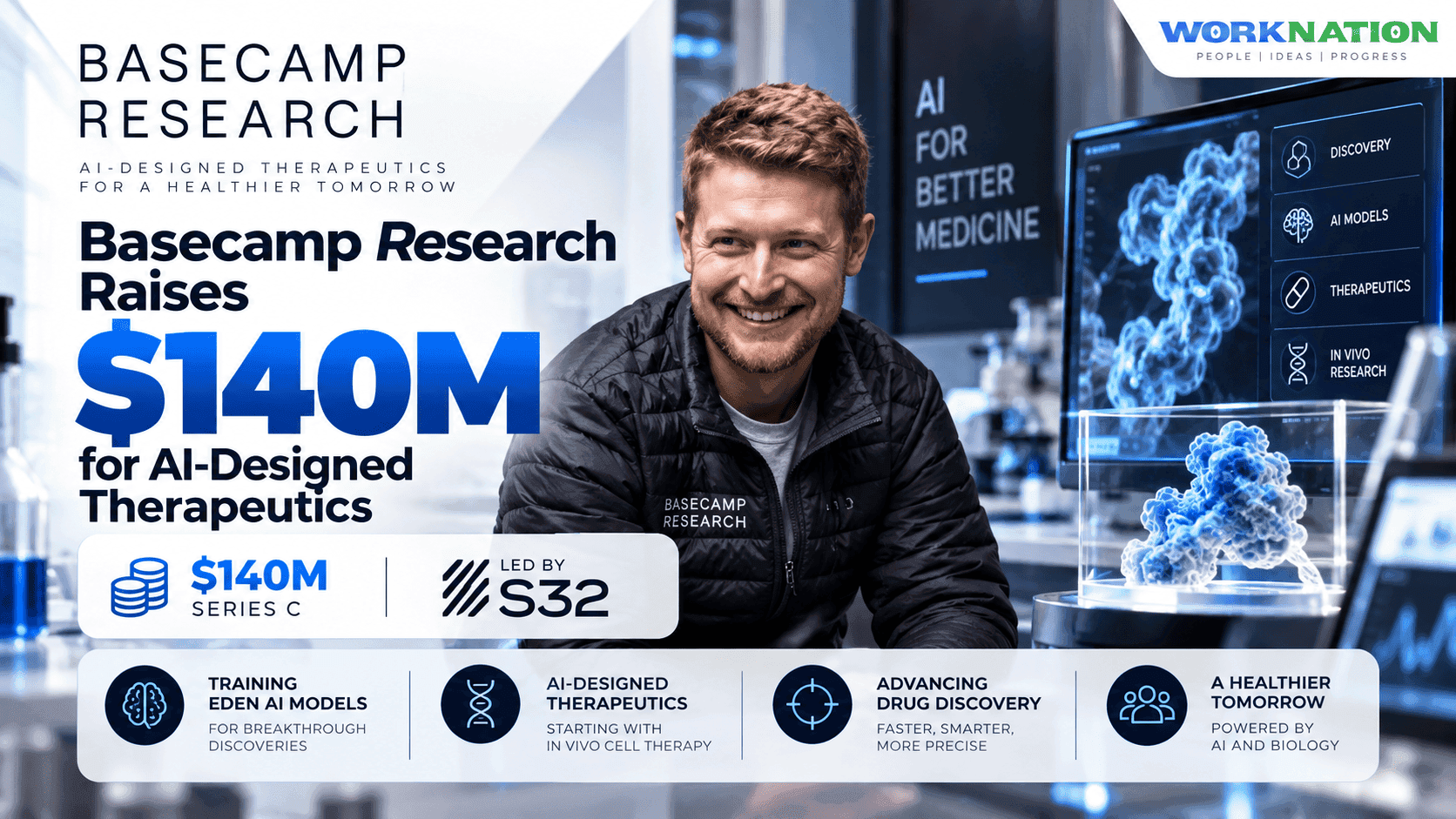
Basecamp Research, a frontier AI company developing AI-designed medicines, has raised $140 million in an oversubscribed Series C financing to train its next generation of biological foundation models and advance a pipeline of therapeutics toward clinical development.
The London- and Boston-based company said the round was led by S32, with participation from Menlo Ventures' Anthology Fund, Catalio Capital Management, European Tech Collective, Firebrand River Capital, Inception Fund, King Philanthropies, NATO Innovation Fund, NVIDIA, PostScriptum, Redalpine, The Rockefeller Foundation, Singular, Sovereign AI and True Ventures.
Basecamp Research plans to use the funding to advance its pipeline of EDEN-designed therapeutics, beginning with in vivo cell therapy, while also expanding pharmaceutical partnerships.
Designing medicines with AI and biological data
Basecamp Research is pursuing an approach that combines artificial intelligence, biological data and genetic engineering.
The company's ambition is to develop treatments for diseases that remain difficult or impossible to cure by designing medicines capable of reprogramming the body to repair itself.
At the center of this approach are the company's EDEN biological foundation models.
Unlike AI systems developed around a single scientific task, Basecamp Research says EDEN models are designed to learn patterns across a broad range of biology. The models are trained on the company's proprietary biological dataset, which it calls the Trillion Gene Atlas.
The Atlas was built through access and benefit-sharing partnerships spanning more than 30 countries across all seven continents.
The company says the dataset provides biological information that can be used to train AI systems on previously unseen biology.
Basecamp Research has also worked with partners including NVIDIA, Anthropic, PacBio and Ultima Genomics in developing the data and technology underlying its platform.
EDEN moves toward therapeutic development
The first major therapeutic application highlighted in the latest financing is in vivo cell therapy.
Traditional cell therapies can require cells to be removed from a patient, modified outside the body and then administered back to the patient. Basecamp Research is pursuing an alternative approach in which a patient's cells can be reprogrammed directly inside the body.
The company is combining EDEN's ability to design long and complex DNA sequences with large serine recombinases that can precisely integrate those sequences into the genome.
The objective is to create cell therapies that can deliver more sophisticated biological functions while potentially simplifying how treatments are administered.
Basecamp Research believes this approach could eventually have applications across diseases including cancer and autoimmune conditions.
The company said it has already demonstrated strong preclinical results across multiple modalities and disease areas.
The latest financing is intended to move its therapeutic pipeline closer to clinical development.
Building a biological foundation model
The Trillion Gene Atlas is a central component of Basecamp Research's strategy.
The company describes it as the world's largest proprietary biological AI training dataset.
Its data comes from biodiversity and biological research conducted through partnerships around the world. Basecamp Research says these access and benefit-sharing partnerships provide the foundation for training models on biological diversity that conventional datasets may not capture.
The company's thesis is that understanding biology at a much broader scale can give AI systems more useful representations of how DNA works.
EDEN models are designed to use this information to generate potential therapeutic candidates from biological and disease information.
The company has already demonstrated this capability through its collaboration with Anthropic on Claude Science.
According to Basecamp Research, EDEN can be applied to the design of multiple therapeutic modalities, including cell therapies, gene therapies, enzymes and peptides.
This gives the company a broader platform strategy than developing a single drug candidate.
Moving from models to medicines
The distinction between an AI research platform and a pharmaceutical company is important to Basecamp Research's strategy.
The company is not simply training models for scientists to use. Its stated goal is to use those models to design actual therapeutics and advance them toward clinical development.
That requires combining computational biology with laboratory research, genetic engineering and therapeutic development.
Basecamp Research's technology therefore spans multiple layers, beginning with biological data and AI models and extending into the design and testing of therapeutic candidates.
The company says its platform is already producing strong preclinical results across several modalities and disease areas.
The next stage will be translating those results into clinical programs.
Expanding pharmaceutical partnerships
Alongside the new financing, Basecamp Research has strengthened its commercial and pharmaceutical strategy.
Richard Pearce, formerly of Biogen, has joined the company as Chief Business Officer.
His appointment comes as Basecamp Research looks to expand its pharmaceutical partnerships and bring its AI-designed therapeutics platform to a wider group of industry partners.
The company is positioning its technology as infrastructure that can support drug discovery and therapeutic design rather than as a conventional single-asset biotechnology company.
That strategy could allow Basecamp Research to work across multiple disease areas and therapeutic modalities while continuing to develop its own pipeline.
Strong investor backing
The Series C attracted a broad group of investors from AI, biotechnology, technology and institutional capital.
S32 led the financing, while the participating investors included NVIDIA, Menlo Ventures' Anthology Fund, Catalio Capital Management, European Tech Collective, Firebrand River Capital, Inception Fund, King Philanthropies, NATO Innovation Fund, PostScriptum, Redalpine, The Rockefeller Foundation, Singular, Sovereign AI and True Ventures.
The round also attracted senior figures from the pharmaceutical and biotechnology industry.
André Hoffmann, Vice-Chairman of Roche, participated in the financing and highlighted the potential of combining AI, biological data and therapeutic design.
Andy Conrad, General Partner at S32 and former CEO of Google's Verily, is also joining Basecamp Research's Board of Directors.
The investor and board support reflects the growing interest in applying frontier AI to biological research and therapeutic development.
The next stage for AI-designed medicine
Basecamp Research's latest financing comes as AI moves deeper into biological research.
The company is building around the idea that models trained on broad biological datasets can help scientists design increasingly sophisticated therapies.
Its immediate focus is in vivo cell therapy, supported by its EDEN models and genetic engineering technology.
The company now plans to use its $140 million Series C to train new EDEN models, advance its therapeutic pipeline toward clinical development and expand partnerships with pharmaceutical companies.
The longer-term objective is broader: to build an AI and biological data platform capable of designing medicines across multiple modalities.
For Basecamp Research, the critical next step is moving from promising computational and preclinical results toward therapies that can demonstrate safety and efficacy in clinical development.
Have a Funding Round or Exciting Update to Share?
Submit your press release to get featured on WorkNation and reach founders, investors, and tech leaders.