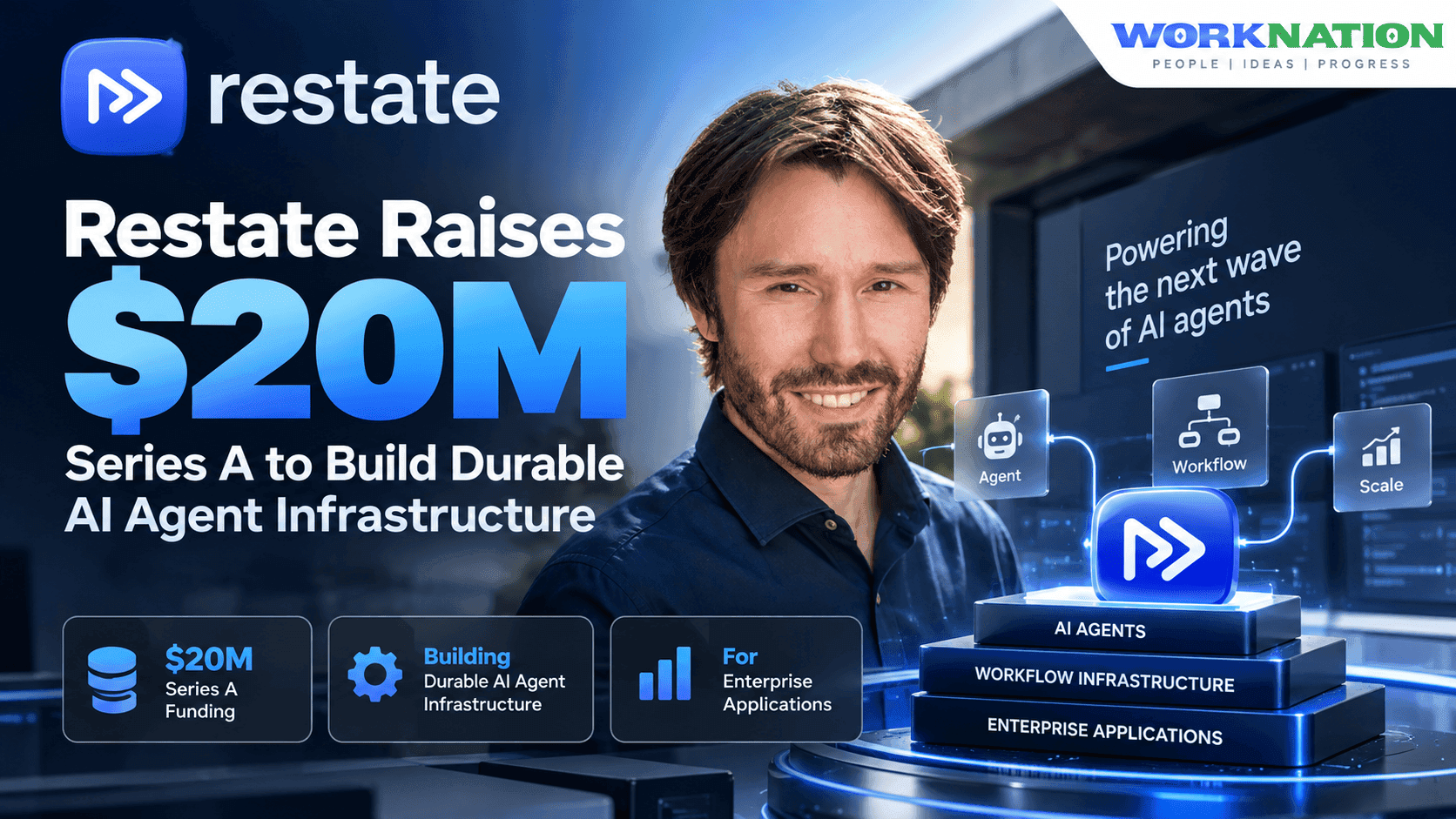
Restate Raises $20M Series A to Build Durable Infrastructure for AI Agents
Top Picks
Submit PR
Stay Ahead of the Market
Get the latest startup funding, hiring trends and global opportunities delivered to your inbox every week.
Restate has raised $20 million in Series A funding to expand its durable workflow infrastructure as AI agents create growing demand for systems that can reliably execute long-running, unpredictable processes.
The Berlin-based startup was founded in 2022 by Stephan Ewen and former colleagues from Data Artisans and Ververica. The company originally set out to build infrastructure capable of making multistep workflows resilient to crashes and network interruptions. As AI agents have become more widely adopted, that technology has found a new use case.
The Series A was led by Singular, with participation from Redpoint Ventures and Capital One Ventures.
Building infrastructure for unreliable workflows
Traditional software workflows can often be restarted when something goes wrong. Agentic workflows can be considerably more complicated.
AI agents may run for longer periods, make decisions dynamically and follow unpredictable paths. A failure halfway through the process can make it difficult to determine exactly what happened or how to safely continue.
Restate's execution engine is designed to make these workflows durable.
The system tracks what happens during execution so that processes can be reproduced and continue consistently even after crashes or network interruptions.
According to CEO and co-founder Stephan Ewen, Restate was not originally designed specifically for AI agents. However, the problems created by agentic systems turned out to closely match the problems Restate was already addressing.
Growing customer demand
The growth of AI agents has become a significant commercial driver for Restate.
Ewen said the company has closed multiple six- and seven-figure customer contracts over the past few months.
The startup has attracted customers including Replit, the AI-powered software development platform, as well as Fortune 500 companies.
Its customer base also includes companies in the financial sector, where reliable execution can be particularly important for complex processes.
While AI companies are an increasingly important market for Restate, the company sees durable workflow infrastructure as relevant to businesses beyond the technology sector.
The fundamental requirement is the same across different use cases: when a process fails midway, the system needs to be able to recover rather than forcing the entire workflow to start again.
Building its own storage infrastructure
Restate is also taking a different architectural approach to durable execution.
Rather than building its execution engine on top of an external database, the company developed its own storage, replication and redundancy layers.
Ewen argues that this architecture allows Restate to remain fast and lightweight.
The company is positioning this efficiency as a differentiator in a market where durable execution infrastructure has historically been associated with heavier workflows.
Restate wants its technology to be suitable for smaller and more frequent processes as well as large, complex workflows.
Competing in a growing infrastructure market
The new funding will put Restate in more direct competition with established durable workflow infrastructure providers such as Temporal.
Temporal announced a $550 million Series E at a $12.55 billion valuation earlier in September 2026, highlighting the increasing investor interest in infrastructure supporting reliable distributed workflows.
Restate is considerably smaller, but the company believes the emergence of AI agents is expanding the overall market for durable execution.
As agents increasingly perform multi-step tasks involving external systems, databases, APIs and business applications, failures can become more costly and difficult to recover from.
A durable execution layer can provide the underlying infrastructure needed to keep these processes running consistently.
Experienced founding team
Restate's founding team brings significant experience in distributed systems and open-source infrastructure.
Ewen previously co-created Apache Flink, an open-source stream-processing framework. He later became CTO of Data Artisans, the company that commercialized Flink.
Alibaba acquired Data Artisans in 2019 and rebranded it as Ververica, where Ewen continued as CTO for three years.
He founded Restate alongside Igal Shilman and Till Rohrmann, former colleagues from Data Artisans and Ververica.
Ahmed Farghal, who previously worked as an engineer at Stripe and Meta, joined as the fourth co-founder during the Series A.
Expanding the team
Restate plans to use the new capital to accelerate its commercial and technical expansion.
The company intends to hire a go-to-market team, add more engineers and expand its presence in the San Francisco Bay Area.
The move is designed to bring Restate closer to existing and potential customers, many of which are located in the region.
The company's longer-term ambition extends well beyond AI-native startups.
Ewen believes durable execution could eventually become a standard component of enterprise infrastructure, similar to databases and other foundational systems.
If AI agents continue moving from experimental tools toward systems that execute important business processes, infrastructure that can guarantee reliable execution could become an increasingly important layer of the enterprise technology stack.
For Restate, the $20 million Series A provides capital to expand that infrastructure while the market around AI agents is still developing.
Have a Funding Round or Exciting Update to Share?
Submit your press release to get featured on WorkNation and reach founders, investors, and tech leaders.