Two Google Alumni Raise $11.3M to Back AI Startups Built for Enterprise Adoption
Top Picks
Submit PR
Stay Ahead of the Market
Get the latest startup funding, hiring trends and global opportunities delivered to your inbox every week.
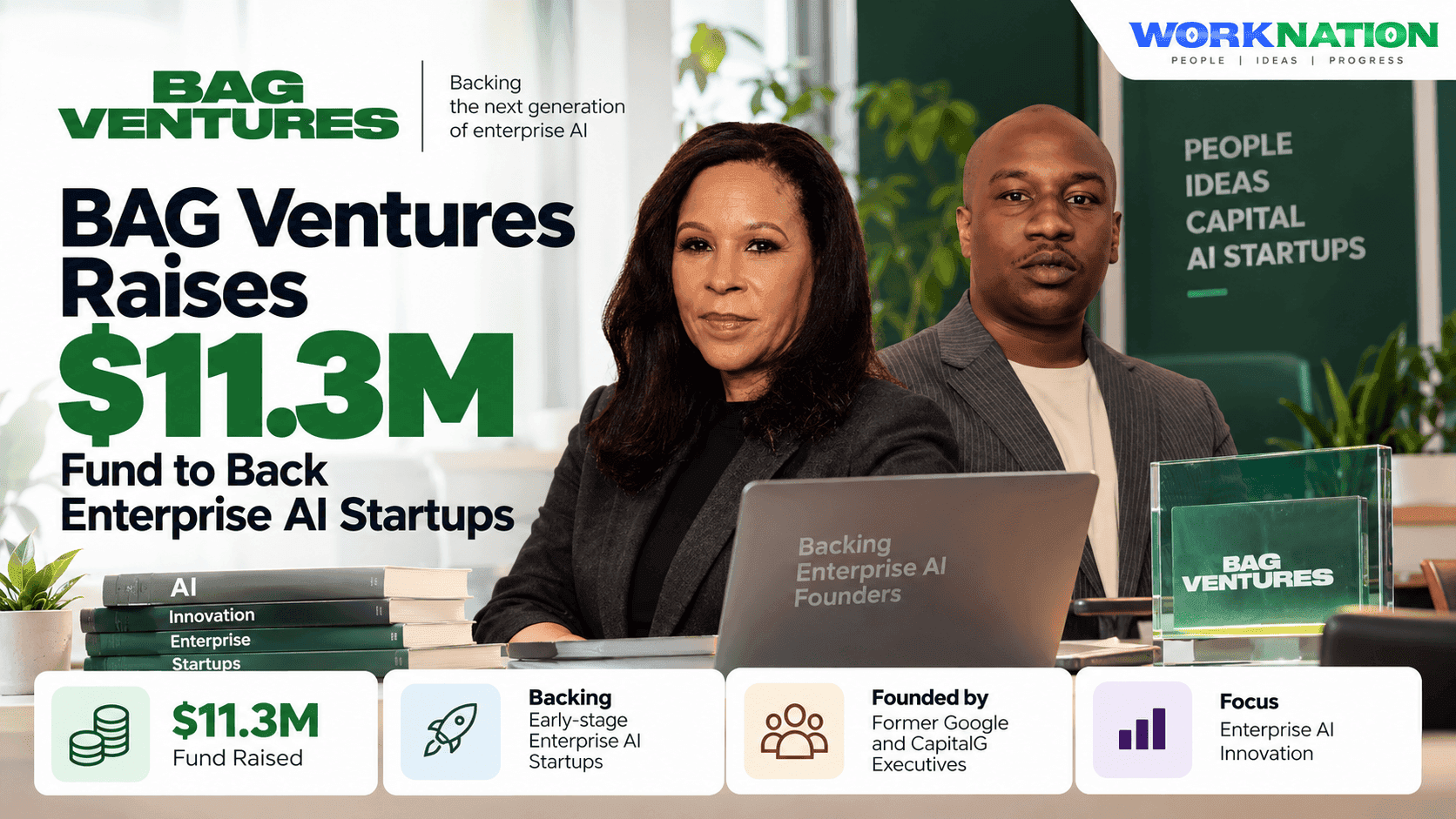
BAG Ventures, an early-stage venture firm founded by two former Google executives, has closed an $11.3 million fund to invest in AI startups building products that enterprises are willing to pay for.
The firm was founded by Bonita Stewart, a former Google vice president, and Jackson Georges Jr., a former CapitalG partner. BAG Ventures has already backed 10 companies, including software company SXD, AI travel agent BizTrip and agentic reasoning platform Nomadic.
The fund was assembled over roughly two years while the firm was already making investments.
Backing AI beyond experimentation
BAG Ventures is investing across several areas of the AI ecosystem, including AI infrastructure, compute, physical and edge AI, security, governance and vertical SaaS.
Its check sizes range from $100,000 to $500,000, with the firm planning to deploy the remaining capital over the next two years.
The firm's investment thesis is centered on a change in how enterprises evaluate AI products.
Jackson Georges argues that enterprises are moving away from open-ended experimentation and becoming increasingly focused on unit economics and measurable outcomes.
Instead of simply paying for general-purpose AI tools, enterprises are increasingly looking for products that can integrate deeply into existing workflows and execute specific business tasks.
Examples cited by Georges include automated code reviews and legal-document processing.
Founders with enterprise access
Stewart and Georges believe their advantage comes from their network of operators and enterprise decision-makers.
The pair launched BAG Ventures to address what Georges describes as an emerging gap between AI founders and the enterprise organizations they want to sell to.
The firm's model combines capital with introductions to potential customers and go-to-market guidance.
BAG Ventures' limited partners include Google and operators from companies such as NVIDIA, Amazon and Snowflake. The firm has more than 150 limited partners across a range of companies.
Stewart spent 17 years at Google, including nearly a decade as a vice president. She also served on the board of Gradient Ventures, Google's early-stage AI fund.
She is also a limited partner in Female Founders Fund and Operator Collective.
Georges previously worked at GE Healthcare and Google before becoming a partner at CapitalG, Alphabet's growth fund. He met Stewart during his time at Google, and the pair also co-led the BAG Collective angel syndicate, which has more than 450 members.
What BAG Ventures wants to fund
The firm is looking for technical teams that have already worked together, have a minimum viable product and at least one partner.
It also wants startups with a clear path toward monetization within 24 months.
A major part of the thesis is building products that go deeper than simply providing another interface to a frontier AI model.
Georges argues that startups built primarily as thin layers around frontier model APIs could face significant pressure as major AI labs continue launching their own products.
Instead, BAG Ventures is looking for companies that become deeply embedded in enterprise workflows and accumulate proprietary data that cannot easily be replicated or scraped.
The goal is to back businesses that own what Georges calls the "intent layer" while developing enough customer integration and lock-in to remain valuable as underlying AI models evolve.
AI security and agent infrastructure
BAG Ventures is also looking closely at security and governance for enterprise AI deployments.
The firm expects highly regulated industries to create demand for specialized AI infrastructure because companies need to manage data privacy, internal data flows, acceptable-use policies and automated security testing.
Georges cited portfolio company Defendermate as an example of this opportunity.
Another area of interest is infrastructure for AI agents.
As enterprises deploy more non-human workers, BAG Ventures expects companies will need new identity and access-management systems designed specifically for AI agents.
That could include technologies for establishing which AI agent is acting, what it is authorized to access and which actions it can perform.
From software seats to business outcomes
One of the firm's broader predictions is that enterprise software purchasing could change as agentic AI becomes more capable.
Instead of paying for software based primarily on the number of users or seats, Georges expects businesses could increasingly pay for completed jobs and measurable outcomes produced through multi-agent workflows.
That could shift the economics of enterprise software and create opportunities for startups that can directly execute work rather than simply provide another interface for employees.
For BAG Ventures, the $11.3 million fund represents a focused bet on this transition.
With its combination of former Google and CapitalG leadership, a network of more than 150 limited partners and an existing portfolio of 10 companies, the firm is positioning itself around AI startups that can move beyond experimentation and demonstrate a clear path to enterprise revenue.
Have a Funding Round or Exciting Update to Share?
Submit your press release to get featured on WorkNation and reach founders, investors, and tech leaders.