CScale Emerges From Stealth With $145M Series C to Build Reliable Optical AI Interconnects
Top Picks
Submit PR
Stay Ahead of the Market
Get the latest startup funding, hiring trends and global opportunities delivered to your inbox every week.
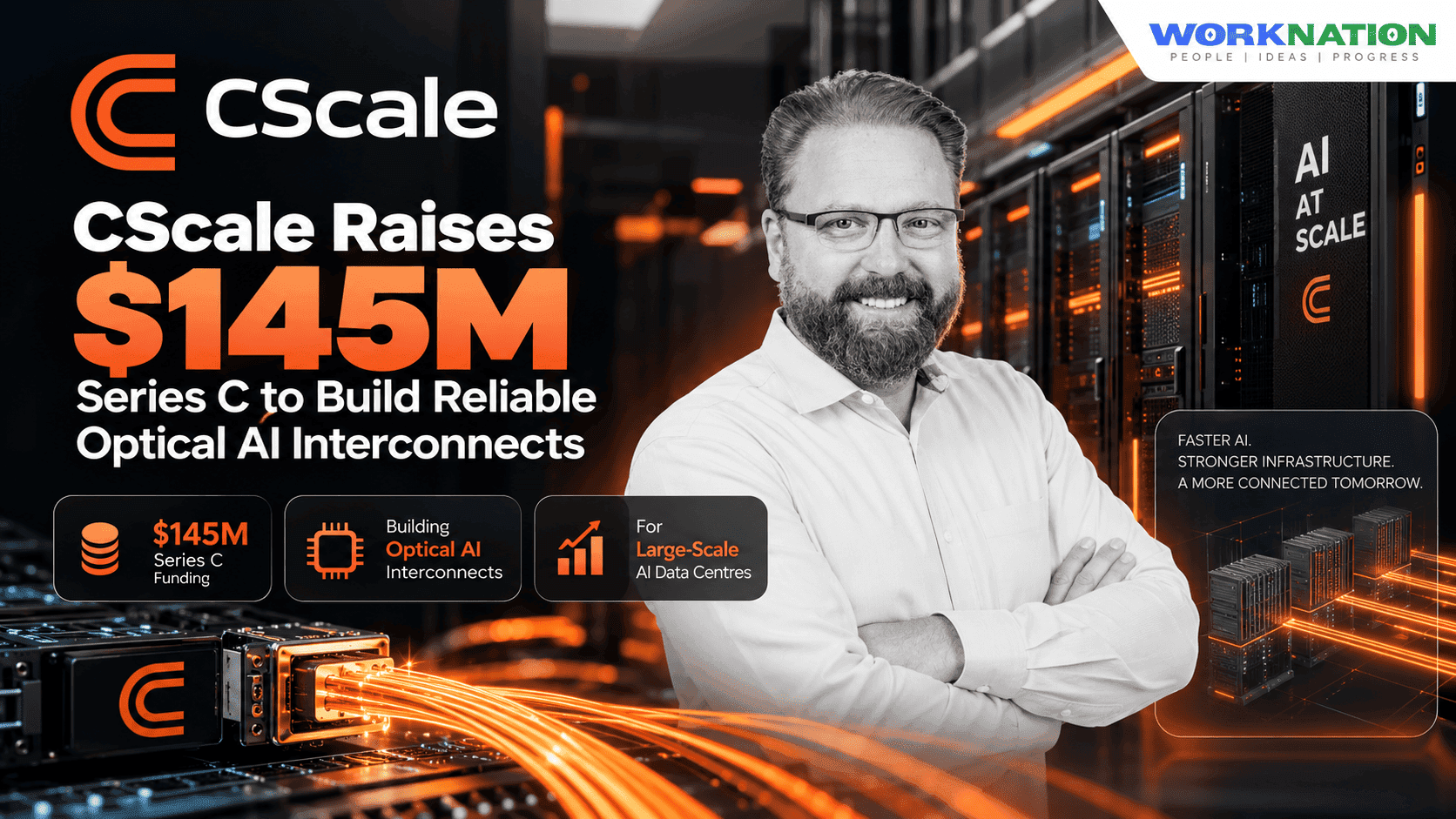
CScale has emerged from stealth with $145 million in Series C funding to develop optical interconnect technology designed to keep large-scale AI computing systems running even when individual optical components fail.
The Palo Alto-based startup, founded in 2023, is focused on one of the increasingly important challenges in AI infrastructure: moving massive amounts of data between accelerators with high bandwidth and extremely low latency while maintaining system reliability.
The Series C round was led by Atreides Management and Valor Equity Partners, with Premji Invest joining as a co-lead. Existing investors Sutter Hill Ventures and Maverick Silicon also participated, while NVIDIA and Intel Capital joined as CScale's first strategic investors.
The latest round brings CScale's total funding to $188 million.
Building optical connectivity for AI clusters
As AI models become larger, the infrastructure required to train and run them is becoming increasingly distributed. Modern AI systems rely on large numbers of accelerators working together, creating enormous demands for communication between chips.
CScale is targeting the scale-up layer of AI infrastructure - the high-bandwidth, ultra-low-latency connections that allow multiple accelerators to operate together as a much larger computing system.
The company argues that this challenge becomes particularly significant as data centres move toward gigawatt-scale deployments.
In these environments, thousands of accelerators can be distributed across dozens of racks. While a failure on an individual optical link may appear unlikely, the sheer number of connections means that even low-probability failures can become recurring events across an entire computing fleet.
CScale is developing an integrated light engine for optical connectivity that is designed to contain failures rather than allowing them to interrupt larger workloads.
The company's approach is focused not simply on replacing failed components, but on maintaining continuity of computation when optical components fail.
"Lasers will fail. Compute shouldn't."
CScale CEO Martin Lund described the company's philosophy around reliability as AI scale-up infrastructure expands.
"As AI scale-up domains extend across dozens of racks, optical interconnect becomes essential," Lund said. "At that scale, reliable, predictable communication is fundamental to system economics."
Lund added that easier component replacement can improve serviceability, but does not necessarily guarantee continuity of computation.
The company is therefore designing its optical interconnect technology around continuity, with the assumption that failures will eventually occur in extremely large deployments.
Experienced leadership
CScale is led by Martin Lund, who brings around three decades of experience across silicon and networking.
Lund previously built Broadcom's switching business into a billion-dollar franchise and held senior executive positions at Microsoft and Cadence. More recently, he led Cisco's Common Hardware Group, where he oversaw silicon, hardware systems and optics, including Silicon One.
The company's CTO and founder is Sanjai Kohli.
Kohli co-founded SiRF, a company that helped bring GPS technology to mass-market devices and received the 2010 European Inventor Award. He later founded Inovi, which was acquired by Facebook in 2014.
Together, the leadership team brings experience spanning networking, silicon, hardware, optics and semiconductor technology.
Strategic investors join the round
The Series C also brings strategic backing from two major semiconductor companies.
NVIDIA and Intel Capital joined CScale as its first strategic investors, alongside financial investors including Atreides Management, Valor Equity Partners and Premji Invest.
Atreides Managing Partner and Chief Investment Officer Gavin Baker described AI infrastructure as increasingly becoming a systems challenge rather than simply a compute challenge.
According to Baker, as AI scale-up systems approach gigawatt-class deployments, interconnect bandwidth needs to be matched with reliability. The investment thesis centers on ensuring that optical failures do not translate directly into compute failures.
Premji Invest Managing Partner Sandesh Patnam also highlighted the company's ambition to build infrastructure designed for the next generation of AI systems.
A competitive optical interconnect market
CScale is entering a market that has attracted significant investment as AI infrastructure companies attempt to solve the growing data-movement bottleneck.
Other companies are also developing optical and photonic technologies for AI data centres.
Celestial AI, for example, has developed its Photonic Fabric platform to address limitations associated with traditional copper-based connectivity. The company later agreed to be acquired by Marvell for $2.35 billion.
Lightmatter has also raised substantial capital for photonic computing and interconnect technologies. Its $400 million funding round valued the company at $4.4 billion and brought its total funding to $850 million.
Eliyan has also raised $145 million in Series C funding while working on electro-optical interconnects for next-generation AI systems.
CScale's approach focuses specifically on reliability as optical networks expand across increasingly large AI clusters.
Why optical reliability matters
Optical connectivity is becoming increasingly important as AI computing systems scale.
Traditional electrical connections face challenges around bandwidth, power consumption and physical distances as more accelerators are connected together. Optical links can provide the bandwidth required for large-scale data movement, but they also introduce new components and potential points of failure.
For CScale, the goal is to make optical connectivity more resilient at the system level.
Its technology is being developed for environments where thousands of accelerators may need to communicate continuously. At that scale, maintaining computation during component failures could become an important part of overall data-centre economics and operational reliability.
The company plans to use its new capital to continue developing and commercialising its optical interconnect platform.
With $188 million raised to date and strategic participation from NVIDIA and Intel Capital, CScale is now moving from stealth development toward commercialisation in a market increasingly shaped by the infrastructure demands of large AI systems.
Have a Funding Round or Exciting Update to Share?
Submit your press release to get featured on WorkNation and reach founders, investors, and tech leaders.