Mecka AI Raises $60M from Sequoia and NVIDIA to Train Humanoid Robots
Top Picks
Submit PR
Stay Ahead of the Market
Get the latest startup funding, hiring trends and global opportunities delivered to your inbox every week.
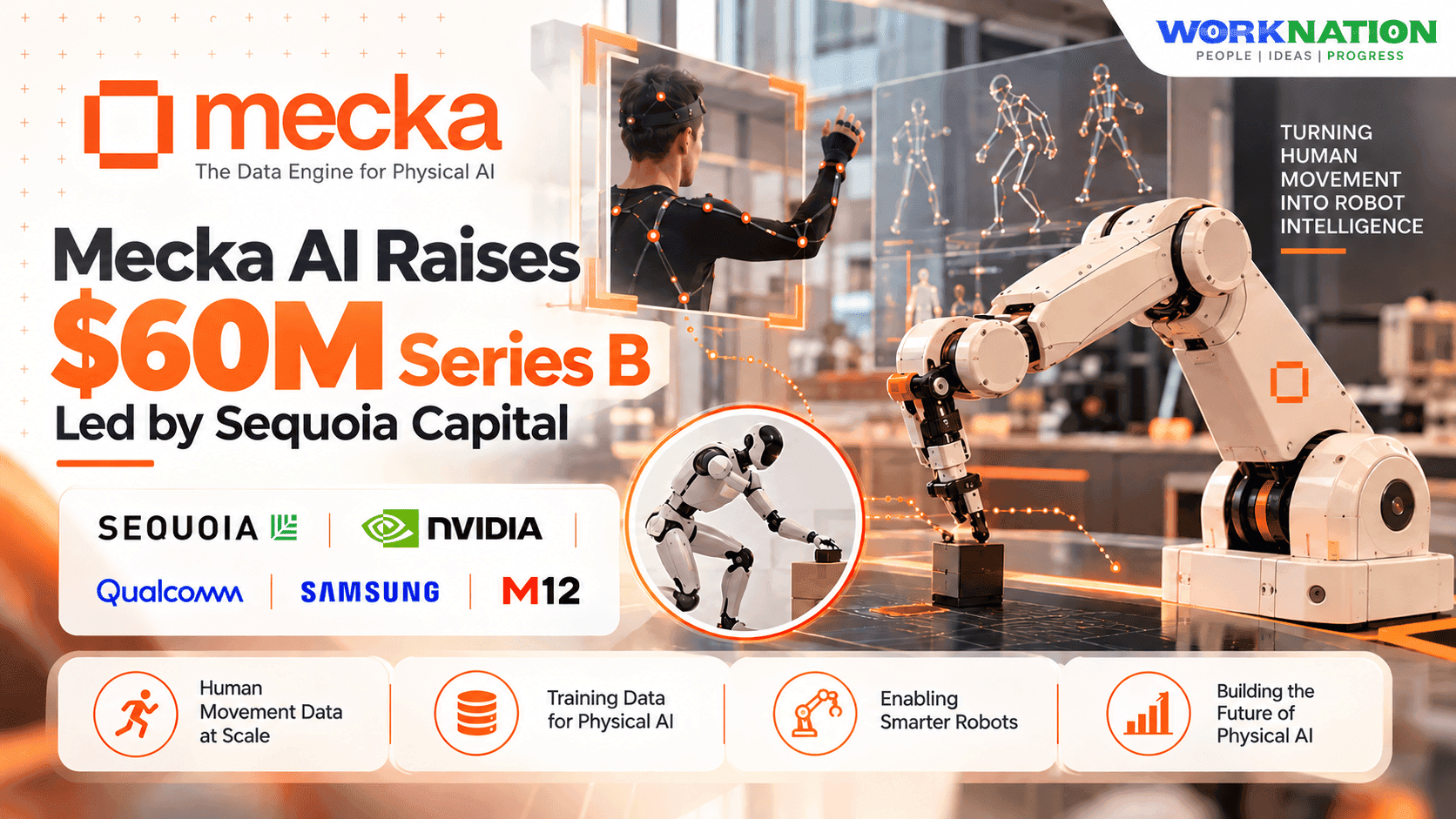
Mecka AI, a robotics data startup operating in Toronto and New York, has raised $60 million in Series B funding led by Sequoia Capital to help humanoid robots learn how humans move and perform everyday tasks.
The round includes new investors NVIDIA, Qualcomm Ventures, Samsung and M12, Microsoft's venture capital fund. Existing investors Kindred, Framework Ventures and Neo also participated. The company additionally counts DoorDash CEO Tony Xu, former ServiceNow and Snowflake CEO Frank Slootman, and former Tesla Optimus robotics programme leader Milan Kovac among its angel investors.
The latest funding brings Mecka AI's total capital raised to more than $120 million, including a $60 million Series A and an $8 million seed round.
Founded by Josh Gao, Jason Chong, Mogen Cheng and Duy Nguyen, the company pays people to record everyday activities using smartphones, body sensors and specialised capture equipment. It converts these recordings into structured motion data that robotics developers can use to train AI systems.
Paying people to teach robots
Humanoid robots need more than powerful hardware and advanced AI models to perform tasks in the physical world. They also need data showing how people move, manipulate objects and interact with their surroundings.
Mecka AI is building a business around collecting that data.
Its contributors record activities such as folding laundry, preparing coffee and repairing vehicles while wearing sensors and using capture equipment. The resulting footage is processed in the company's research laboratory to create structured datasets covering human motion, three-dimensional reconstruction and sensor alignment.
Rather than selling robots themselves, Mecka sells the data that robot developers can use to improve their systems.
This approach targets a growing challenge in robotics: collecting enough high-quality real-world examples for machines to learn complex physical tasks.
From human movement to robotic training data
Mecka's process begins with people performing ordinary activities. The company then uses its own hardware and data-processing systems to turn the recordings into information that robotics developers can use.
The startup claims its hand-pose tracking can achieve accuracy within one centimetre, including for data captured outside its laboratory.
It also operates as a robotics integrator. Beyond collecting data, Mecka can install hardware at customer sites, capture additional information, retrain models and support the deployed systems.
This gives the company a role across several parts of the robotics development process, from collecting training examples to helping customers use the resulting models.
The approach differs from teleoperation, in which people remotely control robots to generate training data. Mecka's human-data collection model instead focuses on recording how people perform tasks directly.
Both approaches aim to help robots learn physical activities, but they produce data in different ways.
Sequoia and NVIDIA back the $60M round
Sequoia Capital led Mecka AI's $60 million Series B.
NVIDIA, Qualcomm Ventures, Samsung and M12 joined as new investors, while Kindred, Framework Ventures and Neo returned for the latest round.
The company also has prominent individual backers, including Tony Xu, Frank Slootman and Milan Kovac.
The participation of NVIDIA and Qualcomm Ventures is notable given their involvement in the broader AI and computing industries. Samsung also has significant interests in hardware and technology, while Microsoft's M12 invests in technology startups.
The funding gives Mecka additional capital to expand its data infrastructure, strengthen its research laboratory and increase commercial robotics deployments.
The company is also hiring across research, hardware and operations.
$100M revenue run rate, according to the company
Mecka says it surpassed a $100 million annualised revenue run rate in June 2026 and projects that figure could reach $300 million by the end of the year.
A revenue run rate annualises recent revenue to estimate what a company might generate over a full year. It is not the same as audited annual revenue.
The company has not named its customers, but says it supplies several leading robotics laboratories and multiple companies in the Magnificent Seven group of major US technology firms.
Its reported growth comes as robotics developers compete to build AI systems capable of carrying out increasingly complex physical tasks.
The startup's valuation remains unconfirmed. TechCrunch reported in September, citing people familiar with the deal, that the Series B could value Mecka at approximately $500 million. Neither figure was confirmed in the company's funding announcement.
The difference between reported commercial growth and independently verified financial performance is important when evaluating the company's progress.
A crowded market for physical AI data
Mecka is entering a competitive market where startups are pursuing different approaches to supplying data for robotics and physical AI.
XDOF, for example, combines remote robot operation with human data collection. It emerged from stealth in June 2026 with a $70 million Series A and has reportedly been discussing a new round at a valuation of approximately $1.2 billion.
Micro1, which began as an AI recruiting business, has also moved into collecting and annotating video data involving robots. According to reporting cited by Tech Funding News, it pays contributors to annotate footage of robots performing tasks.
Encord takes a different approach, providing software to manage and label AI training data rather than focusing on collecting the raw physical data itself. The company raised a $60 million Series C led by Wellington Management and reported strong growth in revenue from physical AI customers.
These businesses illustrate that the market is developing across several layers: data collection, annotation, infrastructure and model training.
Mecka's strategy centres on capturing human movement and turning it into structured data for robotics developers.
Why investors are watching humanoid robotics
Interest in physical AI has grown as developers work to bring AI capabilities into machines that operate in the real world.
Humanoid robots could eventually perform tasks across manufacturing, logistics, maintenance and other settings. However, enabling them to work reliably requires advances in hardware, perception, movement and decision-making.
Training data is one part of that challenge.
NVIDIA's investment in Mecka also reflects its broader involvement in robotics. The company has backed robotics businesses, including NEURA Robotics, while Sequoia has invested in Physical Intelligence, which develops AI models for robots.
The opportunity is substantial, but the industry still faces questions about how effectively different kinds of data translate into better robotic performance.
What the $60M will fund
Mecka plans to use the new capital to scale its data infrastructure, expand its research laboratory and support more commercial robot deployments.
The company is also recruiting across research, hardware and operations as it expands its activities.
Its next challenge is to demonstrate that data captured from human bodies consistently improves the performance of robotic systems and that customers continue paying for the resulting datasets.
The reported revenue figures suggest strong demand, but the company has not publicly identified its customers or independently confirmed the claimed run rate in the supplied report.
For Mecka, the next stage is about proving that its data collection model can scale into a durable business while delivering measurable improvements for robot developers.
Have a Funding Round or Exciting Update to Share?
Submit your press release to get featured on WorkNation and reach founders, investors, and tech leaders.