Neela Biotech Raises £2.1M to Turn Organic Waste into Sustainable Aviation Fuel
Top Picks
Submit PR
Stay Ahead of the Market
Get the latest startup funding, hiring trends and global opportunities delivered to your inbox every week.
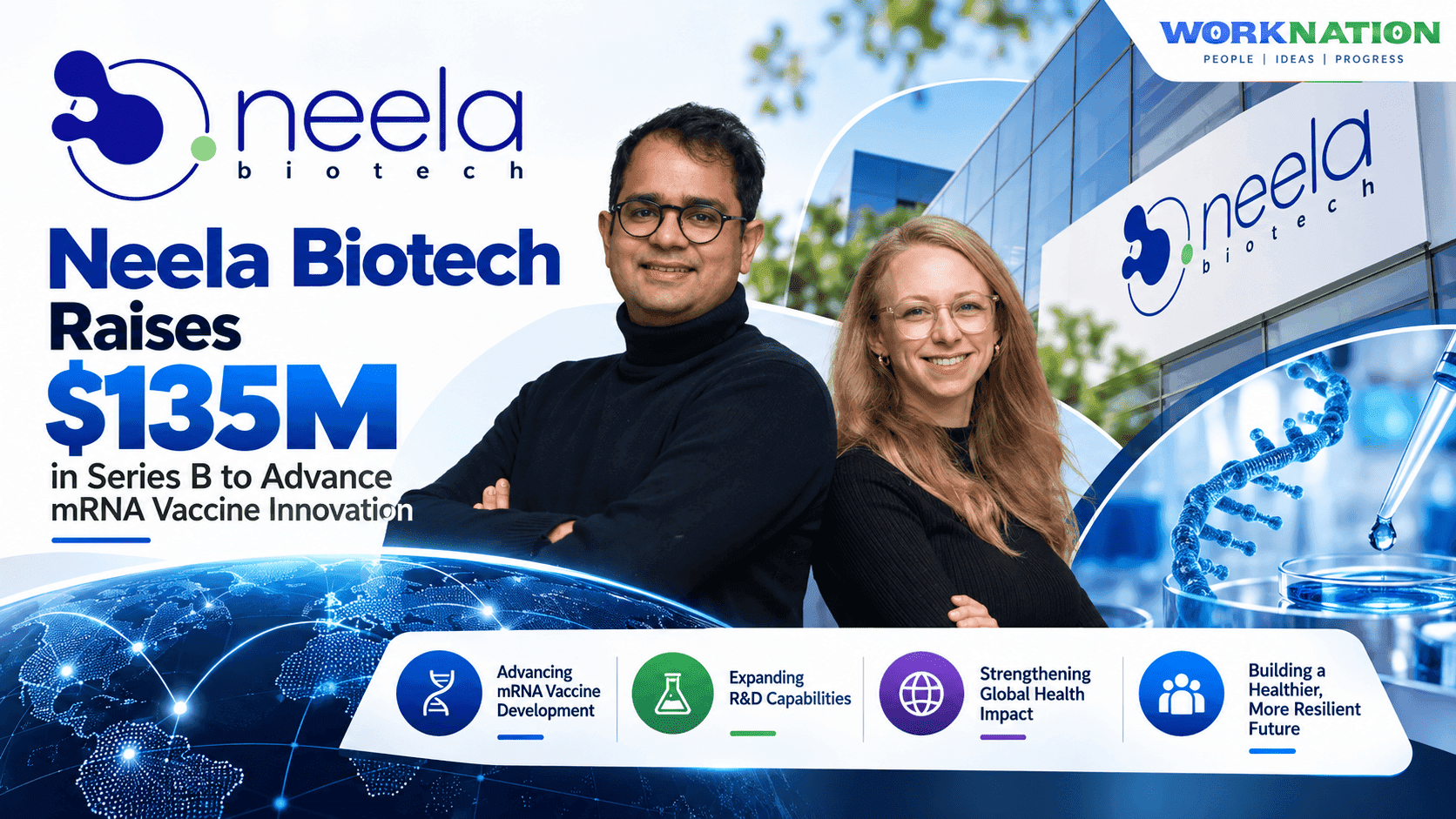
Neela Biotech, a Cambridge-based climate technology startup, has raised £2.1 million in pre-seed funding to develop an AI-powered biological process that could turn food, agricultural and forestry waste into sustainable aviation fuel (SAF).
The funding round was led by climate investor Elbow Beach, which contributed £1.5 million. Other participants included Ascension, Cambridge Enterprise, Ventures Together and strategic angel investors.
Founded in 2025 by Deepanshu Singh and Friederike Nintzel, Neela Biotech plans to use the capital to move its technology from laboratory development to a pilot-scale trial at an existing biogas plant over the next two years.
The company's approach targets a major challenge facing the aviation industry: the limited supply of sustainable feedstocks available for producing lower-carbon jet fuel.
Why sustainable aviation fuel needs new feedstocks
Most sustainable aviation fuel currently comes from waste cooking oil and animal fats. These materials can be processed into fuel using a pathway known as hydroprocessed esters and fatty acids, or HEFA.
However, the supply of suitable waste oils and fats is limited compared with the aviation industry's fuel requirements.
The International Air Transport Association (IATA) expects global SAF production to reach approximately 2.4 million tonnes in 2026, equivalent to just 0.8% of aviation fuel consumption.
The industry faces a much larger challenge in the decades ahead. IATA's net-zero roadmap calls for sustainable aviation fuel production to reach around 500 million tonnes annually by 2050.
Government policies are also increasing demand. The UK's sustainable aviation fuel mandate requires SAF to account for 2% of jet fuel demand in 2025, rising to 10% in 2030 and 22% in 2040.
Meeting these targets will require additional production capacity and alternative feedstocks beyond waste oils and fats.
Neela Biotech is developing a biological route that could make use of a broader range of organic waste, including material from food production, agriculture and forestry.
How Neela Biotech combines AI and microbes
Neela's technology combines AI-guided microbes with anaerobic digestion, a process already used in biogas plants to break down organic waste.
The startup aims to use this biological approach to produce fatty acids that can serve as inputs for sustainable aviation fuel production.
Its proposed system is designed to operate at existing biogas facilities rather than requiring entirely new industrial plants.
That distinction could be important for capital costs. Building new fuel-production infrastructure can require substantial investment before a company has demonstrated that its process works at commercial scale.
By using existing biogas infrastructure, Neela hopes to reduce the capital expenditure required to develop its technology.
The company also says its biological process uses less energy than the thermochemical methods commonly used in sustainable fuel production.
However, the technology remains at an early stage. Neela has not yet conducted its planned pilot trial, and the company has not disclosed a production cost per tonne for the fatty acids it intends to produce.
Demonstrating reliable production and competitive costs will therefore be central to its next phase.
Why existing biogas plants could matter
Neela's strategy is built around infrastructure that already exists across Europe.
Biogas plants process organic material to generate biogas, but Neela believes these facilities could also support a pathway to higher-value products for the aviation fuel supply chain.
For plant operators, the approach could potentially create an additional revenue stream from existing assets.
The company also argues that its technology could help UK biogas operators facing financial pressure as government subsidies run out. That is a potential commercial benefit, although its scale will depend on the technology's performance and economics.
For Neela, the model could reduce the need to finance a completely new industrial facility for every deployment.
But existing infrastructure alone will not guarantee commercial success. The startup still needs to demonstrate that its biological process can operate reliably at pilot scale and produce suitable outputs at a competitive cost.
The economics of sustainable aviation fuel
The cost of sustainable aviation fuel remains a major obstacle to wider adoption.
According to Neela, HEFA-based SAF costs around 1.5 times as much as conventional jet fuel, while e-SAF made using renewable electricity can cost up to 10 times more.
These figures highlight the economic challenge facing alternative fuel technologies. Airlines need lower-carbon fuel options, but producers must also find ways to make them commercially viable.
Fuel prices and supply security add to the pressure. IATA forecast in June 2026 that jet fuel would average $152 per barrel during the year, nearly 70% above 2025 levels. It also projected that the global airline industry's fuel bill could reach approximately $350 billion.
Neela believes its low-energy process and use of existing facilities could offer a route toward cost parity with fossil-based jet fuel at scale.
That remains a company ambition rather than a demonstrated commercial result. The planned pilot should help establish whether the technology can deliver the expected performance and economics.
Investors back Neela's route to pilot scale
Elbow Beach led the £2.1 million round with a £1.5 million investment. Ascension, Cambridge Enterprise, Ventures Together and strategic angel investors also participated.
Jonathan Pollock, CEO of Elbow Beach, highlighted the startup's use of existing infrastructure and its potential to reduce the capital costs associated with developing sustainable aviation fuel technology.
The investment will support Neela's transition from laboratory work to a pilot-scale trial over approximately two years.
That transition is a critical milestone for early-stage climate technology companies. Laboratory results must eventually translate into reliable industrial performance, repeatable production and a credible business model.
For Neela, the pilot will need to show that its AI-guided biological process can produce useful outputs consistently under real operating conditions.
Neela enters a competitive sustainable fuel market
Neela is entering a growing field of companies developing alternative routes to sustainable aviation fuel.
Oxford University spinout OXCCU raised £20.75 million in Series B funding in 2025 to scale a process that converts waste gases into jet-fuel-range hydrocarbons.
Zurich-based Metafuels raised $24 million in February 2026 to develop its methanol-to-jet technology for e-SAF production.
Barcelona-based WtEnergy raised €10 million in February 2026 to expand gasification technology that produces synthesis gas for applications including sustainable aviation fuel.
These companies are pursuing different technical pathways, from waste-gas conversion and methanol-based fuels to gasification. Neela's approach stands out for its focus on biological processing at existing biogas plants.
The technologies are not directly interchangeable, and their commercial prospects will depend on factors such as feedstock availability, energy consumption, production costs and the ability to scale.
Neela's use of existing infrastructure could help reduce capital requirements, but only if its planned pilot demonstrates that the process works as intended.
The next milestone is a working pilot
Neela Biotech has raised £2.1 million to move its technology closer to industrial use. Over the next two years, it aims to demonstrate the process at a pilot-scale trial hosted by a biogas plant.
The key questions are whether the technology can produce fatty acids reliably, how much energy the process consumes and what each tonne of output will cost.
Those figures will help determine whether the company can compete with existing SAF pathways and whether biogas operators have a strong commercial reason to adopt the system.
The aviation industry needs additional sustainable fuel supplies, but scaling a new technology requires more than an attractive concept. It requires proof of performance and competitive economics.
For Neela, the pilot will be the first major test of whether AI-guided microbes and existing biogas infrastructure can become part of the sustainable aviation fuel supply chain.
Have a Funding Round or Exciting Update to Share?
Submit your press release to get featured on WorkNation and reach founders, investors, and tech leaders.