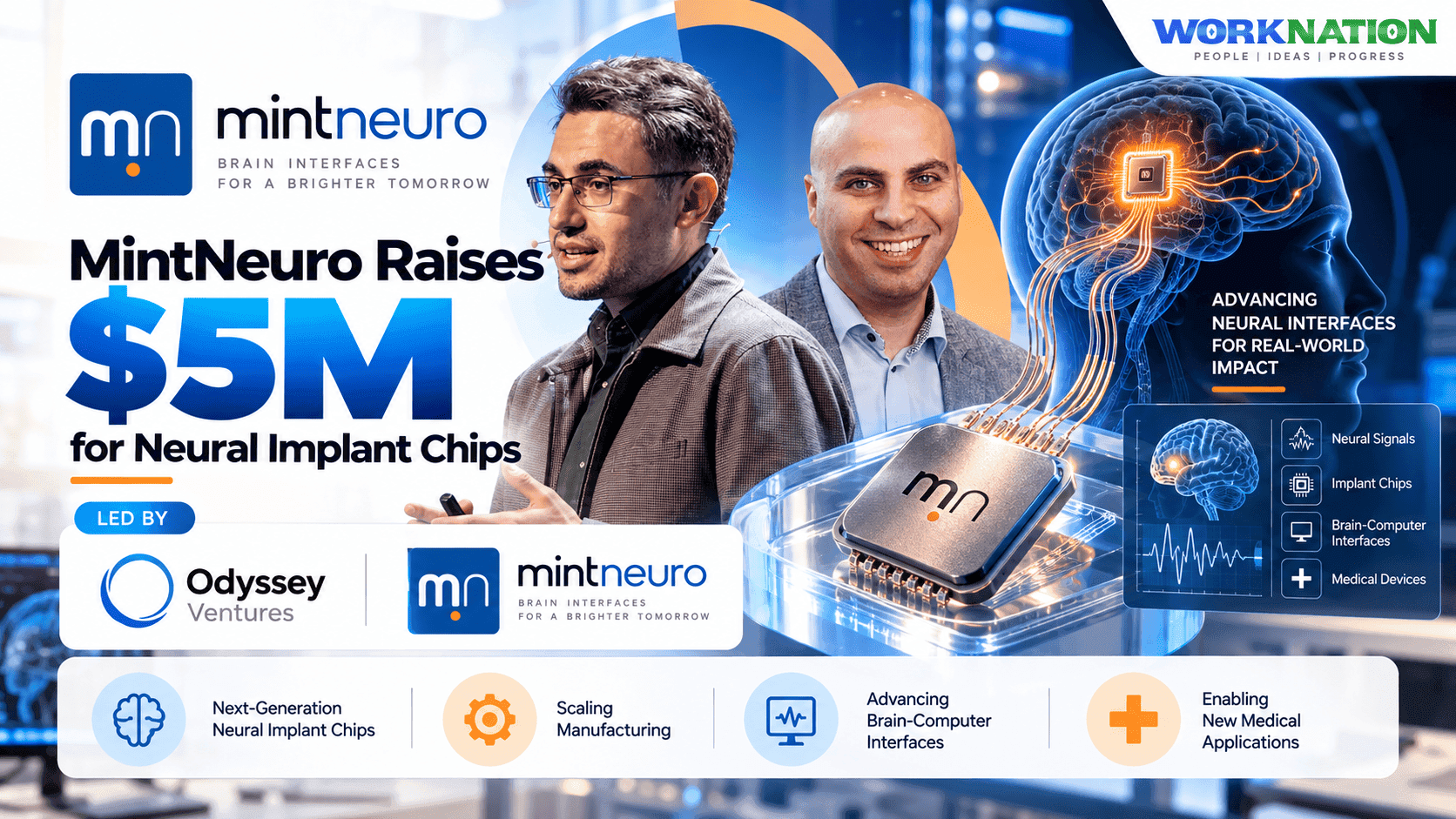
MintNeuro Raises $5M to Develop Chips for Brain-Computer Interfaces
Top Picks
Submit PR
Stay Ahead of the Market
Get the latest startup funding, hiring trends and global opportunities delivered to your inbox every week.
London-based MintNeuro has raised $5 million to scale its specialised semiconductor technology for neural implants, brain-computer interfaces and other devices that connect with the human nervous system.
The funding round was led by Odyssey Ventures, with participation from 33East, JSK Investments and Alumni Ventures. Existing investors Empirical Ventures, Jumpspace Ventures and other early backers also participated. The investment will help MintNeuro accelerate product launches, deliver more chips to development partners and expand its presence in the United States.
Building chips for the next generation of neural devices
Founded in 2022 as a spinout from Imperial College London, MintNeuro develops semiconductor technology designed specifically for neural devices, including implants and wearable electronics.
The company was co-founded by Dr Dorian Haci and Professor Tim Constandinou. Haci serves as CEO, while Constandinou brings expertise in bioelectronics and neural engineering. Professor Andrew Jackson is also a co-founder, and Professor Tim Denison serves as chair.
MintNeuro's technology focuses on three key functions: detecting neural signals, processing that information and delivering electrical stimulation. Combining these capabilities into specialised chips could help developers build smaller, lower-power devices without having to design a new semiconductor for every product.
Why specialised hardware matters
Companies developing neural devices often face a difficult choice. They can adapt general-purpose components that may not meet the strict requirements of devices operating inside the human body, or invest significant time and money in custom chip development.
MintNeuro aims to provide a third option through a modular semiconductor platform designed for the size, power consumption, safety and signal-quality demands of neural technology.
These chips could support devices being developed for conditions such as epilepsy, Parkinson's disease and treatment-resistant depression, alongside technologies designed to restore sensory functions. The potential applications extend across brain-computer interfaces, neuromodulation systems, sensory prostheses and bioelectronic medicine.
However, the technology's potential should not be confused with proven clinical outcomes. The funding announcement concerns the commercial development of the underlying chip platform, not regulatory approval of every medical device that could use it.
Working chips and commercial partnerships
MintNeuro has progressed beyond research-stage development, with working silicon and integration milestones achieved alongside partners including Motif Neurotech and Amber Therapeutics.
One notable development is its multi-year commercial chip supply agreement with Motif Neurotech. The partnership supports Motif's work on a minimally invasive neurostimulator initially targeting treatment-resistant depression. The agreement gives MintNeuro a route to supply its technology into a specific device-development programme rather than relying solely on potential future customers.
The latest funding will help the company deliver more pre-production chips, support partners as they integrate the technology and expand its engineering and commercial teams.
Investors back international expansion
Odyssey Ventures led the $5 million round. Michelle Robson, a founding partner at the firm, said neural devices represent a significant opportunity, while specialised hardware remains a key challenge for companies seeking to bring these technologies to market.
The round also brings together investors with experience across deep technology, healthcare and early-stage businesses. MintNeuro plans to use the additional capital to strengthen its US presence while continuing to operate from its UK and European base.
For the company, the next stage is to move from demonstrating its technology to wider commercial adoption. That means launching products, supporting more development programmes and helping device makers incorporate its chips into their systems.
MintNeuro's progress will depend on how successfully it converts its existing technical milestones and partnerships into repeatable commercial demand. If it succeeds, its semiconductor platform could become a useful building block for companies developing the next generation of neural devices.
Have a Funding Round or Exciting Update to Share?
Submit your press release to get featured on WorkNation and reach founders, investors, and tech leaders.