OllyGarden Raises $4M to Cut Waste in Software Telemetry
Top Picks
Submit PR
Stay Ahead of the Market
Get the latest startup funding, hiring trends and global opportunities delivered to your inbox every week.
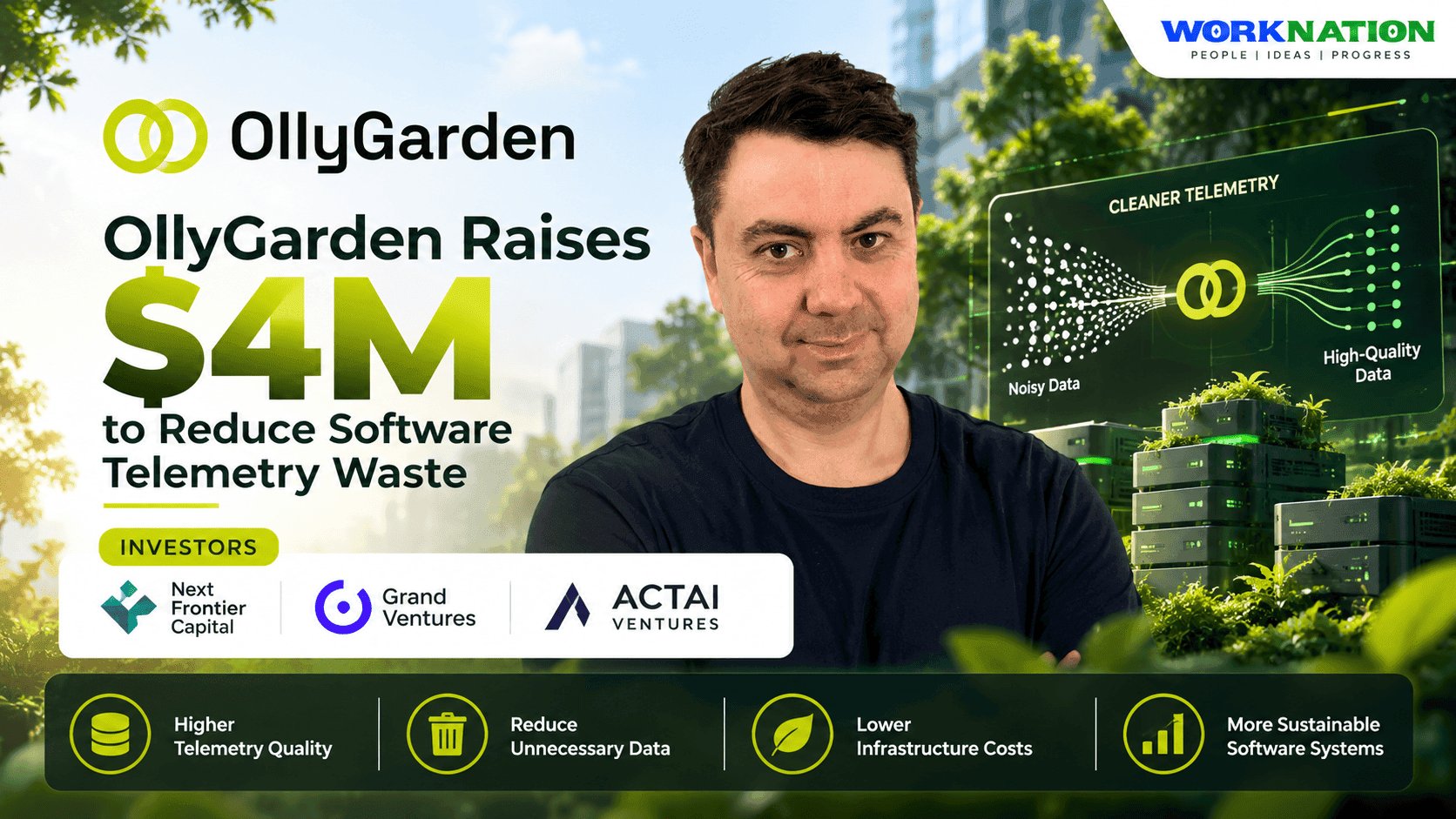
OllyGarden, a Berlin-based startup focused on improving software telemetry quality, has raised $4 million to help companies reduce unnecessary data generated by their software systems. The round brings the company's total funding to approximately $5.6 million and includes continued support from investors with direct ties to the observability industry.
The latest funding was provided by Next Frontier Capital, Grand Ventures, and ACTAI Ventures. London-based DIG Ventures also participated again. Datadog, Grafana Labs, and Dash0, which offer platforms for collecting, storing, and analysing software telemetry, have also invested in OllyGarden.
Founded in 2025, the company has a team of 10 employees. Its central idea is straightforward: companies should not have to pay to store and analyse vast amounts of telemetry data that is noisy, redundant, or poorly instrumented.
Why software telemetry is becoming expensive
Modern software systems generate enormous quantities of operational data. Telemetry typically includes logs, metrics, and traces that help engineering teams understand application performance, diagnose failures, monitor infrastructure, and investigate incidents.
Observability platforms use this data to help engineers determine what is happening inside complex software environments. As applications become more distributed and systems grow more complicated, collecting and analysing telemetry has become an important part of operating software reliably.
However, the volume of information can create its own problem. Poorly configured instrumentation may generate repetitive logs, irrelevant measurements, and traces that provide little value during troubleshooting. Organisations may end up paying to ingest, store, process, and search information they rarely use.
AI-generated code is adding another layer to the problem. As developers use AI coding tools to produce more software, the amount of instrumentation and operational data can also increase. If telemetry quality does not improve alongside code generation, the resulting data volume can raise costs without providing proportional benefits.
OllyGarden co-founder and CEO Juraci Paixão Kröhling argues that the industry cannot keep increasing observability spending simply because more code is being written. The company wants to help organisations control data volume at its source instead of relying only on downstream filtering.
Fixing telemetry before it reaches observability platforms
OllyGarden's approach focuses on the quality of instrumentation itself.
Traditional observability providers offer mechanisms for filtering, processing, and managing incoming telemetry. OllyGarden aims to identify problems earlier, examining how software is instrumented and correcting the underlying issues that produce low-quality data.
This distinction matters because filtering unnecessary information after it has already been generated or ingested may not eliminate every associated cost. Improving instrumentation at source can prevent some of that data from being produced in the first place.
Kröhling says backend observability providers, including Datadog, Grafana Labs, and Dash0, have quality-control mechanisms further along the pipeline but cannot always detect and fix bad instrumentation at source.
The company reports that it has helped some customers reduce log volume by as much as 85%. This is a company-reported figure and has not been independently verified in the source report.
For businesses handling large amounts of telemetry, the intended benefits include lower data volumes, potentially reduced observability costs, and better-quality information for engineers and AI systems.
Meet Rose, OllyGarden's AI agent
One of OllyGarden's main products is Rose, an AI agent that examines OpenTelemetry code and submits pull requests for human approval.
OpenTelemetry is an open standard for collecting and exporting telemetry from applications and infrastructure. It helps engineering teams instrument software in a more consistent way across different systems and tools.
Kröhling has worked on the Jaeger and OpenTracing projects at Red Hat before joining Grafana Labs. He also sits on the OpenTelemetry governance committee. His experience with these projects helped inform OllyGarden's focus on measuring and improving telemetry quality.
The company initially concentrated on the Instrumentation Score, an open method for assessing telemetry quality. It then developed products intended to use those principles to improve how software generates operational data.
Rose examines instrumentation and proposes changes through pull requests, leaving people to review and approve the modifications. This human approval step provides a way for engineering teams to inspect proposed changes before they are applied.
OllyGarden has also introduced Minimum Viable Instrumentation. The product extends Rose's capabilities to code that does not already contain telemetry. It aims to establish an appropriate baseline for each team and code repository without generating excessive data.
The broader goal is to make instrumentation more adaptable. As engineering teams ask new questions about their software, telemetry can be adjusted to capture useful information. Data that no longer serves a purpose can be reduced.
This approach could become more relevant as organisations deploy AI agents that rely on operational data to investigate incidents and analyse software behaviour. Better-quality telemetry can help these agents work from more useful information rather than being overwhelmed by irrelevant signals.
Why Datadog, Grafana Labs and Dash0 invested
OllyGarden's investor base makes the funding round particularly notable. Datadog, Grafana Labs, and Dash0 operate in the observability market, where many products depend on collecting and analysing telemetry.
At first glance, reducing the volume of data customers send to observability platforms might appear to conflict with a business model that charges partly based on data volume. But the relationship is more complicated as AI becomes a larger part of software operations.
AI agents need reliable information to investigate problems and recommend actions. Noisy, redundant, or incorrectly generated telemetry can make those tasks harder and produce less reliable results.
Improving the quality of telemetry could therefore benefit both customers and observability vendors. Lower data volumes may reduce some usage-based revenue, but higher-quality information can make observability products more useful and improve the results delivered by their AI capabilities.
OllyGarden is positioning itself as a complementary layer rather than a direct replacement for observability backends. Its products are intended to improve the information sent to systems that customers already use.
The investments suggest that some established players see value in improving telemetry quality, even when the solution involves reducing unnecessary data.
How OllyGarden plans to use the funding
The new $4 million round follows a $1.6 million pre-seed investment in July 2025, bringing total funding to approximately $5.6 million.
OllyGarden plans to use the capital to expand engineering, strengthen go-to-market operations, and develop additional offerings for open-source projects. The company also wants to make its AI agent available to open-source users without requiring them to worry about token costs.
The funding arrives as AI-generated code and autonomous software agents change how engineering teams build, operate, and troubleshoot applications. More code can mean more potential telemetry, while greater reliance on AI agents increases the value of dependable operational data.
OllyGarden's challenge will be to demonstrate that its approach can consistently improve telemetry quality across different software environments while integrating smoothly with existing tools.
For a 10-person startup, the backing of both venture investors and companies active in observability gives OllyGarden an opportunity to establish itself in a specialised but increasingly relevant part of the software infrastructure market.
Its long-term proposition is that observability should not simply be about collecting more information. It should start with producing better information.
Have a Funding Round or Exciting Update to Share?
Submit your press release to get featured on WorkNation and reach founders, investors, and tech leaders.