ETH Zurich Classmates’ UniSieve Raises $9M to Replace Energy-Intensive Chemical Separation
Top Picks
Submit PR
Stay Ahead of the Market
Get the latest startup funding, hiring trends and global opportunities delivered to your inbox every week.
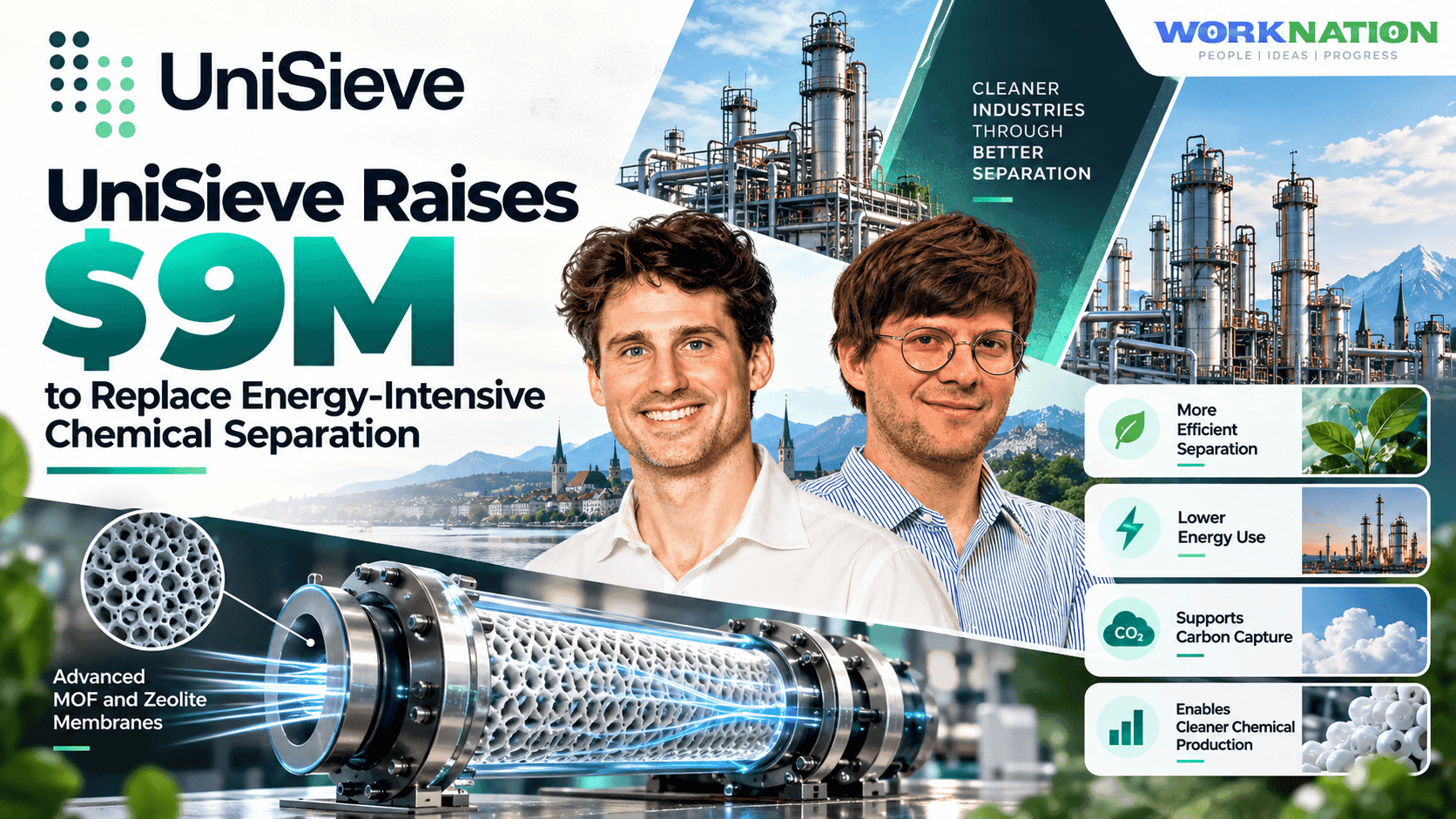
UniSieve, a Zurich-based deep tech startup founded by ETH Zurich classmates Samuel Hess and Elia Schneider, has raised $9 million in Series A funding to scale its molecular separation technology for industrial applications.
The round was led by Orano Venture Fund, managed by Supernova Invest, with participation from existing and new investors including Amadeus APEX Technology Fund, Founderful, Zürcher Kantonalbank, and Guenat Holding. The latest investment brings UniSieve's total funding to $25 million.
The company is developing advanced membranes designed to separate molecules without relying on the heating and cooling cycles used in many conventional chemical separation processes.
From ETH Zurich research to industrial separation
UniSieve was founded in 2018 by Samuel Hess, now the company's CEO, and fellow ETH Zurich student Elia Schneider.
Their approach combines metal-organic frameworks, known as MOFs, with zeolites to create molecular-sieve membranes capable of separating gases with high precision.
The technical challenge has not simply been discovering materials that can separate molecules. The harder problem has been turning those materials into membranes that are durable, reliable, and suitable for industrial-scale manufacturing.
UniSieve says it has now made progress on that manufacturing challenge and is preparing its technology for commercial deployment.
The timing is notable. MOFs received the Nobel Prize in Chemistry in 2025, several years after Hess and Schneider founded UniSieve around the same class of materials.
Why chemical separation matters
Molecular separation is a fundamental part of producing fuels, fertilisers, plastics, and other industrial products. But conventional separation methods can consume significant amounts of energy because they often rely on thermal processes.
The funding announcement cites a 2016 Nature analysis estimating that chemical separations account for around 10% to 15% of global energy use.
UniSieve's technology is designed to address this problem by using membranes that can separate molecules without the heating or cooling cycles associated with conventional processes.
The company is initially targeting two applications where it believes the technology can have a direct industrial impact: olefin production and point-source carbon capture.
Targeting olefins and carbon capture
Olefins are important building blocks for plastics and other chemicals. UniSieve is developing membranes that can be used in the separation processes involved in their production.
The second major application is carbon capture at industrial facilities.
One of UniSieve's publicly identified customers is Polish chemicals company Qemetica, formerly known as CIECH. The company has started live testing of a UniSieve carbon capture unit.
The captured carbon dioxide is intended to be used directly at the site to produce carbonates such as soda, creating a potential pathway for captured CO2 to become an industrial input rather than simply a waste stream.
UniSieve says its two initial applications have reached a stage where manufacturing can be repeated, field performance has been demonstrated, and systems are ready for deployment.
A different approach to industrial carbon capture
UniSieve is entering a competitive carbon capture market.
Canadian company Svante, for example, develops solid-sorbent capture systems using materials related to MOFs. European startups such as ARK Capture Solutions are also developing technologies for capturing industrial emissions.
UniSieve's differentiation is centered on its membrane-based approach.
Rather than relying on heating or cooling cycles, its membranes are designed to perform molecular separation through a compact system. The company argues that this can reduce energy requirements while also simplifying the equipment required for industrial applications.
CEO Samuel Hess says the technology can help industrial customers recover more of their products while controlling emissions and reducing costs.
The commercial question now is whether that technical advantage can translate into widespread industrial adoption.
Investors see a path from pilots to paying customers
The new funding round brings several investors together around UniSieve's move toward commercialization.
Jonathan Grosskopf, investment director at Supernova Invest, highlighted the founders' ability to turn complex materials science into an industrial application while maintaining capital discipline.
Wolfgang Neubert, general partner at APEX Ventures, pointed to the company's progress from pilot deployments toward larger systems and paying customers.
That transition is important for UniSieve. Deep tech companies can spend years developing materials and industrial hardware before reaching meaningful commercial revenue.
For UniSieve, the latest funding is therefore less about proving that its materials can work in a laboratory and more about scaling manufacturing, deploying systems, and converting customer interest into sales.
What the $9M funding will support
The company says the new capital will help it move further into commercial deployment and expand production of its membranes.
UniSieve's technology has applications beyond its two current focus areas. Its potential market spans chemical processing, industrial gas separation, and carbon capture.
The company is also working from a position where customers have already begun paying, according to investor comments cited in the funding announcement.
That gives the startup an important foundation as it attempts to move from pilot projects to larger industrial installations.
UniSieve's journey also highlights the longer timelines involved in deep tech. The company was founded in 2018 by two ETH Zurich classmates, years before MOFs received the Nobel Prize in Chemistry.
Now, with $25 million in total funding and a $9 million Series A behind it, the next test is commercial scale.
For UniSieve, success will depend on whether its membrane technology can consistently replace energy-intensive separation processes in real industrial plants - and whether customers see enough economic value to make the switch.
Have a Funding Round or Exciting Update to Share?
Submit your press release to get featured on WorkNation and reach founders, investors, and tech leaders.