Sava Raises $36M Series B to Replace Fingerstick Glucose Tests
Top Picks
Submit PR
Stay Ahead of the Market
Get the latest startup funding, hiring trends and global opportunities delivered to your inbox every week.
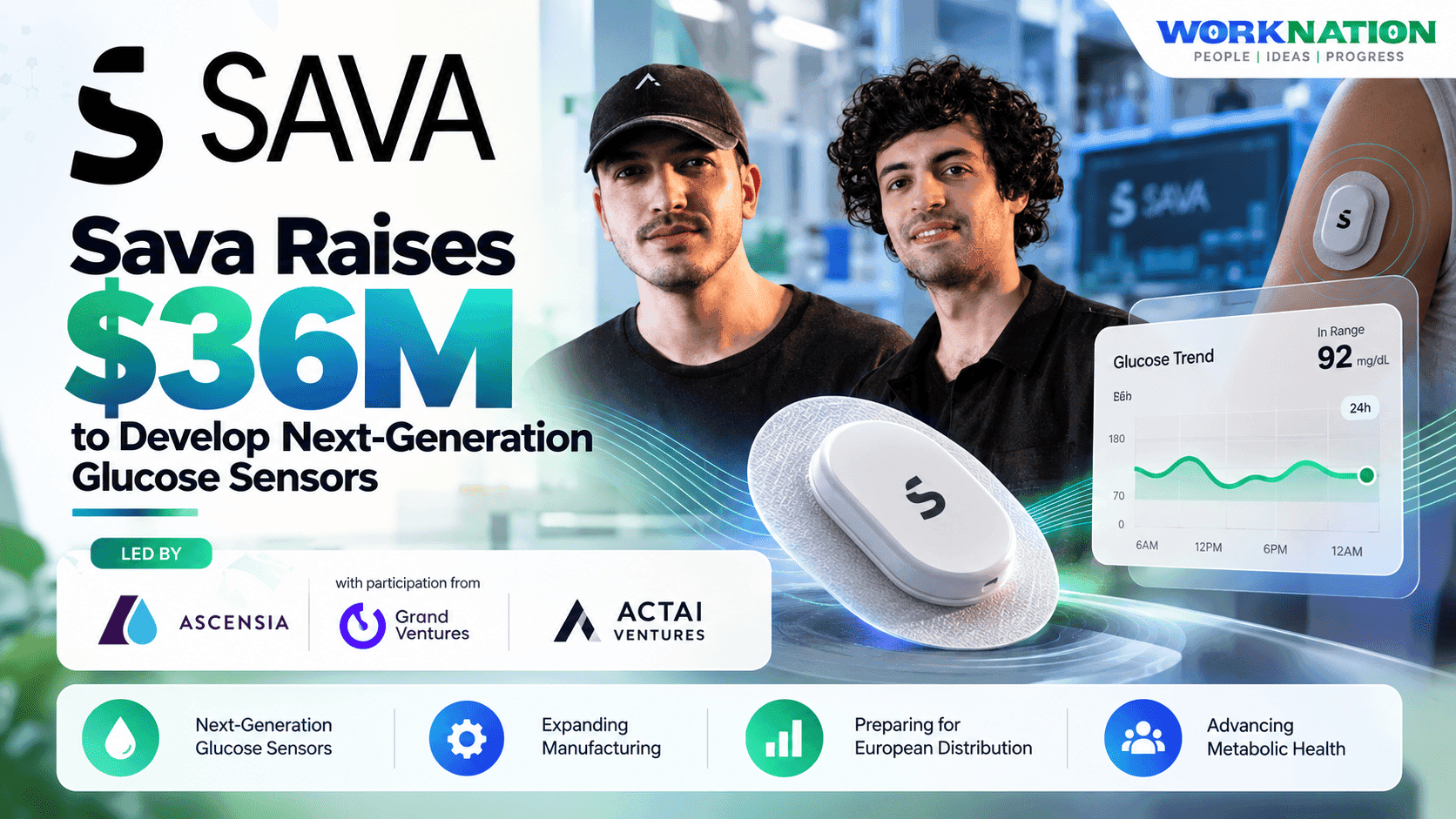
London-based health technology startup Sava has raised $36 million in Series B funding to advance its next-generation glucose monitoring technology, which aims to reduce the need for traditional fingerstick blood tests. The round was led by Ascensia Diabetes Care, a major diabetes care company known for its CONTOUR blood glucose meters.
The investment brings Sava's total funding to $68 million. Alongside the funding announcement, Sava entered a commercialisation and distribution partnership with Ascensia, which plans to distribute its sensor in Europe after the product receives the required CE approval.
Founded in 2019 by bioengineers Renato Circi and Rafaël Michali, Sava is developing microsensor technology designed to measure glucose through fluid beneath the skin. The company hopes to make continuous glucose monitoring more accessible and eventually enable people with diabetes to make insulin dosing decisions without routine fingerstick checks.
The sensor remains experimental and has not yet received approval from the UK's Medicines and Healthcare products Regulatory Agency or the US Food and Drug Administration.
Sava's goal: reducing dependence on fingerstick testing
Traditional blood glucose testing often requires people to prick their fingers to obtain a blood sample. Continuous glucose monitors (CGMs) offer an alternative by measuring glucose levels through sensors worn on or under the skin.
However, Sava believes existing sensor technology has limitations that can be addressed through a different approach to biosensor design.
The company was founded by Circi and Michali, who trained as bioengineers at Imperial College London in a research group that helped develop modern glucose test strips. They established Sava in 2019 and spent several years developing the technology before publicly announcing an $8 million seed round in June 2024.
Sava subsequently raised a $19 million Series A in July 2025. Its latest $36 million Series B gives the company additional capital to advance clinical development, expand manufacturing capabilities, and prepare for commercialisation.
The company's sensor is designed to sit on the skin and detect molecules in the fluid beneath it. According to Sava, its microsensors are approximately ten times shorter than those used in conventional continuous glucose monitors.
The smaller sensor design is intended to reduce disruption to the skin while supporting longer periods of measurement.
In early research involving 50 people, Sava reported that the first 25 participants received accurate glucose readings for up to 10 days. The company says this performance compares favourably with other microsensors that often stop functioning after around five days. These findings are preliminary and should not be treated as proof of performance across a broader patient population.
Sava has since expanded its team to more than 60 employees, including people who previously worked at established glucose monitoring companies such as Abbott and Dexcom.
Moving toward insulin dosing without routine fingersticks
One of Sava's most significant goals is to obtain regulatory approval for non-adjunctive use of its glucose sensor.
In this context, non-adjunctive use would allow people with diabetes to make insulin dosing decisions using the sensor's readings without routinely confirming those readings through separate fingerstick tests.
Achieving that status would require appropriate clinical evidence and regulatory approval. It is not a capability that Sava's experimental sensor currently offers for general clinical use.
The company plans to conduct a major clinical trial and hopes to secure CE approval and begin selling its product within the next 18 to 24 months, according to the source report.
The intended benefit is a simpler glucose monitoring experience for people who need frequent measurements to manage their condition. Reducing the need for repeated fingersticks could make monitoring less burdensome, although the actual benefits will depend on clinical performance, usability, safety, and the product's final approved indications.
The funding will support manufacturing expansion and preparation for commercial launch as Sava progresses toward its pivotal clinical study.
Why Ascensia is backing the technology
Ascensia Diabetes Care's participation is particularly notable because the company already operates in the blood glucose monitoring market through its CONTOUR product range.
The partnership gives Sava a potential route into European markets once the sensor receives the required approval. Ascensia is expected to handle commercialisation and distribution in Europe, allowing Sava to focus on advancing the technology and preparing its manufacturing operations.
Sava CEO and co-founder Renato Circi said the partnership could help bring a different approach to glucose monitoring to millions of people living with diabetes.
The investment also reflects the strategic interest in next-generation monitoring technologies from companies already serving people with diabetes. Established players may gain access to new sensor designs, while technology developers can benefit from distribution experience and commercial relationships.
However, the partnership does not mean Sava's sensor is already approved or available for routine clinical use. Regulatory clearance and clinical validation remain important milestones before a wider launch.
Investors backing Sava's next stage
The Series B was led by Ascensia, with participation from existing investors including Balderton Capital, Pentland Ventures, Norrsken VC, Simplyhealth Ventures, and JamJar Investments. Other investors also participated, including an unnamed strategic investor identified in the source as a round leader.
Balderton Capital led Sava's seed round and co-led its Series A alongside Pentland Ventures. The latest investment builds on that earlier support and gives Sava more resources to move from technology development toward clinical validation and commercial readiness.
The $36 million round brings Sava's disclosed total funding to $68 million.
The capital is expected to support manufacturing capabilities, product development, and preparation for the commercial launch. The company is also working toward a major clinical study that will help establish whether the sensor can meet the requirements for its intended use.
A growing market for continuous glucose monitoring
Sava is entering a market with substantial potential demand. The source report estimates that approximately 12 million people currently use continuous glucose monitors, while 589 million adults worldwide live with diabetes. The International Diabetes Federation forecasts that the number of adults with diabetes could rise to 853 million by 2050.
Market estimates also point to continued growth. Fortune Business Insights values the global continuous glucose monitoring market at $13.86 billion in 2025 and projects it could reach $33.61 billion by 2034, representing a compound annual growth rate of 10.1%.
Sava is not the only company pursuing alternatives to existing glucose monitoring methods. Biolinq raised $100 million in April 2025 for an intradermal glucose sensor, while Liom is developing a needle-free glucose wearable. Other companies are working on insulin delivery and continuous monitoring of additional health indicators.
Sava's wider technology platform is designed to measure substances beyond glucose, including ketones, lactate, cortisol, sodium, and alcohol, according to the company. This could create opportunities in other monitoring applications over time, although glucose monitoring remains the immediate focus of the current funding and commercial partnership.
What comes next for Sava
Sava's latest funding marks a transition from early-stage development toward larger clinical studies and commercial preparation. Its immediate priorities include expanding manufacturing capacity, progressing the clinical programme, and working with Ascensia toward a European launch following regulatory approval.
The central challenge is proving that the sensor can deliver reliable measurements over the required periods and support its intended clinical use. The company must also navigate regulatory requirements before it can market the device for insulin dosing without routine fingerstick confirmation.
If those milestones are achieved, Sava could offer another option in a market where sensor accuracy, wearability, convenience, and access all matter.
For now, the $36 million Series B provides funding and a commercialisation partner as the company works toward its goal of reducing dependence on traditional fingerstick glucose testing.
Have a Funding Round or Exciting Update to Share?
Submit your press release to get featured on WorkNation and reach founders, investors, and tech leaders.