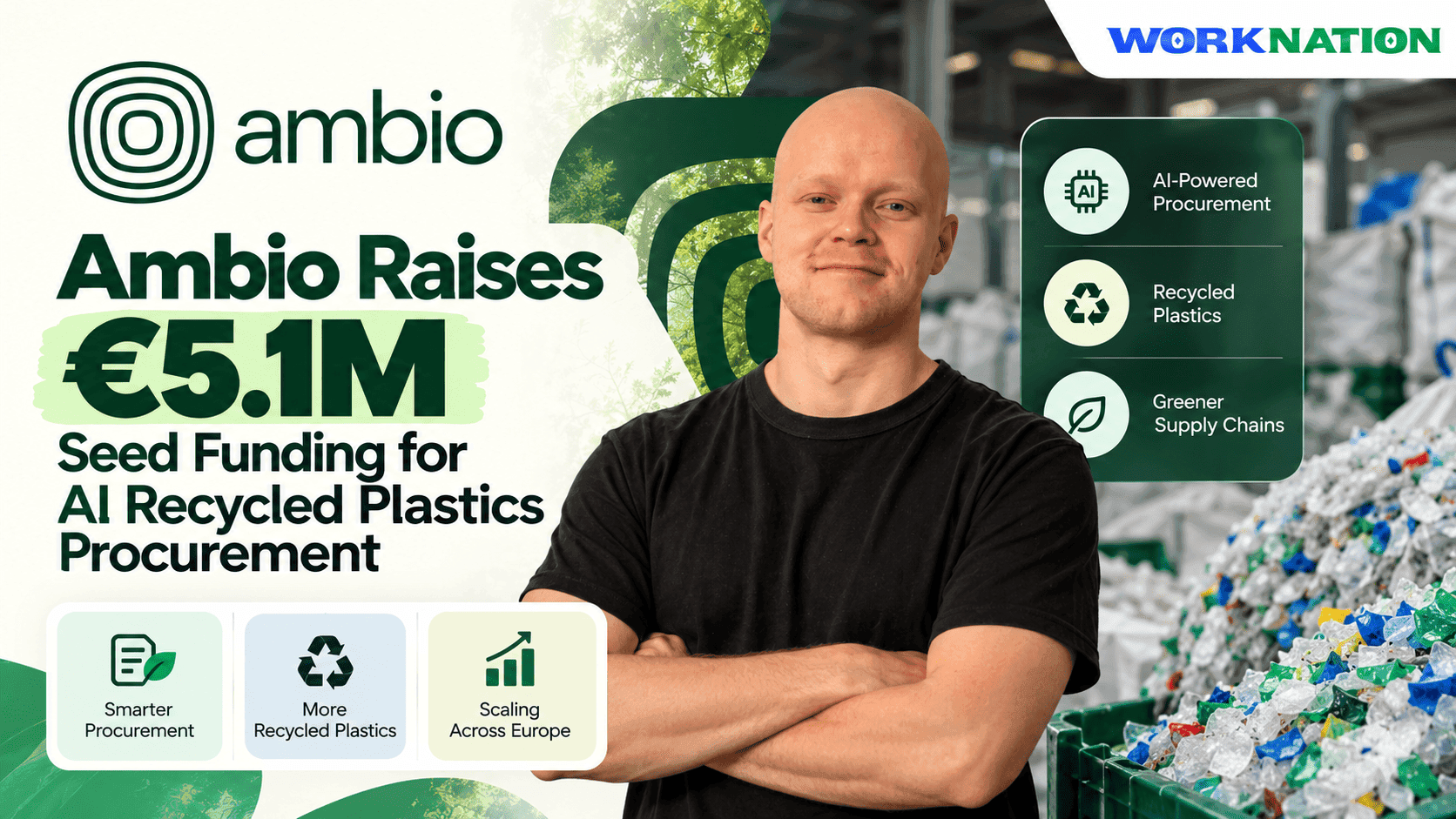
Ambio Raises €5.1M Seed Funding to Scale AI-Powered Recycled Plastics Procurement
Top Picks
Submit PR
Stay Ahead of the Market
Get the latest startup funding, hiring trends and global opportunities delivered to your inbox every week.
Ambio, a Helsinki-based startup using artificial intelligence to simplify recycled plastics procurement, has raised €5.1 million in seed funding. The round was led by b2venture, with participation from Montis and existing investor Lifeline Ventures.
The company operates an AI-native procurement service that connects businesses with recycled plastic suppliers while managing sourcing, quality checks and logistics. Rather than functioning as a passive marketplace, Ambio acts as a principal in transactions, helping buyers secure materials that meet their technical specifications and delivery requirements.
The fresh capital will support international expansion and diversification into additional polymer types. Ambio currently serves customers in the Nordic countries and Germany, primarily in construction and packaging, and recently began operating in France.
Ambio's €5.1M Seed Funding Round
The €5.1 million seed round brings new investment from b2venture and Montis, alongside continued backing from Lifeline Ventures.
Ambio plans to use the funding to expand its geographical reach and increase the variety of recycled plastics it can procure for customers. Its approach focuses on addressing challenges that can make recycled materials difficult for industrial buyers to source consistently.
Co-founder and CEO Tommi Bergström believes that increasing the use of recycled plastics could help Europe reduce its reliance on imported fossil-based feedstock.
The funding comes as recycled plastics suppliers and buyers face challenges involving pricing, material quality, fragmented supply and competition from virgin plastics. Ambio is targeting these problems by coordinating procurement and quality assurance through a single service.
How Ambio's AI-Powered Procurement Service Works
Ambio's platform begins with the buyer's requirements. Customers specify the polymer they need, the technical specifications, required volume and expected delivery date.
The company then matches the request with suitable suppliers and manages the logistics needed to fulfil the order. This model is designed to simplify procurement for businesses that need recycled materials meeting specific production requirements.
Instead of simply introducing buyers and sellers, Ambio takes a more involved role in the transaction. It acts as a principal, coordinating the sourcing and delivery process.
This distinction is important in a market where finding a supplier is only one part of the challenge. Buyers also need confidence that materials will meet their specifications and arrive when required.
By managing procurement from sourcing through delivery, Ambio aims to make recycled plastics easier to purchase at an industrial scale.
Supplier Verification and Quality Control
Material quality is a central part of Ambio's operating model.
The company begins supplier checks with inspections of recycling processes, which can take place in person or online. It then compares technical data sheets with certificates of analysis to assess whether the documented material characteristics are consistent.
Where necessary, Ambio may also send samples to third-party laboratories for further testing.
Buyers can receive test batches ranging from a few hundred grams to 25 kilograms. These samples allow customers to evaluate materials on their own production lines before committing to larger purchases.
This process addresses a practical barrier to recycled plastics adoption: industrial buyers need materials that meet production requirements, not simply materials labelled as recycled.
By combining supplier screening, documentation checks, laboratory testing where needed and production-line trials, Ambio seeks to reduce uncertainty around material quality.
The company is also positioning its service around longer-term delivery arrangements, helping buyers source materials beyond individual transactions.
Founded to Address Fragmentation in Recycled Plastics
Tommi Bergström, a former Boston Consulting Group consultant, and chief operating officer Elmo Pakkanen founded Ambio in February 2023.
According to Bergström, the founders identified problems with the recycled plastics market early on, particularly fragmented supply, inconsistent quality, pricing inefficiencies and the difficulty of trading reliably at scale.
These challenges can complicate procurement for manufacturers that need specific polymer types in predictable quantities. Businesses must find appropriate suppliers, assess material quality, compare pricing and coordinate deliveries, all while ensuring that the material works in their production processes.
Ambio's model brings these activities together under one procurement service.
Its current customer base is concentrated in the Nordic countries and Germany, with customers primarily operating in construction and packaging. The company has also recently entered France as it begins expanding internationally.
The latest funding is intended to support that expansion and broaden the polymer types available through the platform.
Recycled Plastics Face a Challenging Market
Ambio is entering a market where the environmental case for recycling does not always translate into strong commercial demand.
The source article cites S&P Global data indicating that nearly one million tonnes of recycling capacity was expected to be lost between 2023 and the end of 2025, out of 13.2 million tonnes spread across approximately 850 plants.
Cheap imports, regulatory barriers and a widening price gap between recycled and virgin plastics have put pressure on the recycling industry. In some cases, buyers have returned to virgin materials made from fossil feedstock.
These conditions create a difficult environment for companies seeking to increase recycled plastics adoption. Even when recycling capacity exists, buyers must be willing and able to purchase the resulting material at commercially viable prices.
For Ambio, the challenge is therefore not limited to finding more recycled plastics suppliers. Its business also depends on making recycled materials easier for industrial customers to source reliably and use in production.
The company is betting that better procurement, quality verification and logistics can help address some of the obstacles holding back demand.
Why Ambio Is Focusing on the Demand Side
Investment in plastics recycling has often focused on increasing supply through new recycling technologies and processing facilities.
Ambio is taking a different approach by concentrating on the connection between recycled material producers and industrial buyers.
The company's strategy is based on the idea that improving the buying process could help existing recycled plastics supply reach customers more efficiently. Its service combines supplier matching, quality checks and delivery coordination rather than focusing on operating a recycling plant itself.
Ambio identifies traders and distributors as competitors, but Bergström has described the continued purchase of virgin plastic as the company's biggest competition.
That distinction highlights the broader market challenge. Winning business from another procurement platform is only part of the opportunity; encouraging manufacturers to choose recycled materials over virgin alternatives is another.
The liquidation of competing marketplace Cirplus in March, as reported in the source article, also illustrates the difficulties facing businesses operating in this market. Ambio's procurement-led approach is an alternative model, though its long-term success will depend on customer demand and the economics of recycled materials.
What the Funding Means for Ambio
The €5.1 million seed round gives Ambio additional resources to expand into new markets, diversify the polymers it handles and develop its procurement service.
Its operating model addresses several connected challenges in recycled plastics purchasing: supplier fragmentation, quality verification, pricing and logistics. By managing these processes, the company aims to make recycled materials more accessible to businesses in sectors such as construction and packaging.
However, the broader market remains challenging. Lower-cost virgin plastics and weak demand for recycled alternatives can make adoption difficult, even when procurement becomes more efficient.
Ambio's next stage will test whether its model can help more industrial buyers purchase recycled plastics consistently and at commercially viable prices.
The company is betting that improving how recycled plastics are bought, rather than concentrating exclusively on how they are produced, can help strengthen the market for recycled materials across Europe.
Have a Funding Round or Exciting Update to Share?
Submit your press release to get featured on WorkNation and reach founders, investors, and tech leaders.