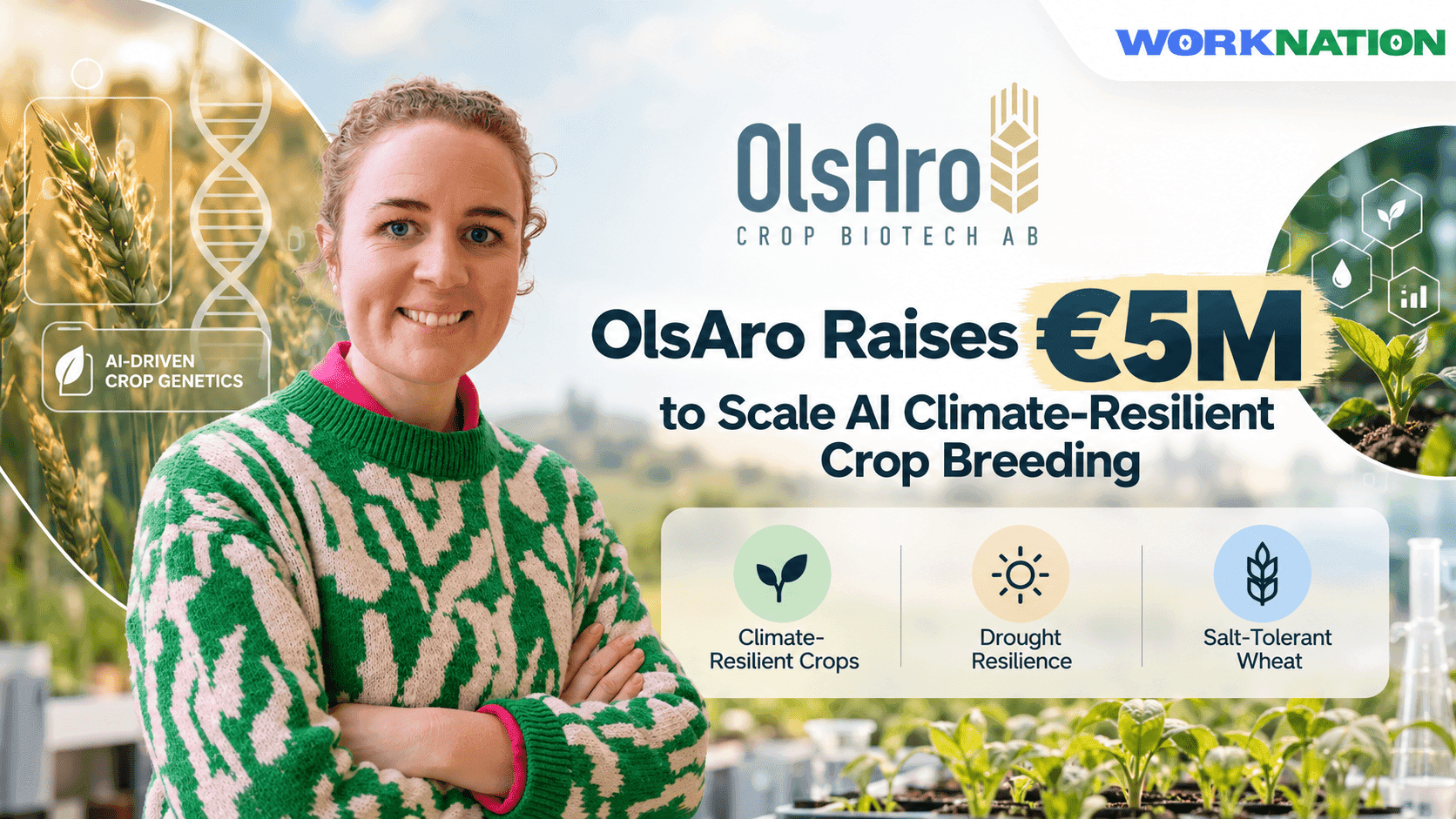
OlsAro Raises €5M Seed Funding to Develop Climate-Resilient Crops With AI
Top Picks
Submit PR
Stay Ahead of the Market
Get the latest startup funding, hiring trends and global opportunities delivered to your inbox every week.
OlsAro, a Swedish agricultural technology startup developing climate-resilient crops using artificial intelligence and genetics, has raised €5 million in seed funding. The round was led by Industrifonden, with Nordic Foodtech VC as co-lead investor. Existing investors Future Food Fund, AgFunder, GU Ventures and PINC, the venture arm of Paulig, also participated.
Based in Gothenburg, OlsAro is developing crop-breeding technology designed to help seed companies create cereal varieties that can perform under challenging environmental conditions, including soil salinity and drought. The company says its salt-tolerant wheat has produced yields up to 41% higher than a moderately salt-tolerant variety under saline conditions in Bangladesh.
The fresh capital will support international field trials, commercial work with seed-company partners, additional research and development, and the expansion of OlsAro's intellectual property portfolio. The company also plans to develop new programmes focused on drought tolerance and nitrogen-use efficiency, while exploring additional cereals such as rice.
OlsAro's €5M Seed Funding Round
The €5 million investment brings OlsAro's total funding to approximately €7.5 million, according to the company.
Industrifonden led the round, with Nordic Foodtech VC serving as co-lead. Future Food Fund, AgFunder, GU Ventures and PINC also participated as existing investors.
OlsAro previously announced a €2.5 million funding round in April 2024, which it described at the time as a seed round but now refers to as pre-seed.
The latest financing is intended to move the company's existing salt-tolerant wheat programme closer to commercialisation while expanding its technology to address additional agricultural challenges.
CEO Elén Faxö said the company wants to turn its research capabilities into a platform that seed companies can use repeatedly to develop climate-resilient crops across different traits and markets.
The investment will support further field testing, partnerships with seed companies and AI-driven trait discovery. It will also help the company build a broader intellectual property portfolio as it expands its crop-breeding programmes.
SeedAX: OlsAro's AI-Driven Crop-Breeding Platform
At the centre of OlsAro's business is SeedAX, a platform that combines genetics, data, AI-driven trait discovery and genetic technologies to identify and validate traits associated with climate resilience.
The platform is designed to integrate those traits into elite germplasm, which refers to high-performing genetic material used in crop-breeding programmes.
Rather than building a large seed production and distribution business of its own, OlsAro focuses on developing genetic traits and working with established seed companies that can incorporate them into commercial products.
This approach allows the company to concentrate on research and technology development while partners handle activities such as seed multiplication, logistics, storage, marketing and sales.
OlsAro's strategy is built around making its platform useful across multiple traits and markets. Its initial focus is salt-tolerant wheat, but the company plans to expand into drought tolerance, nitrogen-use efficiency and other cereals, including rice.
The additional funding will support the development of these programmes and help OlsAro test its technology under different agricultural conditions.
Salt-Tolerant Wheat Shows Potential in Bangladesh
OlsAro's first product focus is wheat designed to perform in saline soil conditions.
According to the company, its wheat produced up to 41% more yield than a moderately salt-tolerant variety under saline conditions in Bangladesh. The result highlights the potential of crop genetics to help farmers maintain productivity where soil salinity presents a challenge.
The company is also testing its wheat in multiple international markets.
In India, DCM Shriram tested three OlsAro wheat lines at three saline sites across Uttar Pradesh and Bihar during the 2024-25 winter season. In July 2025, the company reportedly described the results as encouraging and expressed interest in conducting another season of testing.
These trials are important because crop performance must be evaluated across different locations and growing conditions before a variety can be commercialised at scale.
OlsAro's latest funding will support further international field trials and commercial collaboration with seed-company partners. However, the company's October 2026 funding announcement does not provide a confirmed launch date for its first wheat product.
Why Climate-Resilient Crops Matter
Soil salinity is a significant challenge for agricultural production. The Food and Agriculture Organization of the United Nations estimates that salt-affected soils cover approximately 10.7% of the world's land, equivalent to around 1.381 billion hectares.
The FAO also estimates that salinity affects about 10% of irrigated cropland and 10% of rainfed cropland, while noting substantial uncertainty due to limited data.
Salinity can make it harder for crops to absorb water and maintain healthy growth. Developing varieties that perform better under these conditions could help farmers produce crops in areas where conventional varieties face limitations.
Drought tolerance is another priority for OlsAro. Water availability can affect crop development and yields, making drought-resilient varieties an important area of agricultural research.
The company also plans to focus on nitrogen-use efficiency, which measures how effectively crops convert available nitrogen, including fertiliser inputs, into yield.
Improving this trait could help seed companies develop varieties that use nitrogen more efficiently. OlsAro's new funding will support research into these areas as it seeks to expand beyond its initial salt-tolerant wheat programme.
OlsAro's Business Model: Partnering With Seed Companies
OlsAro's primary customers are seed companies rather than individual farmers.
The company develops genetic traits and integrates them into existing high-performing breeding lines. Seed-company partners can then use that genetic material in their own commercial programmes.
Bangladesh provides an example of this model. OlsAro has partnered with Lal Teer Seed, which handles activities such as seed multiplication, logistics, storage, marketing and sales.
In July 2025, CEO Elén Faxö said the company was targeting market entry in Bangladesh by 2027. At that time, the wheat was in its second year of distinctness, uniformity and stability testing, a process used to evaluate new plant varieties.
The latest funding announcement does not confirm whether that timeline has changed.
The partnership-led model means OlsAro does not need to establish all the infrastructure required to distribute seeds in each market itself. Instead, it can work with established companies that understand local agricultural conditions and distribution networks.
For OlsAro, the opportunity is to develop a platform that can support multiple crop traits and partnerships across different geographies.
Investors Back OlsAro's Agricultural Technology
Industrifonden, which describes itself as Sweden's venture capital fund, invests in companies across deep technology, life sciences and transformative technologies.
Nordic Foodtech VC invests in research-driven companies working across food and agriculture, with a focus on the Nordic and Baltic regions.
Their participation reflects investor interest in technologies that could address challenges across the food and agricultural value chain.
OlsAro's strategy differs from businesses focused primarily on building recycling, processing or production infrastructure. Its core proposition is to use genetics and AI-driven discovery to develop crop traits that seed companies can bring into commercial breeding programmes.
The latest funding will help the company expand its field trials, strengthen its technology and pursue new crop-breeding programmes.
What the Funding Means for OlsAro
OlsAro's €5 million seed round marks another step towards commercialising its salt-tolerant wheat and expanding its AI-driven crop-breeding platform.
The company has reported promising results from saline-condition trials and is working with seed-company partners to test and commercialise its genetic material. It now plans to broaden its research into drought tolerance, nitrogen-use efficiency and additional cereals.
Its partnership-led business model allows OlsAro to focus on genetics and trait discovery while established seed companies manage production and distribution.
The next major milestone will be translating field-trial results into commercially available crop varieties. That will require continued testing, successful partnerships and evidence that the varieties perform reliably across relevant agricultural conditions.
With new capital from Industrifonden, Nordic Foodtech VC and existing investors, OlsAro is aiming to turn its research into a repeatable platform for developing crops that can better withstand environmental stress.
Have a Funding Round or Exciting Update to Share?
Submit your press release to get featured on WorkNation and reach founders, investors, and tech leaders.