Otter.ai Raises $320M from General Catalyst to Expand AI Meeting Platform
Top Picks
Submit PR
Stay Ahead of the Market
Get the latest startup funding, hiring trends and global opportunities delivered to your inbox every week.
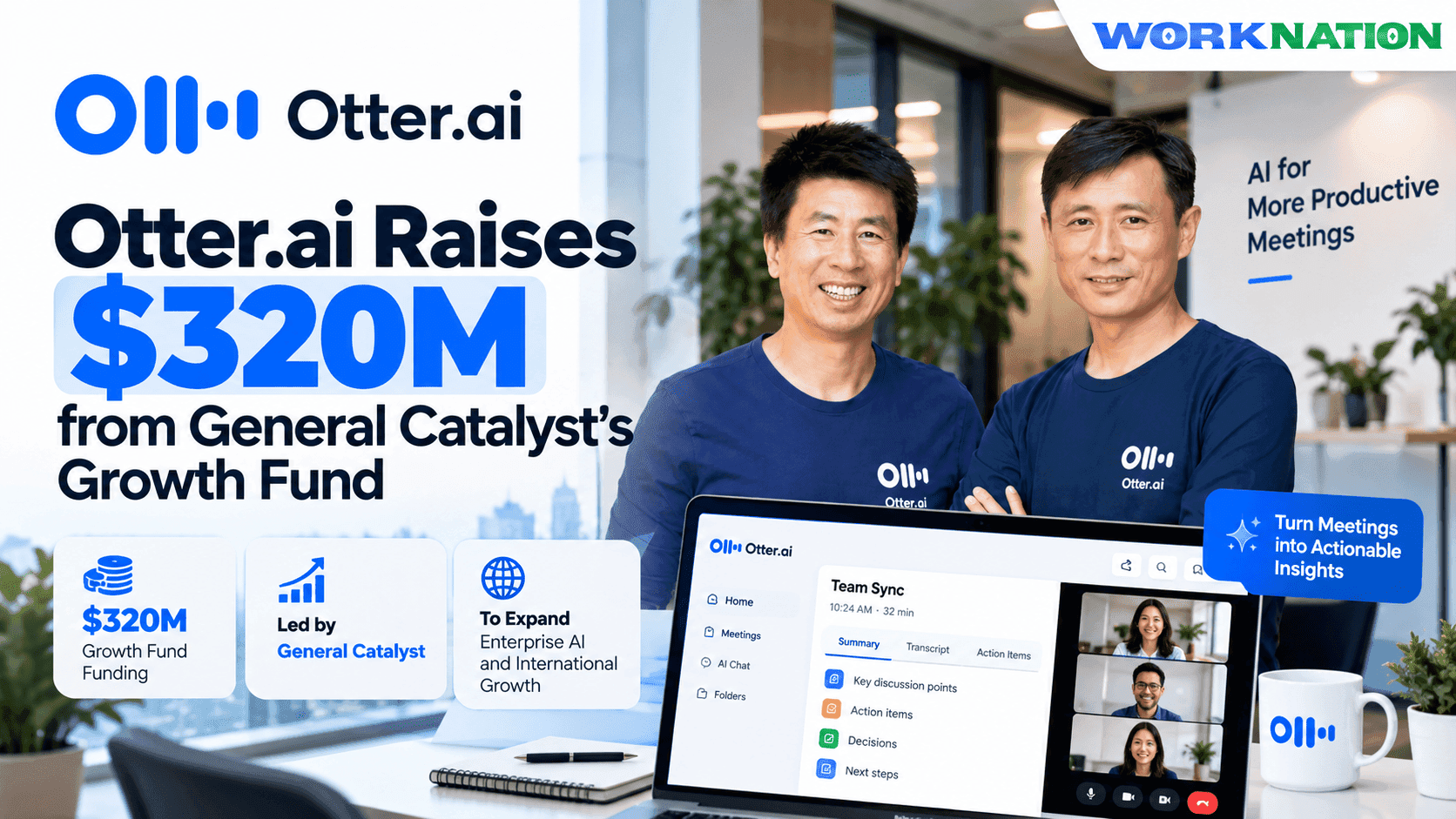
Otter.ai, the US-based AI meeting assistant startup, has secured $320 million in non-equity growth financing from General Catalyst's Customer Value Fund (CVF) to expand its enterprise business and establish itself as a system of record for workplace conversations.
Unlike a traditional venture capital round, the financing is repayable with interest and does not dilute existing shareholders. The funding model links General Catalyst's returns to the results of sales and marketing spending, giving Otter.ai capital to accelerate growth while retaining ownership of its equity.
Founded in 2016, Otter.ai plans to invest the money in enterprise sales, marketing, international expansion and product development. The company says it has more than 40 million users, serves teams at over 86% of Fortune 500 companies and has transcribed more than one billion meetings.
The financing comes as Otter.ai looks to move beyond meeting transcription and summaries toward a broader platform that helps enterprises capture, search and act on information shared during conversations.
Otter.ai secures $320 million in non-equity financing
General Catalyst's Customer Value Fund is providing the $320 million commitment to support Otter.ai's next phase of growth.
CEO and co-founder Sam Liang told Reuters that the financing is repayable with interest and will not dilute shareholders. The repayment terms have not been publicly disclosed. Liang also indicated that the fund could provide additional capital after the initial amount is used.
Otter.ai plans to increase its sales and marketing budget by two to three times, expand its sales team and step up marketing outside the United States. The US remains its largest market, followed by Canada, the UK and India.
The financing is distinct from the company's earlier equity fundraising. According to PitchBook data cited in the report, Otter.ai had raised approximately $50 million in total conventional funding before this announcement. Its last equity round was a $50 million Series B in 2021, backed by investors including Spectrum Equity, Horizons Ventures and Draper Associates.
General Catalyst's CVF structure is designed to provide growth capital without taking equity, with returns linked to marketing outcomes. For Otter.ai, the arrangement offers an opportunity to scale its commercial operations without issuing additional shares.
However, the model also creates a clear financial obligation: the company must repay the financing with interest, regardless of whether its expansion plans achieve their intended results.
From meeting notes to an enterprise voice system of record
Otter.ai was founded in 2016 by Sam Liang, a former Google engineer, and Yun Fu. Its platform connects to meetings on services such as Zoom, Microsoft Teams and Google Meet to transcribe conversations in real time, identify speakers and generate summaries and action items.
The company is now pursuing a broader opportunity: making voice data a useful source of business knowledge.
Meetings often contain customer requirements, sales discussions, strategic decisions and operational information. Yet much of that information remains buried in recordings or transcripts after the conversation ends.
Otter.ai wants to make this information searchable and actionable across an organisation. Instead of functioning solely as a digital note-taker, the platform is moving toward helping employees retrieve relevant context, prepare for conversations and use information from previous meetings to make decisions.
The company says its product has been used by more than 40 million people, up from 25 million a year earlier. It also reports that teams at more than 86% of Fortune 500 companies use Otter.ai and that the platform has transcribed over one billion meetings.
Otter.ai additionally claims to have delivered more than $1.5 billion in return on investment for customers through time saved. This is a company-reported figure rather than an independently verified industry-wide measurement.
AI features aim to turn conversations into action
Otter.ai has been introducing capabilities that extend its role beyond transcription.
In July 2026, the company launched Live Assist, an enterprise AI agent designed to coach users during live calls. The feature points toward a model in which an AI assistant can help participants access information and respond to questions while a conversation is taking place.
Other capabilities include an AI meeting assistant, search across enterprise applications and integrations with external AI tools.
These features are intended to connect meeting information with the wider systems employees use to do their jobs.
Sales teams are among Otter.ai's main early adopters. Their work frequently involves repeated customer conversations, product discussions and follow-ups, making it important to retain context between meetings.
The broader ambition is to help employees spend less time recapping previous conversations and searching for information, and more time acting on what they learn.
For enterprises, the value of this approach will depend on whether the platform can deliver reliable results, integrate with existing workflows and meet requirements for security, privacy and access control.
Why General Catalyst is investing in voice AI
General Catalyst sees voice as a significant opportunity in enterprise artificial intelligence.
Pranav Singhvi, partner and co-founder of the Customer Value Fund, said capturing voice data and turning it into business insights could help organisations move faster, improve decisions and increase productivity.
The investment also reflects General Catalyst's broader use of its Customer Value Fund to finance company growth without conventional equity dilution.
The report notes that Motive secured more than $1.3 billion from the same fund in September 2026, while Grammarly also received $1 billion through the model.
For Otter.ai, the financing offers a way to increase customer acquisition spending and pursue enterprise opportunities at a larger scale. The approach places greater emphasis on measurable commercial outcomes than a conventional equity investment.
The key test will be whether additional spending generates sufficient customer growth and revenue to justify the financing and cover its repayment obligations.
Competition in the AI meeting intelligence market
Otter.ai is competing in a market that includes specialist AI meeting assistants, newer productivity startups and built-in tools from major software providers.
London-based Granola raised $125 million in a Series C round in March 2026 at a reported $1.5 billion valuation. Fireflies.ai, another competitor, reached a reported $1 billion valuation through a tender offer in June 2025 and has said it has been profitable since 2023.
Meanwhile, meeting and collaboration software providers continue to develop their own AI capabilities, increasing pressure on independent products.
This creates a challenge for Otter.ai: transcription and meeting summaries may become standard features rather than reasons for customers to pay for a separate service.
Its strategy is to make the platform more valuable by connecting meeting records to enterprise knowledge and workflows. If users can search past conversations, receive relevant context before meetings and get assistance during calls, the product could become more deeply embedded in everyday work.
The market's growth potential is substantial, but competition will make retention, product differentiation and enterprise adoption important measures of long-term success.
Privacy and trust remain important challenges
Otter.ai's growth also comes with questions about how meeting recordings are captured and used.
The report highlights a federal class-action lawsuit filed in August 2025 alleging that Otter's notetaker could join meetings and record participants without obtaining consent from everyone involved, and that recordings were used for AI training. These are allegations, not established findings of wrongdoing.
The issue is particularly relevant because the product's core functionality depends on accessing conversations involving multiple participants.
As Otter.ai expands into enterprise settings, organisations will need clarity around consent, recording policies, data handling and the controls available to administrators and meeting participants.
Trust is likely to be an important factor in whether companies adopt AI meeting assistants across entire departments or limit their use to specific teams and workflows.
Can Otter.ai turn its user base into a durable enterprise business?
Otter.ai crossed $100 million in annual recurring revenue in March 2025, according to the company, and its reported user base has grown to more than 40 million.
Those milestones provide a foundation for its next phase. However, the company has not disclosed updated revenue figures or detailed enterprise revenue, monthly active user or churn data in the report.
The $320 million financing is therefore both an opportunity and a test. Otter.ai plans to invest heavily in sales, marketing and international growth, but its ability to repay the capital will depend on translating that spending into sustainable business results.
Its longer-term ambition is to make meeting conversations a searchable, reusable source of organisational knowledge rather than information that disappears after a call ends.
If Otter.ai succeeds, it could become an important layer in enterprise AI workflows. If customers see transcription as a feature that can be supplied by existing workplace software, the company will need to demonstrate why its standalone platform is worth paying for.
Have a Funding Round or Exciting Update to Share?
Submit your press release to get featured on WorkNation and reach founders, investors, and tech leaders.