Swiss Biotech Nouscom Raises $135M to Advance Cancer Prevention Vaccine
Top Picks
Submit PR
Stay Ahead of the Market
Get the latest startup funding, hiring trends and global opportunities delivered to your inbox every week.
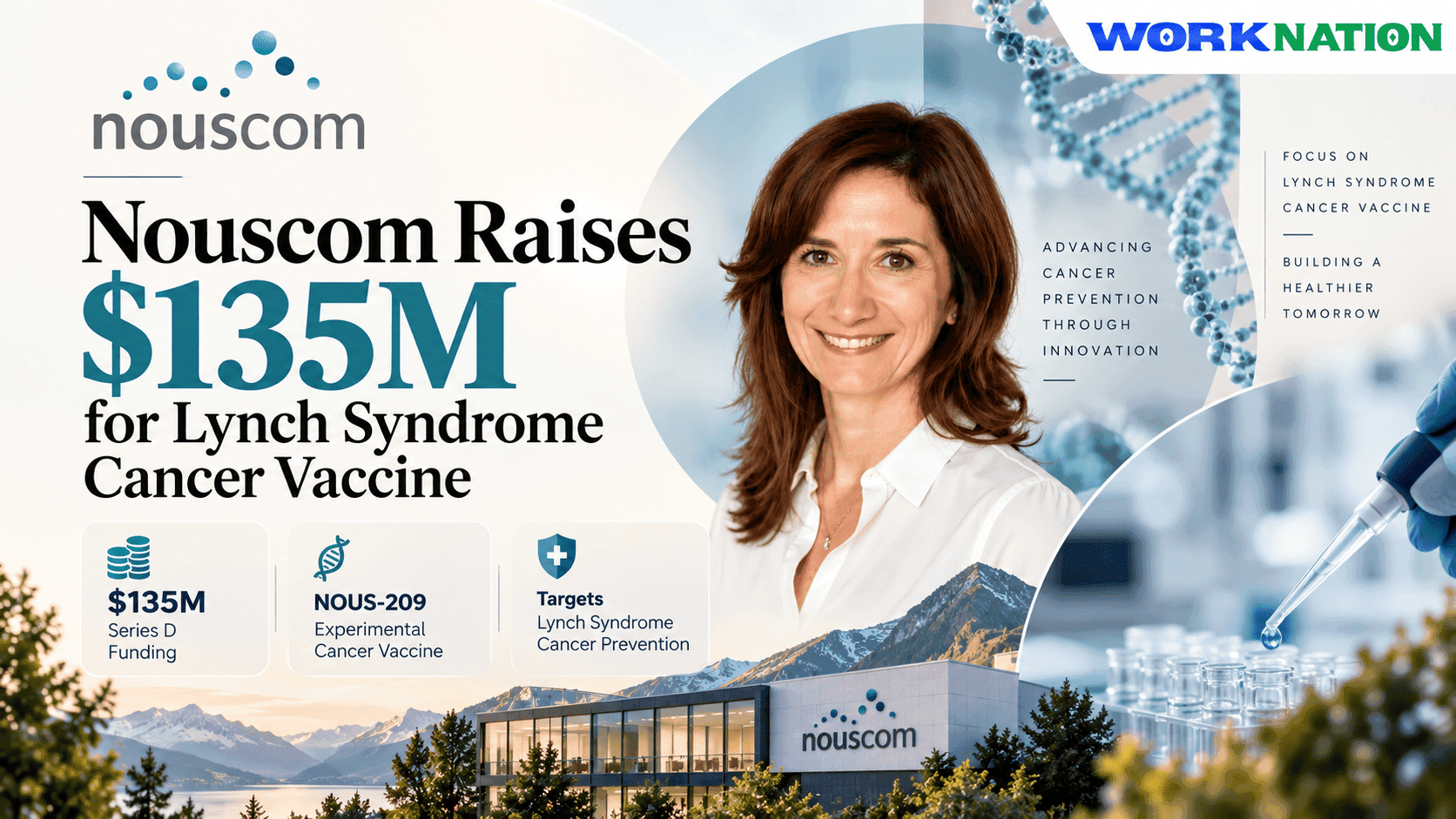
Swiss biotechnology company Nouscom has raised $135 million in an oversubscribed Series D funding round to advance the clinical development of NOUS-209, an experimental vaccine designed to prevent cancers associated with Lynch syndrome. The funding will support a global, registration-enabling clinical trial aimed at determining whether the vaccine can help prevent cancer before tumours develop.
The round was co-led by M Ventures and Revelation Partners, with participation from new and existing investors. The financing comes as Nouscom prepares to build on encouraging early clinical findings, although further trials are needed to establish whether the vaccine can actually prevent cancer.
Nouscom raises $135 million in Series D funding
The $135 million Series D round brings together investors from the biotechnology, healthcare and life sciences sectors.
New investors include Angelini Industries, through Angelini Investments; the European Investment Bank, through its Aurea co-investment facility with Angelini Ventures; and Neva SGR, part of the Intesa Sanpaolo Group.
Existing investors also participated in the round. They include 5AM Ventures, Andera Partners, Angelini Ventures, EQT Life Sciences, Indaco Venture Partners, Panakes Partners, Versant Ventures, XGEN Ventures, Bpifrance through its InnoBio2 fund, and CDP Venture Capital through its Large Ventures Fund.
The capital will primarily support the next stage of clinical development for NOUS-209, an off-the-shelf vaccine being developed for people with Lynch syndrome.
A registration-enabling trial is designed to generate evidence that could support a future regulatory approval application. The US Food and Drug Administration granted NOUS-209 Fast Track designation on June 1, 2026. This designation is intended to facilitate the development and review of treatments addressing serious conditions with significant unmet medical needs.
The funding represents a major step in Nouscom's effort to advance a cancer prevention approach that could eventually offer Lynch syndrome carriers an option beyond regular surveillance and preventive surgery.
What is Lynch syndrome, and why does cancer prevention matter?
Lynch syndrome is an inherited genetic condition associated with an increased risk of developing several types of cancer, particularly colorectal and endometrial cancer.
According to the Nature Medicine paper cited in the report, the condition affects approximately one in 300 people and can carry a lifetime cancer risk of up to 80%. Nouscom estimates that colorectal cancer risk among Lynch syndrome carriers can reach 50%, compared with approximately 2% in the general population.
People with the condition typically require regular monitoring, including frequent colonoscopies. Some may also consider preventive surgery depending on their circumstances and medical advice.
Although surveillance can help detect cancer, it does not eliminate the underlying inherited risk. Nouscom is developing NOUS-209 to investigate whether an immune-based approach could help address that risk earlier, before cancer develops.
The company was co-founded by Riccardo Cortese, who served as its original chief executive before his death in 2017. Marina Udier joined Nouscom as chief operating officer in 2016 and became interim CEO in May 2019 before subsequently taking on the role permanently.
Udier has a PhD in organic chemistry from Yale and previously worked at Novartis, McKinsey and Versant Ventures.
She said the company's objective is to change the options available to people living with Lynch syndrome, who currently rely heavily on surveillance and surgery to manage their cancer risk.
How NOUS-209 works
NOUS-209 is designed to train the immune system to recognise and attack cells that may become cancerous.
The vaccine uses two viral vectors to deliver 209 shared frameshift neoantigens. Neoantigens are markers that can appear on cancer cells but are absent from healthy cells. Frameshift neoantigens can arise from genetic changes associated with certain cancers, including those linked to Lynch syndrome.
Rather than developing a separate vaccine for each patient, Nouscom's approach targets neoantigens that recur across people with the condition.
The goal is to stimulate T cells, a type of immune cell, to recognise these targets and attack cancerous or precancerous cells before tumours form.
This off-the-shelf approach could offer a different development and manufacturing model from personalised cancer vaccines, which are designed around the individual characteristics of a patient's tumour.
However, the central question remains whether the immune response produced by NOUS-209 can translate into a meaningful reduction in cancer incidence.
What the early clinical trial results show
The Phase 1b/2 clinical trial enrolled 45 healthy carriers of Lynch syndrome. Participants received an initial dose of NOUS-209 followed by a booster eight weeks later.
According to the results reported by the company:
All 37 participants whose immune responses could be evaluated developed a neoantigen-specific immune response.
The immune response remained detectable after one year in 85% of participants.
Grade 3 fatigue was reported in 4% of participants.
These findings provide early evidence that NOUS-209 can generate a measurable immune response in people with Lynch syndrome, with responses persisting in many participants after a year.
Nevertheless, immune activity alone does not demonstrate that a vaccine prevents cancer. The trial did not include a control group, meaning researchers cannot determine from these results alone how much of any observed outcome is attributable to the vaccine rather than the natural course of the disease or other factors.
The upcoming global trial will therefore be an important step in assessing whether the approach can deliver a clinically meaningful preventive benefit.
Why Nouscom is pursuing an off-the-shelf cancer vaccine
Cancer vaccine development has historically faced significant challenges, although recent clinical progress in personalised cancer vaccines has raised interest in the broader field.
Some experimental approaches tailor vaccines to the mutations identified in an individual patient's tumour. NOUS-209 follows a different strategy by targeting shared neoantigens associated with Lynch syndrome.
If successful, this could allow a single product to be manufactured in advance for a defined group of people at elevated cancer risk, rather than requiring an individually designed vaccine for each recipient.
Nouscom has pursued this approach for approximately a decade. A €42 million Series B round in November 2017 was intended to advance NOUS-209 into clinical development. The company later secured a €75.8 million Series C, which Angelini Ventures extended in March 2024.
The latest financing provides additional resources to move the programme toward a larger, registration-enabling study.
The opportunity also sits within a wider European biotechnology market in which investors and public institutions are directing capital toward innovative healthcare technologies. The European Commission and the European Investment Bank Group have announced the BioTechEU initiative, which aims to mobilise €10 billion for biotechnology and life sciences in 2026 and 2027.
Who is backing Nouscom?
M Ventures, the corporate venture capital arm of Germany's Merck Group, co-led the latest financing alongside Revelation Partners. M Ventures had also participated in previous financing rounds, reflecting its continuing involvement in Nouscom's development.
Angelini Industries has supported the company through Angelini Ventures and participated again through its investment activities. The new round also brings in the European Investment Bank through the Aurea co-investment facility and Neva SGR.
The investor group combines specialist venture capital firms, corporate investors and institutions supporting biotechnology development.
M Ventures managing director and head of biotechnology investments Hakan Goker highlighted Nouscom's cancer interception strategy and its progress toward a regulatory-aligned clinical trial. Angelini Industries CEO Sergio Marullo di Condojanni also pointed to the company's potential contribution to cancer prevention.
The investors' participation provides financial backing for the next stage of development, but the scientific and commercial prospects of NOUS-209 will ultimately depend on the evidence generated in further clinical studies.
What comes next for Nouscom?
The immediate priority is to advance NOUS-209 into the global trial intended to support a potential regulatory submission. The study will need to establish whether the vaccine can prevent or meaningfully reduce the occurrence of cancers associated with Lynch syndrome.
The early results are encouraging in terms of immune response, but they are not proof of cancer prevention. Larger clinical studies and further evidence will be needed to assess efficacy, safety and the vaccine's potential role alongside existing surveillance and preventive strategies.
For Nouscom, the $135 million Series D provides the resources to pursue that next milestone. For people living with Lynch syndrome, the research represents a potential new direction in managing inherited cancer risk, provided future trials demonstrate that the approach works.
Have a Funding Round or Exciting Update to Share?
Submit your press release to get featured on WorkNation and reach founders, investors, and tech leaders.