Plinto Raises €2.9M Pre-Seed to Build AI Agents That Catch Invoice Errors
Top Picks
Submit PR
Stay Ahead of the Market
Get the latest startup funding, hiring trends and global opportunities delivered to your inbox every week.
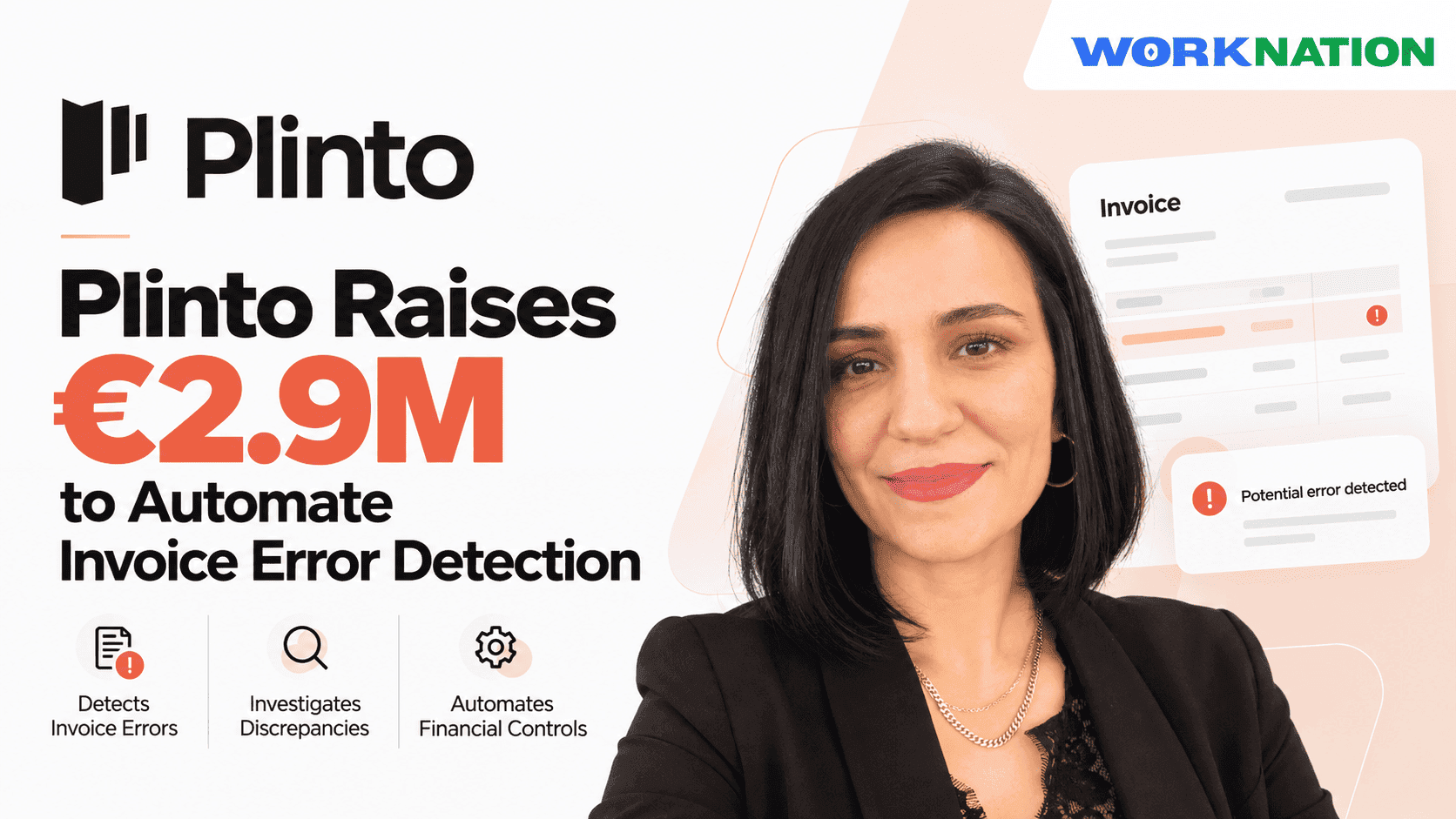
Copenhagen-based fintech startup Plinto has raised €2.9 million in pre-seed funding to develop AI agents that identify financial discrepancies, investigate payment issues, and help businesses resolve errors before they affect their bottom line.
The round was backed by People Ventures, Emblem, and several business angels. Founded by former Peakon employees, Plinto is building an AI-powered financial control platform that compares business transactions against contracts, budgets, and internal policies. When the system identifies a discrepancy, its agents can investigate the issue and help coordinate the steps needed to resolve it.
The company is targeting a problem that finance teams often face: accounting systems record transactions, but verifying that every payment follows the correct agreement and business rules can still require extensive manual work.
Plinto aims to automate those checks while keeping human employees in control of decisions and actions taken by its AI agents.
From Financial Dashboards to AI-Powered Controls
Plinto was founded by Jakob Nielsen, Nermina Suljevic, and Sebastian Rehnby, alongside chief technology officer Andreas Garnæs. All four previously worked at Peakon, the Copenhagen-based employee feedback software company acquired by Workday in 2021 for approximately $700 million.
The founders initially approached the financial management market through business intelligence dashboards. Their early product focused on helping companies understand financial information through data visualisation and reporting.
However, feedback from a chief financial officer changed the direction of the business.
According to the source article, the CFO questioned whether the figures displayed on the dashboard could be trusted. The founders recognised that presenting financial data was not enough if finance teams still had to manually verify whether individual transactions matched contracts, budgets, and company policies.
The emergence of new AI capabilities in late 2024 helped the team explore a different approach: automating complex financial checks rather than simply displaying their results.
Plinto launched at the beginning of 2025. During its first year, Nielsen worked closely with finance teams and CFOs at a pilot customer, providing on-site support to understand how the technology could fit into existing financial workflows.
That experience helped shape the company's current focus on AI agents that identify and investigate discrepancies and support their resolution.
How Plinto's AI Agents Work
Plinto connects with a company's existing financial and operational systems, including accounting software, documents, banking systems, and communication platforms such as Slack and Microsoft Teams.
Rather than operating as a standalone accounts payable product, the company positions its technology as background infrastructure that works alongside the tools businesses already use.
Its agents compare recorded transactions with relevant agreements and rules, then investigate potential deviations. Depending on the circumstances and the customer's preferences, they can notify employees, recommend an action, or draft a message to a supplier.
For example, if an invoice appears inconsistent with a contract, the system can flag the discrepancy and help gather the information needed to resolve it. If a duplicate invoice appears under a slightly different supplier name, the system may identify the duplication even when the records are not identical.
Plinto divides work among specialised agents and says it continuously monitors their performance. Multiple agents can also be assigned to the same problem.
The objective is to reduce the amount of manual checking required from finance teams while making financial controls more continuous.
Importantly, the platform is designed to retain human supervision. Customers can determine how much autonomy the system receives, ranging from simply prompting an employee to suggesting an action or preparing a communication for approval.
This approach allows Plinto to automate parts of financial control without requiring businesses to hand over every decision to an AI system.
The company has not disclosed detailed technical benchmarks for its agents, including independently verified detection accuracy or the financial value of discrepancies resolved across its customer base.
Why Invoice Errors Matter for Businesses
Financial discrepancies can arise in many ways. An invoice may be duplicated, a supplier may charge an amount inconsistent with an agreement, or a payment may not follow the company's purchasing policies.
Individually, these problems may appear minor. Across thousands of transactions, however, repeated errors can create meaningful costs, particularly for businesses operating on tight margins.
Finance teams often need to review invoices, compare records, contact suppliers, and coordinate with colleagues before discrepancies can be resolved. When these checks depend heavily on manual processes, some issues may remain undetected until after a payment has been made.
Plinto wants to move these controls earlier in the process by monitoring transactions and identifying irregularities continuously.
Co-founder Nermina Suljevic highlighted the importance of small errors for businesses operating with low margins. The company's goal is to help organisations catch and resolve discrepancies before they affect financial results.
The platform's potential value extends beyond duplicate invoice detection. By connecting transactions with contracts, budgets, and policies, Plinto aims to help finance teams identify deviations from the rules governing their spending.
However, the company has not published an overall estimate of customer savings or disclosed how much the issues detected by its system have been worth. Its commercial value will depend on whether detected discrepancies can be resolved efficiently and whether those improvements justify the cost of adopting the platform.
Early Customer Activity and Pilot Projects
Plinto reports that it already has several customers and is involved in pilot projects across logistics, real estate, facility services, and food production.
One customer application reportedly identified around 430 problems each month within a single business area. The company did not disclose the total financial value of those issues or how many were ultimately resolved.
In another case, Plinto detected a duplicate invoice that used a slightly different supplier name. This example illustrates the kind of inconsistency that can be difficult to catch through simple matching of invoice records.
These early applications suggest that the technology is being tested in businesses with different operational requirements. They do not, on their own, establish the platform's overall accuracy or the scale of its financial impact.
For Plinto, converting pilot projects into repeat commercial contracts will be an important next step. It will need to demonstrate that its agents consistently identify meaningful discrepancies, fit into existing workflows, and help customers resolve problems without introducing additional administrative work.
Plinto's Funding and Growth Plans
The €2.9 million pre-seed round was backed by People Ventures, Emblem, and several business angels.
The company plans to use the funding primarily to recruit additional employees and strengthen its product, engineering, sales, and customer success functions.
Plinto currently has eight employees, four of whom are managers, according to the source article. Co-founder Suljevic intends to coordinate these functions as the company develops its platform and prepares for a potential future funding round.
Building the team will be important as Plinto moves from hands-on pilot support toward a more scalable product and sales operation.
Its immediate challenge is not simply to build more sophisticated AI agents. It must also establish a repeatable way to deploy the technology across different companies, integrate it with existing systems, and demonstrate measurable value.
The company has not disclosed a valuation, revenue figures, or a specific timeline for its next funding round.
Competition in AI-Powered Financial Control
Plinto operates in a market where several categories of software are beginning to overlap.
Traditional enterprise resource planning systems and accounts payable platforms already help companies manage invoices, payments, and financial records. General-purpose AI models can also assist with document analysis and financial workflows.
Plinto's stated differentiation is its focus on continuous financial control: comparing transactions with contracts, budgets, and policies, investigating deviations, and helping resolve them through AI agents.
The market is also attracting startups with more specialised approaches.
Munich-based Finto raised $3.4 million in July 2026 to develop AI agents that match invoices with purchase orders and handle mismatches. Its focus overlaps with some of Plinto's capabilities, although the two companies may differ in their broader product scope.
Repodo, which raised €8.2 million in August 2026, focuses on AI-powered auditing. Plinto, by contrast, positions itself around controls that operate before a formal audit, with the aim of catching and resolving issues earlier.
These companies reflect growing interest in applying AI to financial processes that have traditionally required significant manual review.
For Plinto, the competitive opportunity lies in establishing a clear position between conventional finance software and broader AI tools. The company will need to show that its specialised agents can reliably work across existing systems and produce results that generic tools or established financial platforms cannot easily replicate.
What Comes Next for Plinto?
Plinto's €2.9 million pre-seed round gives the company capital to expand its team and develop its AI-driven financial control platform.
Its approach addresses a practical business problem: recording transactions is not the same as ensuring that every transaction complies with the relevant agreement, budget, and policy.
By connecting to existing systems and deploying agents to investigate discrepancies, Plinto hopes to help finance teams move away from repetitive manual checks toward more continuous oversight.
The company's early pilots offer initial examples of the problems its technology can identify, but the next stage will require stronger evidence of customer retention, financial savings, and repeatable commercial adoption.
As larger finance software providers and specialised AI startups expand their capabilities, Plinto's ability to turn promising pilots into lasting customer relationships will be central to its growth.
The €2.9 million round is an early step toward that goal. The real test will be whether the startup can make automated financial control reliable enough to become a routine part of how businesses manage their money.
Have a Funding Round or Exciting Update to Share?
Submit your press release to get featured on WorkNation and reach founders, investors, and tech leaders.