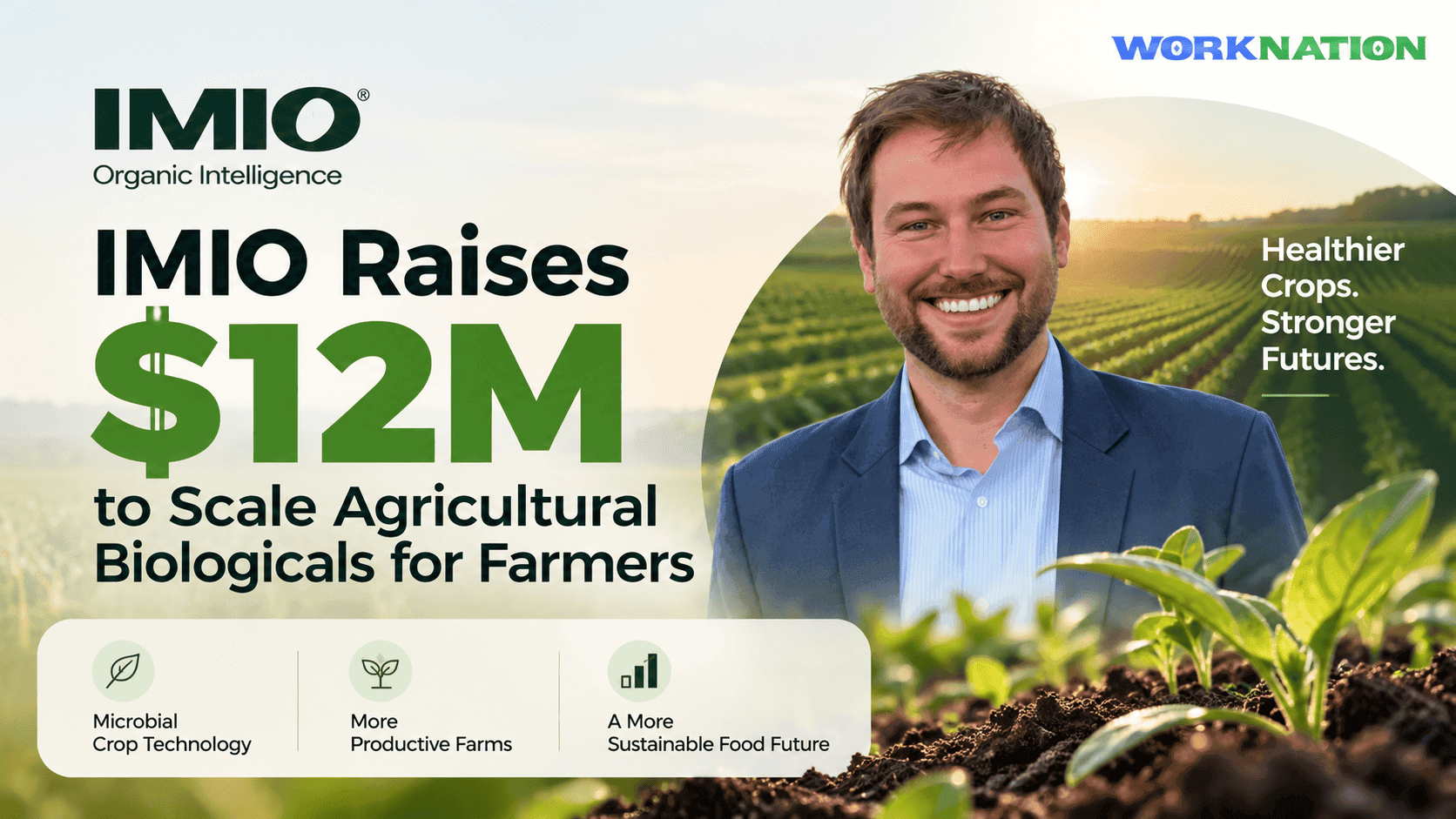
IMIO Raises $12M from Sofinnova and Chipotle’s Cultivate Next to Scale Agricultural Biologicals
Top Picks
Submit PR
Stay Ahead of the Market
Get the latest startup funding, hiring trends and global opportunities delivered to your inbox every week.
IMIO, a US agricultural biotechnology startup, has raised $12 million in funding to expand its microbial crop technology and establish a headquarters, laboratory and biomanufacturing facility in Chicago. The round was led by Sofinnova Partners, with participation from Cultivate Next, Chipotle's venture fund, alongside Starshot Capital, Grow Together Salinas, Earth Foundry and Serra Ventures.
Founded by Charles Smith in 2019, IMIO develops freeze-dried microbial products designed to accelerate the decomposition of crop residue and return nutrients to the soil. The company is targeting a practical challenge in agriculture: helping farmers use biological products consistently within existing farming operations.
IMIO says its microbial product, Re-Gen, has increased corn yields by an average of 11.9 bushels per acre in its reported results. The company is generating revenue and employs 10 people, including part-time executives, according to Smith.
The new funding will support infrastructure and manufacturing capabilities intended to help the startup develop and scale its technology.
What Does IMIO Do?
Agricultural biologicals are products derived from living organisms, including bacteria and fungi, that can support crop production, soil health and other agricultural processes.
They are attracting interest as farmers and agricultural businesses explore ways to improve nutrient cycling, manage crop residue and complement conventional farming inputs. However, adopting biological products can be challenging when their performance varies across conditions or when application methods do not fit established farming practices.
IMIO is focused on crop residue, the plant material left behind after harvesting. This material can affect field management, soil productivity and nutrient availability. Depending on the crop and conditions, residue can also retain pathogens.
The company's Re-Gen product contains selected microbial strains that are combined in specific proportions and freeze-dried. Farmers mix the powder with water and apply it to crop residue.
According to IMIO, the combination of fungi, bacteria and yeast accelerates decomposition, helping return nutrients to the soil.
The company supplies Re-Gen for row crops and produce. While its early development work focused on hemp stalks, corn and vegetable crops have become larger commercial markets for the business.
Rather than positioning its product as a complete replacement for conventional agricultural inputs, IMIO is working within a market where biologicals are generally used alongside existing farming products.
Why Reliability Matters in Agricultural Biologicals
One of the central challenges facing agricultural biologicals is consistency in real-world conditions.
Products based on living organisms must remain viable through storage, transportation and application. Their performance can also depend on how they interact with soil, crop residue, weather and established farm practices.
IMIO argues that many biological products have been difficult to use reliably alongside conventional farming methods. The company sees product formulation and delivery as important parts of addressing this problem.
Its approach involves evaluating individual microbial strains, testing them and combining them in specific proportions before freeze-drying the resulting mixture.
Freeze-drying is intended to help maintain product stability during storage and transportation. Farmers can then mix the powder with water before applying it to fields.
This delivery format is important because agricultural products must work within operational conditions that can be very different from those in a controlled laboratory. Farmers need products that can be stored, transported and applied using practical methods, with results that justify their cost.
The broader market still relies heavily on biologicals as supplementary products. The article cites survey findings that 98% of respondents said growers use biologicals alongside conventional products, while only 2% reported using them as complete replacements.
For IMIO, the opportunity is to demonstrate that a microbial product can deliver measurable value without requiring farmers to overhaul their existing operations.
From Food Waste Research to Crop Residue Technology
IMIO's origins lie in Charles Smith's interest in food waste and its environmental consequences.
Before founding the company, Smith worked in finance and at venture-backed software startups. He later began researching environmental problems, including the amount of food produced worldwide that goes to waste.
Smith has highlighted the environmental impact of discarded food, particularly the greenhouse gases associated with organic waste decomposition.
He founded IMIO in 2019, and the company received funding from the National Science Foundation in 2020. According to Smith, its first product, Re-Gen, emerged from work supported by that grant.
The initial development programme focused on hemp because the grant was oriented towards the crop. Early versions of the product were designed to break down hemp stalks.
The company subsequently adjusted its commercial focus as it identified larger opportunities in corn and vegetable production.
That shift illustrates how the startup moved from an initial research application towards a broader agricultural market. Instead of limiting its technology to a single crop, IMIO is applying microbial formulations to residue management across different farming settings.
The company's next stage will depend on translating that technical development into reliable manufacturing and repeatable field performance.
What the Corn Yield Results Show
IMIO says its freeze-dried microbial products increased corn yields by an average of 11.9 bushels per acre.
This is a notable result because farmers evaluate agricultural technologies partly through their effects on yields, input costs and field operations. A measurable yield improvement could make a biological product more attractive if it can be reproduced under commercial farming conditions.
However, the reported figure should be treated as a company-reported result. The supplied article does not provide the full trial methodology, sample size, geographic distribution, comparison groups or statistical analysis needed to independently assess the finding.
The result therefore represents an indication of the company's reported performance, rather than proof that every farmer or field will achieve the same improvement.
Consistency will be particularly important as IMIO expands. A product must perform across varying field conditions and be manufactured in batches with dependable microbial activity.
The company will need to show that its formulations can deliver repeatable results beyond individual trials and that the economic benefits justify the cost of adoption.
For farmers, the relevant question is not simply whether a microbial product can improve crop performance, but whether it can do so reliably enough to support purchasing decisions across multiple growing seasons.
Why Sofinnova Partners and Chipotle's Cultivate Next Invested
Sofinnova Partners led the $12 million round. Cultivate Next, Chipotle's venture fund, also participated, alongside Starshot Capital, Grow Together Salinas, Earth Foundry and Serra Ventures.
The investment brings together backers interested in agricultural technology, biological innovation and improvements across the food system.
Sofinnova partner Guillaume Baxter said crop residue presents a challenge for farmers because it can affect soil productivity and increase input costs. He described IMIO's combination of biotechnology and scalable biomanufacturing as a way to use microorganisms to restore soil health, recycle nutrients and improve farm economics.
Christian Gammill, co-general partner at Cultivate Next, highlighted the importance of making innovation practical for growers and connecting farmers with food buyers.
For an agricultural biotechnology company, that emphasis on practical value is significant. Technical innovation alone does not guarantee adoption. Products must also fit into existing operations, deliver dependable outcomes and offer a clear economic rationale for farmers.
The involvement of Chipotle's venture fund also reflects an interest in technologies that could contribute to improvements across the wider food system. The supplied article does not specify a direct commercial agreement between Chipotle and IMIO.
Building a Chicago Laboratory and Biomanufacturing Facility
IMIO plans to use the funding to establish its headquarters, laboratory and biomanufacturing plant in Chicago.
The facility is expected to support the company's product development and manufacturing ambitions. For a business that relies on carefully selected and formulated microbial strains, the ability to develop products and produce them consistently is central to scaling.
Laboratory infrastructure can support strain testing and formulation work, while manufacturing capabilities can help the company move from product development towards larger-scale supply.
The challenge is ensuring that commercial production maintains the characteristics required for the product to perform as intended. Microbial products must remain stable and viable through manufacturing, storage, transportation and application.
The new facility could give IMIO greater control over those processes as it serves more customers. However, the funding announcement does not specify the plant's production capacity, construction timeline or planned manufacturing volumes.
Smith has said the company is already generating revenue, providing an early commercial foundation for its next stage of development.
A Competitive Agricultural Biologicals Market
IMIO operates in a growing agricultural biologicals market. The supplied article cites a MarketsandMarkets forecast projecting the sector will reach $34.99 billion by 2030, with a compound annual growth rate of 13.7%.
That market includes companies working with microorganisms to support crop growth, nutrient availability and crop protection.
One competitor is Pivot Bio, based in Berkeley, California, which sells nitrogen-producing microbes for application at planting. Belgium-based Aphea.Bio develops microbial biostimulants and biocontrol products.
IMIO's focus differs in that it works with post-harvest crop residue and microbial formulations intended to accelerate its decomposition.
The startup is also raising capital in a difficult environment for some agricultural and climate technology businesses. The article notes that numerous agrifood and climate technology companies experienced significant difficulties or collapsed between 2023 and early 2026.
At the same time, farm economics remain under pressure. The US Department of Agriculture's 2026 net farm income estimate, cited in the article, was $158.4 billion, down 2.6% from 2025 and 5.5% lower after adjusting for inflation.
These conditions increase the importance of demonstrating a direct benefit to growers. Farmers considering a new product need evidence that it can improve productivity, manage costs or deliver other measurable advantages.
What Comes Next for IMIO?
The $12 million funding round gives IMIO resources to develop its Chicago facilities and pursue broader commercial adoption.
Its opportunity rests on addressing an identifiable agricultural problem with a product designed to fit into existing farm practices. Its reported corn yield results offer an early performance indicator, while its focus on microbial stability and residue decomposition provides a defined technical direction.
The next test is whether IMIO can reproduce those results consistently across farms, crops and environmental conditions while manufacturing its products at a larger scale.
It will also need to demonstrate that its products provide sufficient economic value to encourage repeat purchases in a market where farmers are careful about adding new costs.
For now, IMIO is moving from its early research roots towards a more substantial agricultural biotechnology operation. The new funding will help build the infrastructure required for that transition, but long-term success will depend on reliable field results and commercially sustainable production
Have a Funding Round or Exciting Update to Share?
Submit your press release to get featured on WorkNation and reach founders, investors, and tech leaders.