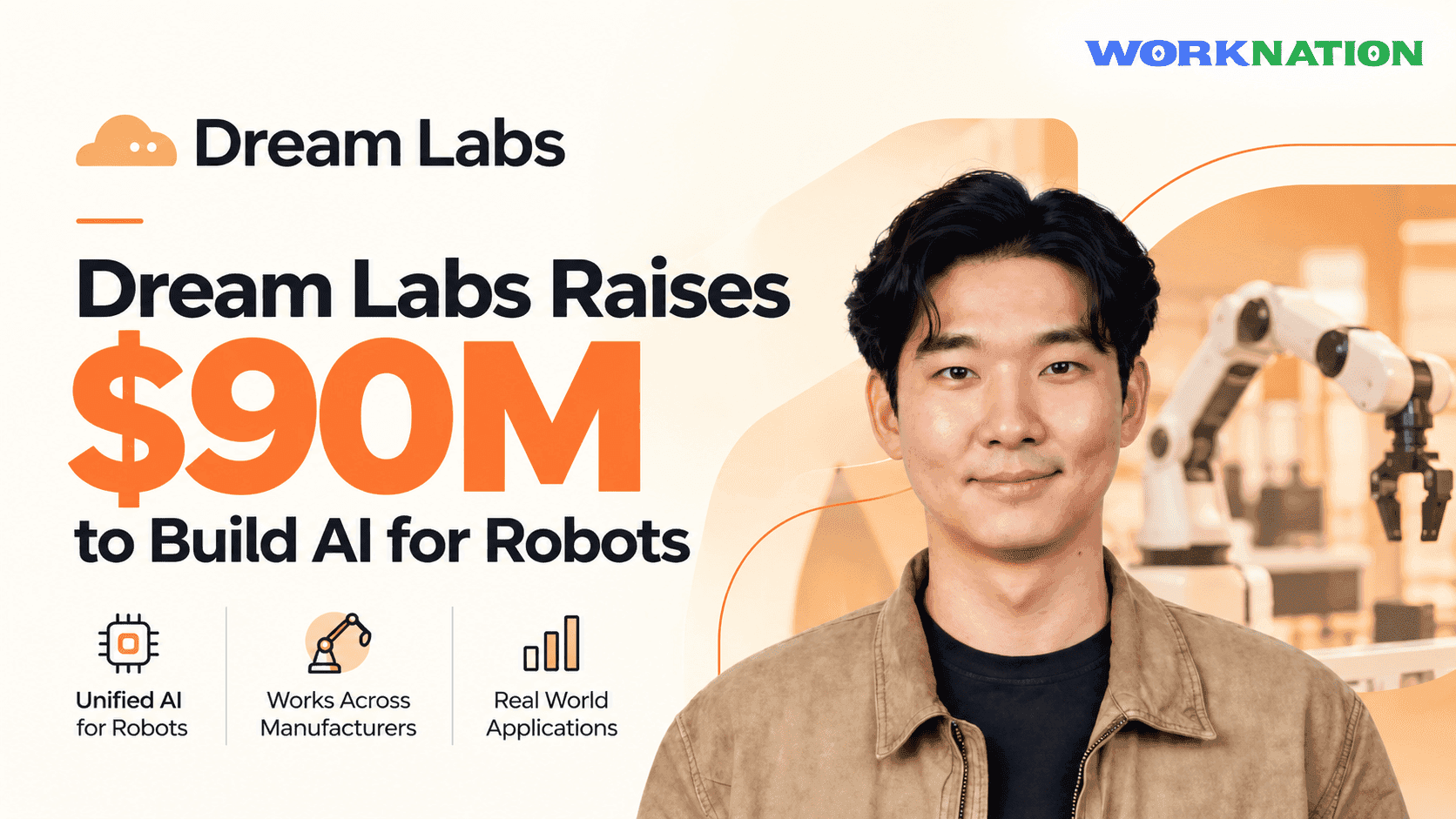
Dream Labs Raises $90M Seed to Build a Shared AI Brain for Robots
Top Picks
Submit PR
Stay Ahead of the Market
Get the latest startup funding, hiring trends and global opportunities delivered to your inbox every week.
San Francisco-based robotics startup Dream Labs has raised $90 million in seed funding to develop artificial intelligence models that allow robots from different manufacturers to perform tasks using a shared AI system. Founded in 2026 by former NVIDIA robotics researchers, the company aims to make robots easier and cheaper to deploy by reducing the time and specialised engineering required to teach them new skills.
The funding round was led by B Capital and Kindred Ventures, with participation from A.Capital, Unusual Ventures, SV Angel, Wing VC, Scribble VC, Adrian Aoun, and other investors.
Announced on October 19, 2026, the investment coincided with the launch of Dream API, a platform that translates camera feeds and plain-English instructions into robot motor commands. Dream Labs says its technology can work with robots it has not previously encountered, potentially allowing developers to deploy AI-powered capabilities without building a separate intelligence system for every machine.
The company's first model, Dream-1, currently focuses on tabletop tasks such as picking up and placing objects and folding laundry. Support for mobile robots and more dexterous robotic hands remains part of its future roadmap.
From NVIDIA Robotics Research to a Startup
Dream Labs was founded by former NVIDIA robotics researchers seeking to make robotic intelligence more accessible.
Its co-founder and CEO, Joel Jang, previously worked as a senior research scientist at NVIDIA's GEAR Lab, where he led the world-model team for Project GR00T, NVIDIA's robotics initiative.
Jang's research included DreamZero, a world action model described in a February 2026 research paper. The paper presented a 14-billion-parameter model that could adapt to a new robot using approximately 30 minutes of demonstration data.
That research provides context for Dream Labs' current approach: developing models that can transfer learned skills between different robotic platforms rather than relying entirely on robot-specific programming and training.
The startup's central argument is that the availability of affordable robot hardware has advanced faster than the software required to make those machines useful. Even when a robot costs only a few thousand dollars, teaching it a particular task can still require specialist expertise and extensive development time.
Dream Labs wants to reduce that barrier by building a shared AI model that developers can access through an API.
Instead of training a new model for every robot and application, developers could connect compatible hardware to Dream Labs' platform and provide instructions describing the task they want it to perform.
The company's longer-term opportunity depends on how reliably that approach works across different robots, environments, and real-world tasks.
How Dream-1 Gives Robots a Shared AI Brain
Dream-1 is designed to interpret human demonstrations and translate them into robotic actions.
According to Dream Labs, the model is trained on videos of people performing everyday activities. It learns patterns in how tasks unfold and uses that information to predict subsequent actions for a robot.
This differs from approaches that depend heavily on collecting demonstrations from a specific robot or programming individual movements for each application.
Because Dream-1 learns from human video, Dream Labs argues that its capabilities can transfer across hardware platforms. The company says the model can control robots equipped with grippers without task-specific training on the target robot, an approach commonly described as zero-shot transfer.
The practical objective is to make a new robot useful much faster than traditional development workflows allow.
CEO Joel Jang compares the concept to driving a rental car. A driver does not need to relearn how to drive every time they encounter a different vehicle. They adapt to the available controls while applying previously acquired skills.
Dream Labs wants robotic AI to work in a similar way: retaining general task knowledge while adapting its actions to the hardware it encounters.
However, the scope of the current model is important. Dream-1 is focused on tabletop manipulation, including picking up and placing objects and folding laundry. The company has not yet demonstrated its full vision across every category of robot.
Its claims about cross-hardware performance will need to be evaluated across varied objects, environments, robot designs, and task conditions.
Dream API Opens Access to Developers
Dream Labs launched Dream API alongside its funding announcement.
The API allows developers to send a robot's camera feed and a natural-language instruction to the company's system, which generates motor commands for the machine.
The platform runs Dream Labs' models in data centres and is designed to let developers integrate robotic intelligence without building the entire AI infrastructure themselves.
The company also offers a fine-tuning service. Developers can submit a small set of demonstrations, allowing Dream Labs to return a customised model within hours, according to the source article.
This creates two potential routes for adoption. Developers can use the general-purpose model for tasks it already supports or customise a model for specific requirements using additional demonstration data.
Dream Labs has also introduced a browser-based Robot Playground. Users can enter instructions and watch a robot in the company's San Francisco office respond in real time. The startup presents this as an opportunity to test its technology directly rather than relying exclusively on edited demonstration videos.
Forbes reported that Dream-1 pricing starts at $3 per hour, with a cheaper model available at 75 cents per hour. These reported rates provide an early indication of the company's usage-based pricing approach, although total deployment costs may also include hardware, integration, networking, and other operational expenses.
Dream Labs says it works with more than 20 hardware partners, with supported robots generally costing between $2,000 and $10,000.
If the model can deliver useful performance across this hardware range, the combination of relatively affordable robots and remotely accessible AI could lower the barrier to experimentation for developers and businesses.
Why Affordable Robot Intelligence Matters
Robotics has historically required a combination of mechanical engineering, control systems, specialised software, and task-specific development.
A business purchasing a robotic arm may still need engineers to program its movements, collect training data, test its performance, and adapt it to changing requirements. Those costs can make deployment difficult even when the physical machine itself is relatively affordable.
Dream Labs is targeting this gap between the cost of robot hardware and the cost of making it operational.
A shared model could allow developers to reuse learned capabilities across machines, potentially reducing duplicated engineering work. An API-based service could also provide access to increasingly capable models without requiring every company to train and maintain its own robotics AI system.
Possible applications could eventually include warehouse operations, repetitive handling tasks, and other environments where robots interact with physical objects. These are potential applications of the broader approach, not confirmed commercial deployments disclosed in the source article.
The company's immediate focus remains narrower. Dream-1 currently handles tabletop manipulation, while support for wheeled mobile robots and dexterous hands is planned for later development.
That distinction matters because navigating a changing environment, manipulating delicate objects, and coordinating complex movements introduce different technical challenges.
Dream Labs will need to show that its model can operate reliably outside controlled demonstrations and across a sufficiently broad range of real-world conditions.
Dream Labs Enters a Crowded Robotics AI Market
Dream Labs is entering a competitive field that includes startups developing general-purpose robotic intelligence, video-trained models, and integrated humanoid systems.
Skild AI raised approximately $1.4 billion in January 2026, led by SoftBank, at a reported valuation above $14 billion. Rhoda AI raised $450 million at a $1.7 billion valuation in March 2026. Genesis AI emerged from stealth in July 2025 with $105 million in seed funding, while FieldAI announced $405 million across two rounds in August 2025.
Figure represents a different approach, developing its own humanoid robots alongside its AI capabilities. The company closed a Series C exceeding $1 billion at a reported $39 billion valuation in September 2025.
Dream Labs' positioning is distinct in one important respect: it aims to provide intelligence for robots made by other companies rather than requiring customers to purchase a single proprietary robot platform.
Its focus on relatively affordable hardware and developer access through an API could appeal to robotics manufacturers, software developers, and businesses that want to experiment with automation using existing machines.
However, a shared model is not automatically a competitive advantage. Dream Labs must demonstrate that it can match the reliability, task coverage, and performance of specialised systems while supporting different hardware configurations.
The company also faces substantial infrastructure demands. Training and running advanced robotics models requires computing resources, and the startup plans to allocate much of its new funding toward compute capacity, expanding the range of supported tasks and robots, and serving more users.
What the $90M Funding Will Support
The $90 million seed round gives Dream Labs substantial capital to develop its model and expand its platform.
B Capital and Kindred Ventures led the investment, joined by A.Capital, Unusual Ventures, SV Angel, Wing VC, Scribble VC, Adrian Aoun, and other investors.
The company intends to use the funding primarily for computing infrastructure and to broaden Dream-1's capabilities across additional tasks and robot types.
That work is central to its strategy. Supporting more robots and more complex tasks will require additional training, evaluation, and engineering. The company will also need enough infrastructure to handle growing API demand.
The source article does not disclose Dream Labs' valuation, revenue, customer count, or commercial contracts. Its announcement of more than 20 hardware partners indicates breadth in its hardware relationships, but the precise nature of those partnerships is not specified.
The funding is therefore an early investment in the company's technical and commercial ambitions rather than proof that a universal robotic intelligence platform has already been achieved.
The Road Ahead for Dream Labs
Dream Labs is betting that robotics will become more accessible when developers can separate the intelligence layer from the physical machine.
Its API, video-trained Dream-1 model, and relationships with hardware partners form the foundation of that approach. The immediate challenge is to expand beyond tabletop tasks while maintaining dependable performance across different robots.
The broader market offers significant potential. The International Federation of Robotics reported a record five million industrial robots operating in factories in 2025, with installations rising that year. However, industrial robots represent a different category from the tabletop machines Dream-1 currently supports, so the figures should be viewed as wider robotics market context rather than an estimate of Dream Labs' addressable market.
The company must also compete with better-funded rivals investing in models, compute infrastructure, and robot-specific data.
Ultimately, Dream Labs' success will depend on whether developers can use its technology to deploy useful robotic applications faster and more economically than existing alternatives.
The $90 million seed round gives the former NVIDIA researchers significant resources to pursue that vision. The next milestone is demonstrating that a shared AI brain can move from promising tabletop demonstrations to reliable performance across a much wider range of real-world robots.
Have a Funding Round or Exciting Update to Share?
Submit your press release to get featured on WorkNation and reach founders, investors, and tech leaders.