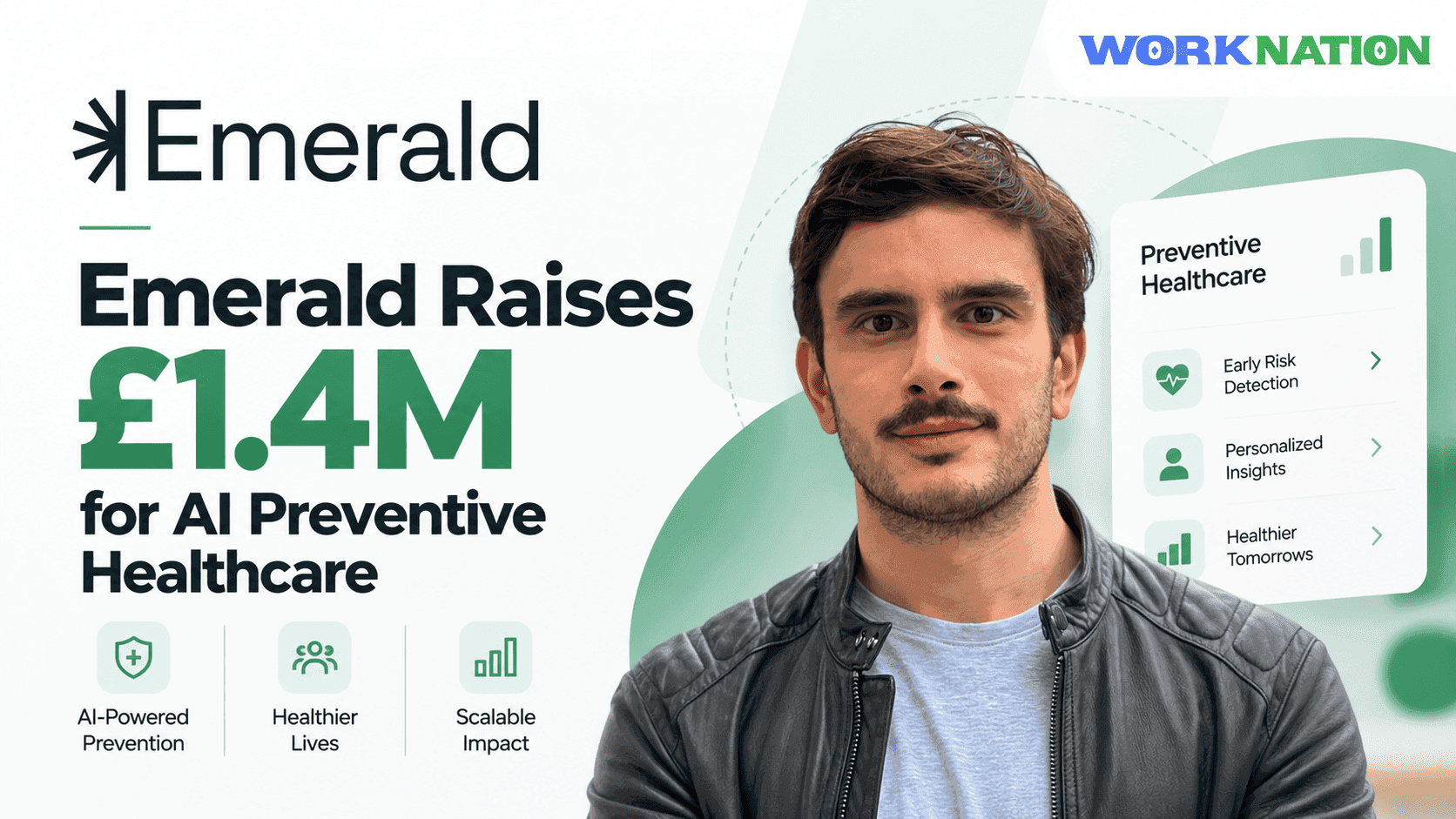
Emerald Raises £1.4M to Scale AI-Powered Preventive Healthcare, Targets 1M Members
Top Picks
Submit PR
Stay Ahead of the Market
Get the latest startup funding, hiring trends and global opportunities delivered to your inbox every week.
London-based preventive healthcare startup Emerald has raised £1.4 million in new funding, bringing its total funding to £2.9 million. Founded by former Revolut and Peakon-era technology entrepreneurs alongside a clinician, the company is developing a preventive health platform that combines laboratory testing, general practitioner (GP) support, wearable data, and AI-enabled technology.
The latest funding includes a £700,000 grant from Innovate UK and another £700,000 from venture capital investors. Existing investors participated in the round, alongside Boost Capital Partners, while Sequel and Highgoal Capital joined as new investors.
Emerald plans to use the funding to expand commercially, develop its product, strengthen its clinical services, and advance its AI capabilities. The company has set an ambitious target of reaching one million members within the next three years.
According to Emerald, its membership grew tenfold during 2026, and the company has conducted more than 100,000 laboratory tests. These figures are company-reported, while its expansion target will depend on its ability to acquire and retain members in an increasingly competitive preventive healthcare market.
From a Credit Card Concept to Preventive Healthcare
Emerald's origins were different from its current healthcare focus.
Co-founders Alexander Badalyan and Anton Shchipanov initially explored building a premium credit card that could compete with American Express and Yonder. However, customer interviews revealed stronger interest in preventive healthcare benefits, including health screenings and access to general practitioners.
The founders subsequently changed direction and established Emerald in 2024 with Dr Dan McNally, who oversees clinical operations.
Badalyan, the company's chief executive, previously co-founded Mashroom, a UK-based property technology and insurance startup. Shchipanov, the chief technology officer, previously worked on software at Revolut.
McNally brings clinical experience to the founding team. He has worked as an NHS clinician, advised health technology companies at Oliver Wyman, and published a study examining COVID-19 mortality over 28 days in London.
The combination of technology, business, and clinical expertise underpins Emerald's approach: connecting health data and testing with professional medical guidance rather than leaving members to interpret test results on their own.
The company initially raised £625,000 from European founders, operators, and professional athletes. In January 2026, it announced another $1.2 million, bringing its reported pre-seed funding to $2 million at that stage. The latest £1.4 million round brings its total funding to £2.9 million, according to the October 2026 report.
Emerald says its valuation has increased since its previous round, but it has not disclosed the valuation figures.
How Emerald's Preventive Healthcare Platform Works
Emerald combines laboratory screening with an app that brings together test results, wearable data, and an individual's health history.
The objective is to give members a more connected view of their health and help them understand what their results may mean for their future wellbeing.
Members receive access to a general practitioner who can assess their health concerns, diagnose conditions, prescribe medication where appropriate, and refer them to private or NHS services.
For example, if a screening identifies high cholesterol, a member can discuss the results with their GP and receive guidance on potential treatment or further care.
This approach extends beyond the testing process itself. Rather than simply providing laboratory results, Emerald aims to connect screening with follow-up medical support.
That distinction matters because identifying a potential health issue is only one part of preventive care. Members also need to understand the findings and determine whether further investigation, lifestyle changes, treatment, or specialist referral is appropriate.
Emerald delivers its service through direct healthcare access and partnerships with employee benefits platforms. Employers can offer the service as a workplace benefit, allowing staff to access screenings and follow-up care.
The company works with organisations including Pluxee, Epassi, and Yonder, alongside other businesses in employee benefits, fintech, and fitness.
Through these partnerships, Emerald aims to reach employees who may otherwise have limited access to convenient preventive health services.
AI and Clinical Technology
AI-enabled technology is an important part of Emerald's development plans.
The latest Innovate UK grant is intended to support advances in AI applications and the company's underlying technology. Innovate UK's digital health innovation lead, Chris Sawyer, said the award supports the development of AI-enabled technology designed to help clinicians provide more personalised, proactive care.
The company has not disclosed detailed information about its AI systems, the specific clinical tasks they automate, or independent evaluations of their performance.
Its broader platform combines health information from multiple sources, including laboratory tests, wearable devices, and personal health history. Integrating these data points could help provide clinicians with a more complete picture of an individual's health, although the actual benefits depend on data quality, appropriate clinical interpretation, and effective follow-up.
Emerald also reports that it is registered with the Care Quality Commission to carry out diagnostic and screening procedures and to treat disease, disorder, or injury. It further states that it has UK Conformity Assessed Class I medical device status through the Medicines and Healthcare products Regulatory Agency framework.
These regulatory arrangements form part of the company's healthcare operating model. They should not be interpreted as evidence that every feature or AI capability has independently demonstrated improved health outcomes.
Emerald Reports Tenfold Membership Growth
Emerald says its membership increased tenfold since early 2026 and that it has carried out more than 100,000 laboratory tests.
The company has also reported improvements in certain health indicators among users who underwent follow-up screenings. According to Emerald, cholesterol levels improved for two out of every three users, blood sugar decreased by a third, and inflammation dropped by nearly half.
These are company-reported results. The article does not provide the underlying study design, sample sizes, comparison groups, or detailed methodology needed to independently assess these findings.
Even so, the reported activity points to the company's focus on linking testing with ongoing health management.
Emerald co-founder and CEO Alexander Badalyan said people want more than tests alone. They want to understand their results and take practical steps to improve their long-term health with guidance from trusted medical professionals.
That approach is central to Emerald's positioning: combining health screening, data integration, and GP access in one service.
However, membership growth and the number of tests conducted do not automatically demonstrate long-term improvements in health outcomes. Sustaining engagement, ensuring appropriate follow-up, and measuring clinical effectiveness will be important as the company scales.
New Funding to Support Commercial Expansion
Emerald will allocate the new capital to commercial growth, product development, and clinical services.
The £700,000 Innovate UK grant will support its AI applications and core technology, while the remaining £700,000 comes from venture capital investors.
Existing investors participated in the round, joined by Boost Capital Partners, Sequel, and Highgoal Capital.
The funding gives Emerald additional resources to strengthen its product and broaden its reach through partnerships. The company has not announced a specific hiring target or provided updated employee numbers in the latest report. It had approximately 12 employees as of January 2026.
Its goal of reaching one million members within three years will require a substantial increase in distribution and service capacity. Partnerships with employee benefits providers could help it reach larger populations without relying exclusively on individual consumer acquisition.
At the same time, the company will need to ensure that its clinical services can keep pace with membership growth.
Competition in the Preventive Healthcare Market
Emerald is operating in a market attracting substantial investment, with competitors using different approaches to preventive health screening and personalised care.
Neko Health, which operates scanning clinics in the UK, raised $700 million in Series C funding in July 2026 and reached a reported valuation of nearly $7 billion.
US-based Function Health raised $450 million in growth funding from General Catalyst and says it has more than 500,000 members. Australian startup Everlab raised AU$65 million in June 2026 and plans to expand into the UK. UK preventive health startup Stride also raised £4.6 million in seed funding in October 2026.
While Neko Health and Function Health focus heavily on direct-to-consumer scanning or laboratory testing, Emerald combines partner-laboratory screenings with GP support, prescribing, and referrals. It also uses employer benefits platforms as a distribution channel.
This difference could help Emerald reach members through established workplace relationships, although its success will depend on the value employers and employees see in the service.
Market forecasts also suggest substantial long-term commercial interest in preventive healthcare. Precedence Research estimates that the global preventive healthcare technologies and services market was worth $336.17 billion in 2025 and projects it could reach $920.31 billion by 2034. Transparency Market Research offers a lower forecast of $773.1 billion by 2034.
These are external market estimates, not forecasts of Emerald's potential revenue. The difference between them also illustrates the uncertainty involved in defining and projecting the market.
Can Emerald Reach One Million Members?
Emerald's target of one million members within three years represents a major growth ambition for a company with £2.9 million in total reported funding.
The company has several potential growth channels: employer benefits, partnerships with fintech and fitness businesses, laboratory screening, and GP-led follow-up care.
Its integrated approach could appeal to customers who want a clearer connection between test results and access to medical professionals. But scaling healthcare services requires more than expanding a software platform. Clinical capacity, service quality, data protection, member retention, and appropriate medical oversight will all matter.
The company will also face competition from better-funded businesses with established brands and substantial resources for expansion.
Emerald's latest funding provides support for its next phase, particularly AI development, commercial partnerships, and clinical services. Its reported membership growth offers an early indicator of demand, but reaching one million members will require sustained execution.
Ultimately, Emerald's progress will depend on whether it can turn preventive screening into an accessible, trusted, and repeatable healthcare service that members continue to use
Have a Funding Round or Exciting Update to Share?
Submit your press release to get featured on WorkNation and reach founders, investors, and tech leaders.