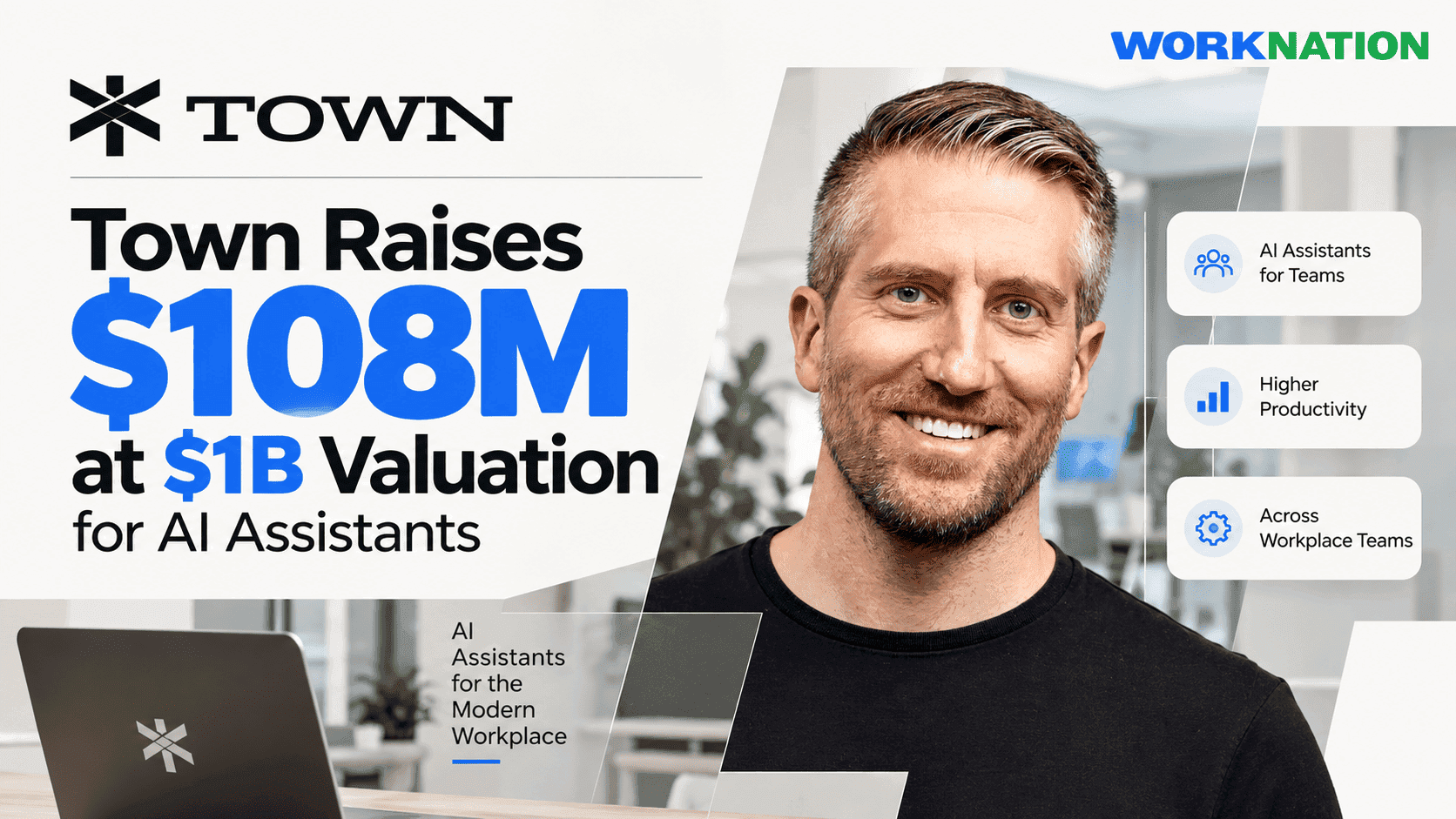
Town Raises $108M at $1B Valuation to Connect AI Assistants Across Teams
Top Picks
Submit PR
Stay Ahead of the Market
Get the latest startup funding, hiring trends and global opportunities delivered to your inbox every week.
Town, a San Francisco-based AI startup building assistants that collaborate across workplace teams, has raised $108 million in a Series B funding round at a $1 billion valuation. The round was co-led by Forerunner Ventures and Menlo Ventures, with participation from existing investors Andreessen Horowitz (a16z) and First Round Capital.
The funding comes less than five months after Town publicly launched its AI assistant, known as Townie. The company is betting that the next stage of workplace AI will involve more than helping individual employees complete tasks faster. Instead, it wants AI assistants to communicate with one another, exchange information and coordinate work across departments.
According to Town, paying teams have grown ninefold since July, while paying customers have increased fourfold. The company also says it reached at least $1 million in annual recurring revenue within weeks of its public launch. However, it has not disclosed its total number of customers or paying teams.
From AI Tax Preparation to Workplace Assistants
Town was founded in 2024 by Jean-Denis Greze and Tony Vincent. The startup initially focused on AI-assisted tax preparation for small businesses before expanding into a broader workplace assistant platform.
Greze previously served as chief technology officer at fintech company Plaid, where he was involved during a period of significant growth. Menlo Ventures says Plaid's annual recurring revenue increased from approximately $10 million to more than $300 million during his tenure.
Co-founder Tony Vincent previously worked as director of applied AI product at Google. He also founded Aspen, which Google acquired, and Sold, which was acquired by Dropbox. Greze and Vincent previously worked together at Dropbox.
Town raised an $18 million seed round led by First Round Capital in March 2025. It subsequently expanded beyond tax preparation and introduced Townie as a general-purpose AI assistant for workplace tasks.
In June 2026, Town publicly launched Townie alongside a $55 million Series A led by Andreessen Horowitz. The latest Series B brings its total funding to approximately $181 million, based on the disclosed seed, Series A and Series B rounds.
How Townie's AI Assistants Work
Town assigns each employee a personalised AI assistant called a Townie. The assistant connects to work tools such as email, calendars, documents and other business systems, building context around the employee's projects, professional relationships and communication style.
Menlo Ventures says the platform supports more than 60 integrations, including Salesforce, Jira and GitHub.
Townie's intended role extends beyond answering questions or generating text. It can help prepare messages, retrieve information, organise work and support employees with tasks that require context from multiple business systems. According to the company, Townies draft messages by default rather than automatically sending them.
The startup's latest development is enabling individual Townies to communicate with one another.
Instead of requiring employees to repeatedly request information from colleagues, one assistant can ask another assistant for relevant context, pass along tasks and coordinate parts of a workflow. This could help reduce delays when projects depend on information distributed across different departments.
For example, Town describes a scenario in which a business operations team updates its competitor analysis. Rather than requiring every sales representative to review the changes independently, each employee's Townie can use the updated information to prepare for sales calls.
The assistants can also communicate with customers, partners and job candidates through email and text, according to the company.
The underlying idea is to make AI useful not only at the individual level but also across the relationships and dependencies that shape how organisations operate.
Privacy and Security Are Central to the Model
Allowing AI assistants to exchange workplace information creates a significant challenge: determining what information can be shared, with whom and under what circumstances.
Town says each assistant shares only information its associated employee would be permitted to share and requests permission when necessary. The company also says that each organisation retains ownership of the context its Townies develop.
According to Town, it uses models from multiple AI laboratories and does not train models on connected customer data by default. The company also says it is SOC 2 Type II compliant, a framework for evaluating controls related to security and other areas of organisational operations.
These safeguards are particularly relevant because workplace assistants may have access to sensitive documents, customer records, internal communications and business systems.
However, the effectiveness of these protections will depend on how permissions are implemented in practice, how assistants handle ambiguous requests and whether information remains appropriately restricted when tasks pass between employees.
Town's approach places trust at the centre of its product strategy. Its ability to coordinate work across teams will depend not just on the quality of its AI responses, but also on whether businesses are comfortable giving assistants access to the information and systems they need.
Why Menlo Ventures and Forerunner Are Backing Town
Menlo Ventures and Forerunner Ventures co-led the $108 million Series B. Existing backers Andreessen Horowitz and First Round Capital also participated.
The round included Better Tomorrow Ventures, Precedent.vc, Scribble Ventures, Serena Ventures and Sparked Ventures. Angel investors included Brendan Foody, Josh Silverman, Romain Huet, Scott Belsky, Steve Bartel, Taro Fukuyama and Varun Anand.
Menlo Ventures had already adopted Town internally in June 2026, giving the firm direct experience with the product before co-leading the latest funding round.
Menlo partner Shawn Carolan highlighted the potential for AI assistants to become a new interface for workplace productivity. He also pointed to the company's business focus, founder experience and emphasis on security as reasons for backing the startup.
Forerunner founding partner Kirsten Green had previously expressed enthusiasm about Town when the firm participated in its earlier funding round.
The investment reflects growing interest in AI products that move beyond standalone chat interfaces and become integrated into everyday business operations. For investors, the opportunity is to back a platform that could become part of how employees access information, communicate and execute work.
Competition in the AI Assistant Market Is Intensifying
Town is entering a competitive market in which startups are building AI agents that can perform tasks, connect business applications and coordinate workflows.
Instinct, an AI assistant aimed at consumers, raised $1 billion at a reported $10 billion valuation in September 2026. Its product also supports coordination between assistants belonging to trusted contacts.
In the enterprise market, Gumloop raised $50 million in a Series B led by Benchmark in March 2026 to help businesses build AI agents that automate workflows across tools such as Slack, Microsoft Teams and email.
Germany-based amber raised a €7 million Series A in August 2026 for its autonomous enterprise AI agents. The company says its data layer can reduce AI token costs by up to 60%.
Potpie, meanwhile, focuses on providing AI agents with the context they need to work inside large codebases.
These companies approach AI automation from different directions, but they share a broader ambition: making AI systems capable of completing useful work within complex environments rather than simply responding to individual prompts.
The opportunity is substantial, although adoption remains a challenge. McKinsey's January 2025 report, Superagency in the Workplace, found that 92% of surveyed companies planned to increase AI investment over the following three years, while only 1% of leaders described their organisations as mature in their use of AI.
The findings illustrate the difference between investing in AI and integrating it effectively into business processes.
What Comes Next for Town?
Town's $1 billion valuation places considerable expectations on a company that only publicly launched its general-purpose assistant in June 2026.
Its reported growth in paying customers and teams suggests early commercial interest. However, the company has not disclosed customer totals, retention figures or detailed revenue metrics beyond its reported achievement of at least $1 million in annual recurring revenue shortly after launch.
The next challenge will be demonstrating that employees and organisations continue paying for Townie as the novelty of AI assistants gives way to everyday business use.
Town must also prove that assistants can coordinate work reliably without exposing confidential information, making unauthorised decisions or creating additional oversight for employees.
If it succeeds, Town could help establish a model in which AI assistants function as collaborators across an organisation rather than isolated tools for individual workers. If it fails to manage permissions, reliability and trust, those same capabilities could become barriers to adoption.
For now, Town is positioning itself around a clear premise: AI can make individual employees more productive, but the larger opportunity may be helping entire teams work together more efficiently.
Have a Funding Round or Exciting Update to Share?
Submit your press release to get featured on WorkNation and reach founders, investors, and tech leaders.