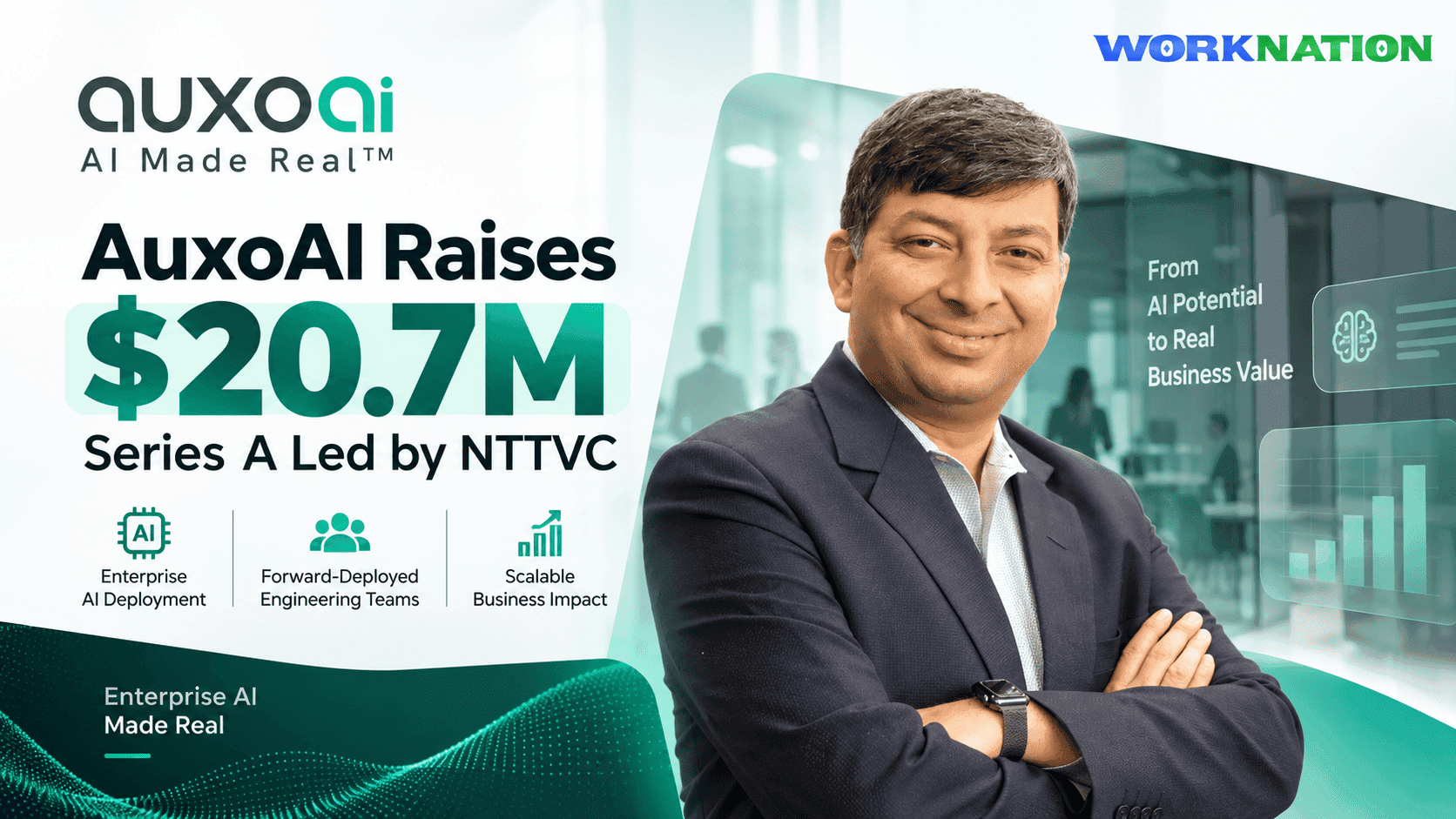
AuxoAI Raises $20.7M Series A Led by NTTVC to Scale Enterprise AI Deployment
Top Picks
Submit PR
Stay Ahead of the Market
Get the latest startup funding, hiring trends and global opportunities delivered to your inbox every week.
AuxoAI, a San Francisco Bay Area enterprise AI startup, has raised $20.7 million in a Series A funding round led by NTTVC, the Silicon Valley venture firm established in partnership with Japanese telecommunications group NTT. The round also includes three strategic investors: George Still Jr., partner emeritus at Norwest Venture Partners; Amit Zavery, president, chief product officer and chief operating officer at ServiceNow; and Giacomo Sonnino, managing director at Charlesbank Capital Partners and former chief operating officer of QuantumBlack North America.
Founded in 2023, AuxoAI helps large organisations move from experimenting with artificial intelligence to deploying AI systems in production environments. The company combines AI strategists with forward-deployed engineers who work closely with customers to understand business processes, identify opportunities for automation and build solutions tailored to operational requirements.
AuxoAI plans to use the new funding to recruit more forward-deployed staff globally, develop its own technology and expand its partner network.
The investment comes as businesses increasingly look beyond access to powerful AI models and focus on integrating those models into everyday operations. For AuxoAI, the opportunity lies in addressing the gap between AI capabilities and the practical work required to make them useful inside complex organisations.
Why Enterprise AI Deployment Remains Difficult
Access to general-purpose AI models has expanded rapidly, but deploying them successfully across a large organisation remains challenging.
A business may have access to advanced AI tools yet struggle to integrate them into existing systems, connect them with internal data, redesign workflows or ensure that the resulting applications operate reliably. These challenges can be particularly pronounced in industries with complex processes, specialised requirements and established technology infrastructure.
AuxoAI's approach is built around the idea that technology alone is not enough. Companies also need teams that understand how their businesses operate and can translate that understanding into working AI applications.
The startup's forward-deployed engineers work alongside customers rather than building products entirely in isolation. Their role includes understanding operational requirements, identifying where AI can make a difference and developing systems that fit into real business environments.
This model combines technical implementation with business and operational expertise. It is intended to help enterprises move beyond isolated pilots towards AI systems that can be used in production.
The company was founded by Amaresh Tripathy, Arvinder Pal Singh and Kabir Singh. The founders describe their mission as integrating AI into the operating fabric of enterprises by understanding organisational context and rethinking how work gets done.
What AuxoAI Offers Enterprises
AuxoAI provides a combination of AI strategy, engineering and implementation services. Its teams work with companies across sectors including manufacturing, consumer goods, healthcare and telecommunications.
According to the company, its forward-deployed engineering team has worked with more than 40 clients across these and other industries.
The approach begins with understanding a customer's existing processes and requirements. The team then identifies opportunities for AI deployment and develops systems designed to operate within the customer's environment.
This can involve connecting AI models to existing workflows, adapting applications to industry-specific requirements and addressing the practical challenges that emerge when AI systems are introduced into production.
For example, a consumer goods company may want to use AI to understand customer preferences or evaluate potential product concepts. A healthcare technology business may seek to improve marketing operations, while a manufacturer may look for ways to streamline complex internal processes.
These applications require more than a model that can generate a response. They need appropriate data, integrations, workflow design and implementation.
AuxoAI aims to provide that combination through teams that work directly with enterprise customers.
Damia: A Workbench Designed to Speed Up AI Deployment
Alongside its engineering services, AuxoAI has developed Damia, a workbench intended to make subsequent AI deployments faster.
The platform packages knowledge and capabilities developed through earlier customer projects, allowing the company to reuse elements of its implementation experience rather than approaching every deployment entirely from scratch.
One example described by the company is the use of synthetic consumer personas. These are AI-generated representations of customer groups that businesses can use to explore ideas and test concepts before investing in research involving real consumers.
Such tools could help companies evaluate early-stage ideas or investigate possible customer responses more efficiently. However, synthetic personas are not equivalent to direct feedback from real customers, and their usefulness depends on how accurately they represent the populations being studied.
Damia forms part of AuxoAI's attempt to combine a service-led deployment model with reusable technology.
That distinction matters because forward-deployed engineering can require substantial human involvement. A workbench that makes deployments more repeatable could help the company serve more customers without increasing staffing at the same rate as revenue.
The supplied announcement does not disclose Damia's standalone revenue, pricing or the proportion of deployments that can be completed using the platform without significant engineering involvement.
Why NTTVC Led the $20.7 Million Round
NTTVC led the Series A, bringing additional capital and strategic support to AuxoAI's expansion.
The firm was founded in 2019 by Vab Goel after his 19-year tenure as a partner at Norwest Venture Partners. NTTVC was established in partnership with NTT, the Japanese telecommunications group, and announced a $500 million debut fund in October 2020.
Its investment portfolio includes companies such as Anthropic, Neysa, nference, Celona, Eko Health and Shoreline, which was acquired by NVIDIA.
NTTVC founding partner Vab Goel said the firm was drawn to AuxoAI's combination of technical ambition, enterprise understanding and ability to build trust through customer relationships.
That emphasis reflects a central issue in enterprise AI adoption. Businesses are often deploying AI into important operational processes, where reliability, data access and integration with existing systems can be as important as the underlying model's capabilities.
The round also includes three strategic investors with experience across enterprise software, technology leadership and consulting.
George Still Jr. is a partner emeritus at Norwest Venture Partners and a longtime Workday board member. Amit Zavery is president, chief product officer and chief operating officer at ServiceNow. Giacomo Sonnino is a managing director at Charlesbank Capital Partners and previously served as chief operating officer of QuantumBlack North America.
Their participation adds experience from enterprise technology, investment and AI consulting to the company's investor group.
Partnerships With Google Cloud and AWS
AuxoAI is also building relationships with major cloud and enterprise technology providers.
The company said it joined Google's Gemini Enterprise transformation program in April 2026. The programme is associated with Google's efforts to help partners accelerate enterprise AI adoption.
AuxoAI also holds an advanced tier with Amazon Web Services, according to the supplied article.
These partnerships could support the company's ability to reach enterprise customers and build solutions using established cloud infrastructure and AI platforms.
The broader industry is increasingly investing in implementation capabilities alongside AI products. Google's announced $750 million partner fund, for example, includes support for initiatives involving embedded forward-deployed engineers and agentic AI development.
For AuxoAI, a larger partner network could help generate customer opportunities and support deployments across industries and geographies. However, the announcement does not disclose how much revenue comes through these partnerships or how much of the new funding will be allocated to individual partner programmes.
Competition in the Forward-Deployed AI Market
AuxoAI is entering a competitive market where companies combine engineering teams, AI technology and enterprise consulting to help businesses implement AI.
Distyl AI is one established competitor, focusing on AI deployment for large enterprises. The company raised $175 million at a reported $1.8 billion valuation in September 2025 in a round led by Lightspeed Venture Partners and Khosla Ventures.
Arrakis, which operates in London and Paris, raised a $30 million Series A in July 2026 to expand its work deploying AI engineers into industrial organisations.
These businesses share an emphasis on helping enterprises turn AI capabilities into working applications, although their customers, products and deployment strategies may differ.
AuxoAI's stated differentiators include its experience across more than 40 clients, its Damia workbench and its partnerships with Google Cloud and AWS.
The key question is whether the company can turn its experience into a repeatable business model. Customer-specific engineering can generate value, but it can also be expensive and difficult to scale if each deployment requires extensive bespoke work.
Damia could help address that challenge by allowing AuxoAI to reuse knowledge and technology across projects. The company will need to demonstrate that this approach can improve deployment speed, delivery costs and operating margins as the business grows.
The Challenge of Scaling a People-Heavy AI Business
AuxoAI's funding will support global hiring, technology development and partner expansion. These priorities suggest the company intends to increase both its delivery capacity and the tools available to its teams.
Yet its operating model creates a specific commercial challenge. Forward-deployed engineers need to understand customers' businesses, work with existing systems and solve problems that may not be identical from one client to another.
That hands-on approach can be valuable for customers, especially when AI projects involve complex processes or sensitive enterprise data. At the same time, the company must avoid becoming a traditional consulting business whose growth depends almost entirely on hiring more people.
Reusable technology, repeatable deployment methods and strong partner relationships could help improve scalability. But the funding announcement does not provide financial details that would establish AuxoAI's margins, revenue growth or level of recurring software income.
The next phase will test whether the startup can combine customer-specific implementation with a technology platform that becomes more valuable and efficient as adoption grows.
What Comes Next for AuxoAI?
The $20.7 million Series A gives AuxoAI resources to expand its engineering workforce, strengthen its technology and develop its enterprise partnerships.
Its opportunity comes from a practical problem facing businesses: obtaining access to AI models is increasingly straightforward, but integrating those models into real operations remains difficult.
AuxoAI is betting that organisations will pay for teams that can bridge this gap by combining technical implementation with a deep understanding of business processes.
Its work with more than 40 clients provides an early foundation, while Damia represents an effort to make deployment more repeatable.
The challenge is to prove that this combination can scale efficiently in a market attracting well-funded competitors.
If AuxoAI can turn its deployment experience into reusable capabilities while maintaining customer trust and delivery quality, it could establish a stronger position in enterprise AI implementation. Its longer-term success, however, will depend on measurable customer outcomes and a business model that scales beyond adding more engineers.
Have a Funding Round or Exciting Update to Share?
Submit your press release to get featured on WorkNation and reach founders, investors, and tech leaders.