Pliant Raises $80 Million in Series C Led by Seaya Nova and Speedinvest to Power AI Agent Payments
Top Picks
Submit PR
Stay Ahead of the Market
Get the latest startup funding, hiring trends and global opportunities delivered to your inbox every week.
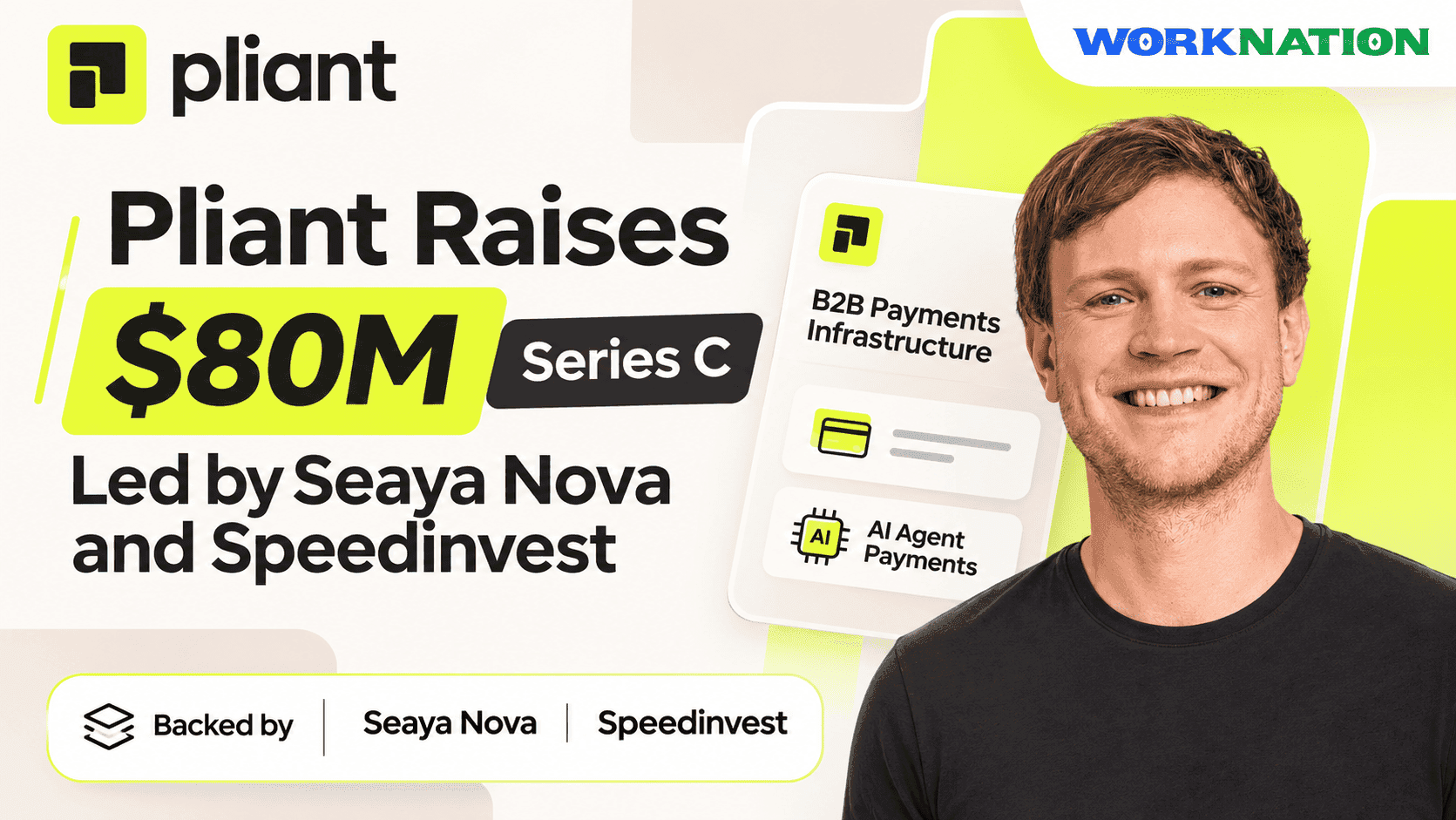
Berlin-based fintech startup Pliant has raised $80 million in a Series C funding round led by Seaya Nova and Speedinvest, as it expands its business-to-business (B2B) payments infrastructure to support transactions initiated by artificial intelligence agents.
The oversubscribed round also included participation from existing investors Illuminate Financial, Motive Partners and Molten Ventures.
The company will use the fresh capital to expand its operations in the United States and Canada, enter additional international markets and accelerate development of its agentic payments infrastructure.
Founded in 2020 by Malte Rau and Fabian Terner, Pliant has grown from a corporate credit card provider into a broader B2B payments infrastructure platform. The company recently crossed $100 million in annual recurring revenue (ARR), marking another milestone as it targets the emerging market for AI-powered financial workflows.
From corporate cards to B2B payments infrastructure
Pliant was founded during the COVID-19 lockdowns in 2020, when the collapse of Wirecard exposed major weaknesses in Germany's payments industry.
Rau brought more than a decade of experience across fintech and banking. Before launching Pliant, he founded Geldspeicher and worked as interim Chief Revenue Officer at FinCompare. Terner, who serves as co-founder and Chief Product Officer, also worked at FinCompare and previously at lending company Lendico.
The company initially focused on corporate credit cards for German businesses. It has since expanded into a broader suite of commercial payment services, including:
Commercial card issuance and management.
Payment accounts and foreign exchange services.
Corporate spend management.
Payment infrastructure for banks and fintechs.
API-based integrations for software platforms.
Pliant's infrastructure allows banks and software companies to build and operate their own commercial card programmes without developing the entire payment system themselves.
For example, Commerzbank launched a digital card for business customers through Pliant in 2024.
The company also acquired Austrian insurtech hi.health in April 2025 to expand its capabilities in insurance claims payments.
Crossing $100 million in annual recurring revenue
Pliant's latest funding comes after three consecutive years of doubling its business, according to the company.
It crossed $100 million in annual recurring revenue in July 2026, reflecting growing demand for its commercial payments infrastructure.
The company employs more than 300 people across eight offices and processes billions of dollars in annual payment volume for customers and partners.
Its customer base spans travel, insurance, AI-native businesses, banks, fintechs and software platforms.
Pliant's commercial cards are issued in 13 currencies across 32 countries. The company is a principal member of Visa and Mastercard and operates under a European e-money licence, alongside regulated partners in the United Kingdom and United States.
Bringing AI agents into business payments
The next phase of Pliant's strategy focuses on enabling AI agents to initiate and manage business payment workflows.
As businesses adopt AI assistants and autonomous software agents, Pliant believes these systems will increasingly need access to financial infrastructure to complete tasks rather than simply provide recommendations.
The company's platform already uses its own AI agents to automate recurring finance work. It is also opening its infrastructure to external AI agents, including assistants such as ChatGPT and Claude, as well as internally developed enterprise agents.
These integrations use the Model Context Protocol (MCP), an open standard that allows AI applications to connect with external software and initiate workflows.
Through these connections, AI agents can interact with Pliant's payment infrastructure while operating within defined permissions, spending controls and audit trails.
The underlying infrastructure is designed to provide the regulated payment capabilities required for these transactions, rather than allowing AI agents to move money without oversight.
CEO Malte Rau said Pliant was built as an API-first and modular B2B payments platform, making it suitable for both established businesses looking to automate payment processes and AI-native companies that need a licensed payments partner.
Competing in the emerging agentic payments market
Pliant is entering a market where payment networks and fintech infrastructure providers are also developing ways for AI agents to execute transactions.
Stripe has introduced tools for agent-compatible payments, while Visa and Mastercard have announced initiatives focused on AI-driven commerce and payment workflows.
Specialist startups are also emerging. Stockholm-based SolvaPay raised €2.4 million to build payment infrastructure for AI agents, while Crux Labs has raised more than $6 million to develop tools for auditing AI agents.
The opportunity extends beyond consumer purchases. Businesses could eventually use AI agents to manage supplier payments, corporate expenses, travel bookings and other financial workflows.
However, allowing software agents to initiate payments introduces important requirements around authorisation, fraud prevention, transaction monitoring and accountability. Regulated payment providers could play a central role in ensuring these systems operate within appropriate controls.
Funding to support North American expansion
The $80 million Series C round is double the $40 million Series B that Pliant raised in April 2025, which was led by Illuminate Financial and Speedinvest.
The company also has separate debt facilities, including a €100 million facility announced in January 2024.
Tech Funding News estimates that Pliant's cumulative equity funding now exceeds $180 million, although this figure is not a total independently confirmed by the company.
With the latest capital, Pliant plans to strengthen its presence in the United States and Canada, enter additional international markets and develop its AI payment capabilities.
Seaya Nova managing partner Vinoth Jayakumar said licensed payment infrastructure would become increasingly important as AI changes how businesses move money.
Pliant's next challenge will be translating its existing commercial payments business into infrastructure that can reliably support transactions initiated by AI agents.
Have a Funding Round or Exciting Update to Share?
Submit your press release to get featured on WorkNation and reach founders, investors, and tech leaders.