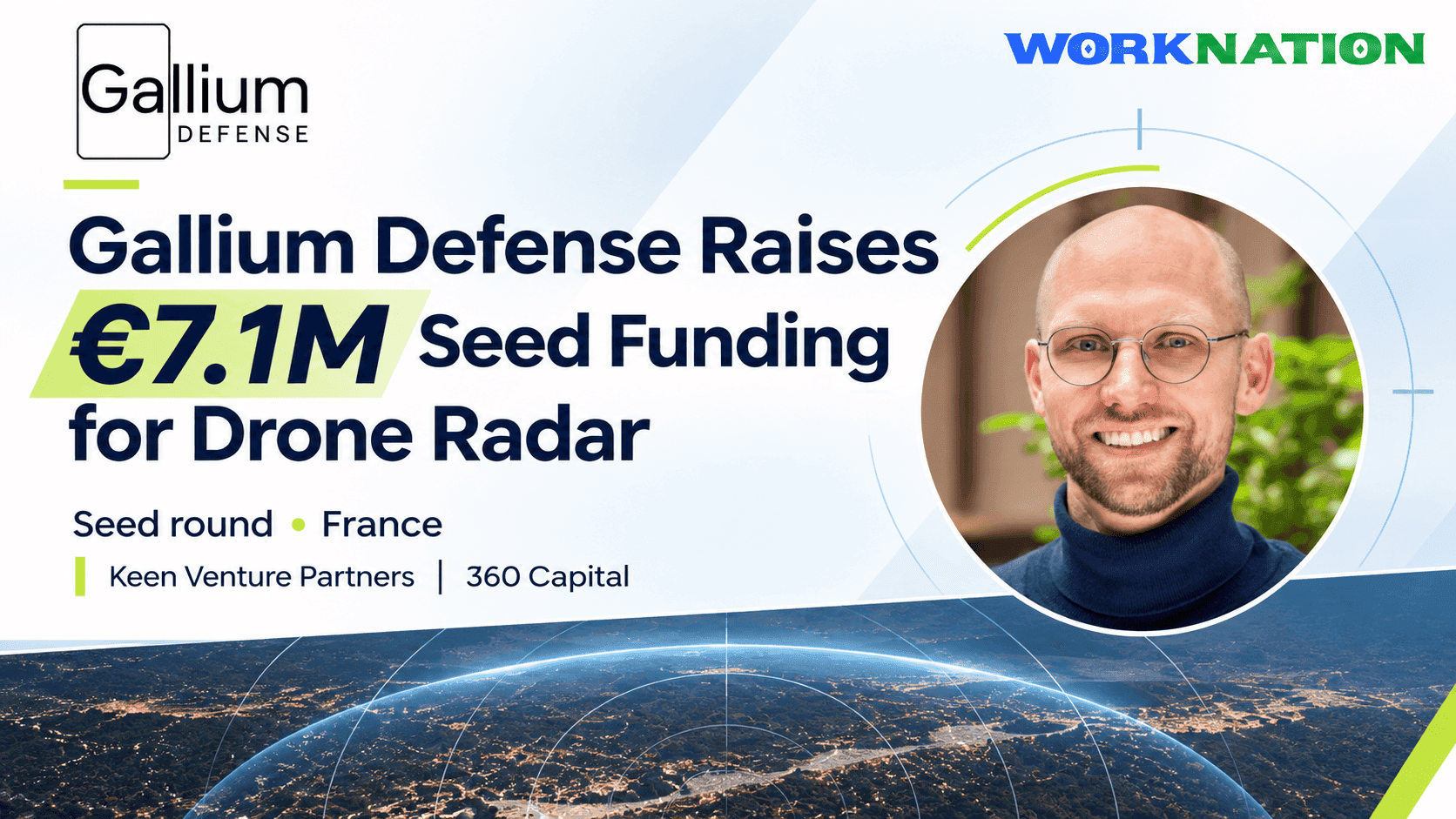
Gallium Defense Raises €7.1 Million Seed Round to Build Low-Cost Drone Detection Radars
Top Picks
Submit PR
Stay Ahead of the Market
Get the latest startup funding, hiring trends and global opportunities delivered to your inbox every week.
French defence technology startup Gallium Defense has raised €7.1 million in a seed funding round as it prepares to manufacture its first radar systems designed to detect small drones at a lower cost.
The round was led by Keen Venture Partners and 360 Capital, with participation from Omnes Capital and Polytechnique Ventures.
Founded in April 2026 by Eric Fournier, Florian Lemoine and Robin Mandel, the Paris-based company is developing radar technology for detecting and tracking drones around critical infrastructure and military sites.
The company plans to use the funding to support initial radar production, expand its team, train artificial intelligence models and conduct demonstrations for civilian and military customers.
Building a lower-cost alternative to conventional radar
Gallium Defense is positioning its technology around a challenge in modern air defence: making drone detection systems more affordable without sacrificing operational performance.
The company describes its ambition as becoming the "Dacia of radar", referring to its effort to deliver high-performance detection at a significantly lower price.
Its approach combines cheaper antenna components with processing power embedded directly into the antenna. The company has also worked with strategic partners, including radar design and prototyping specialists from France's Microwave Valley.
Gallium's first product, the GDS-10, is an X-band Active Electronically Scanned Array (AESA) radar with a software-defined, AI-based architecture.
The system is available in two variants, one designed for critical infrastructure and another for military applications.
According to the company, GDS-10 can detect Class 1 and first-person-view (FPV) drones at distances of up to 10 kilometres. It offers 360-degree azimuth coverage and 90-degree elevation coverage, while tracking multiple targets simultaneously, including drone swarms.
The radar is designed to operate during the day and night, in different weather conditions and in environments where electronic jamming is present.
Funding to support production and AI development
Gallium Defense's technology development began with research and development work in 2024, before the company was formally established in April 2026.
Founder Eric Fournier brings 17 years of experience in the defence industry and has worked on several radar projects in France. The company was established alongside Florian Lemoine and Robin Mandel.
Fournier told Tech Funding News that the product is already functional, while machine learning development remains an important part of the next stage. The algorithms require field data and testing to improve their performance under real operating conditions.
The fresh funding will help the startup move towards production, train its AI models and demonstrate the system to prospective customers.
Six potential customers and a €6 million order target
Gallium Defense is currently pre-revenue and has six potential customers in its pipeline.
According to Fournier, discussions with these prospects could translate into approximately €6 million in orders by 2027. This remains a target dependent on converting prospective customers into actual buyers.
The company currently has 15 people and expects to increase its headcount to 17 by the end of 2026. Depending on sales, it aims to grow its workforce to between 30 and 50 people in 2027.
The startup also plans to begin shipping its first units by June 2027, making production and customer conversion important milestones for the business.
Competition in the counter-drone market
Gallium Defense is entering a market that already includes established radar developers and newer defence technology companies.
Dutch company Robin Radar Systems secured a contract in December 2025 to supply 100 IRIS drone detection radars to the Dutch Ministry of Defence. In the United States, Echodyne and Chaos Industries have also attracted significant funding for their defence technologies.
Other European startups are approaching the counter-drone market through different technologies. Alta Ares is developing systems combining interceptors with detection and tracking, while Egide and Stendr are working on interception and AI-based drone detection respectively.
Gallium's differentiation rests on its proposed radar architecture and cost model. The company is attempting to make drone detection systems affordable enough for deployment across a wider range of sites.
The next major test will be whether its technology can move from demonstrations and customer discussions to commercial orders and scaled production.
With €7.1 million in fresh capital, Gallium Defense is preparing for that transition. Its ability to deliver the promised detection performance at a lower price will determine whether its "Dacia of radar" ambition can become a commercial reality.
Have a Funding Round or Exciting Update to Share?
Submit your press release to get featured on WorkNation and reach founders, investors, and tech leaders.