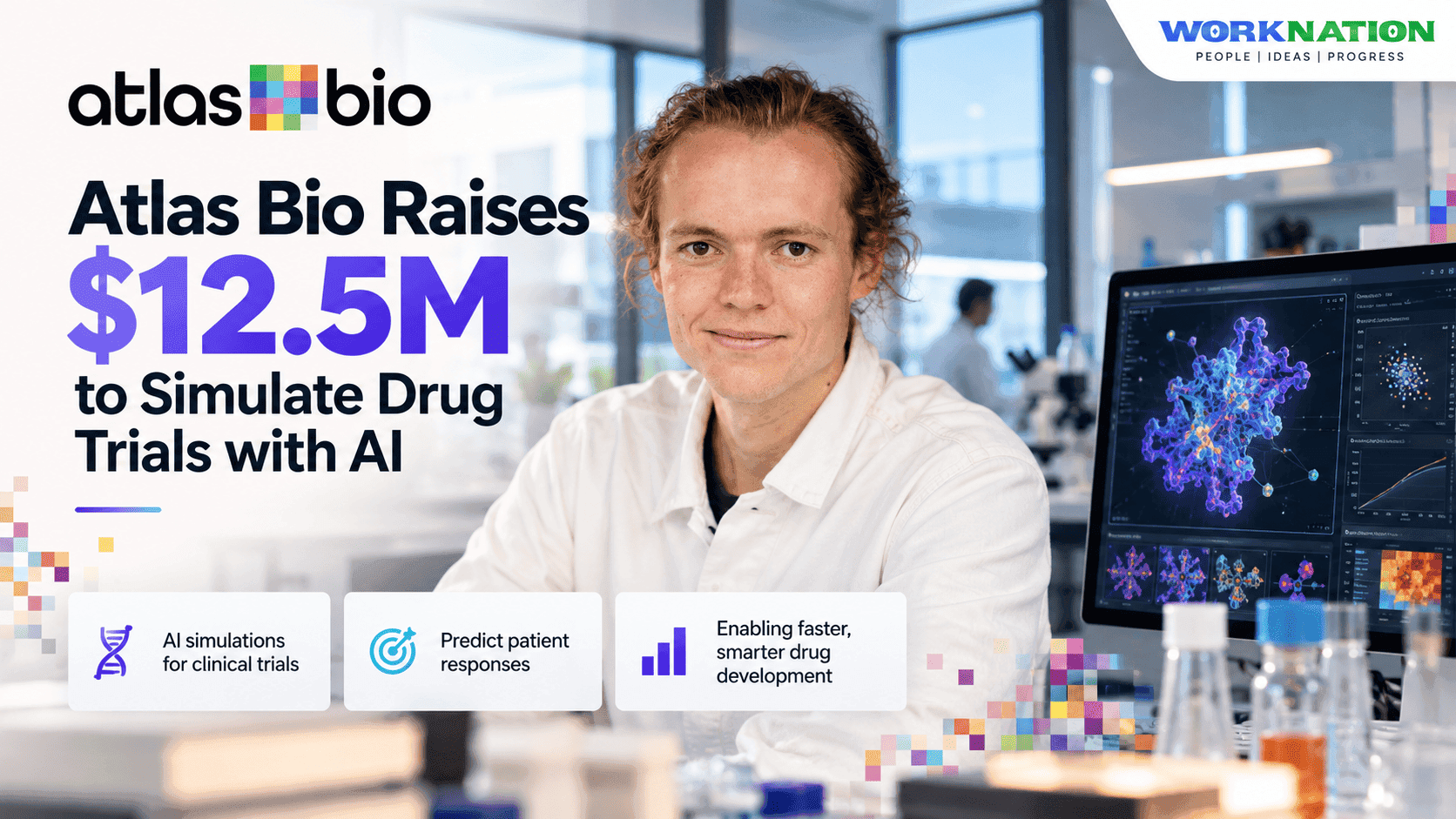
Atlas Bio Raises $12.5 Million to Simulate Drug Trials Using AI
Top Picks
Submit PR
Stay Ahead of the Market
Get the latest startup funding, hiring trends and global opportunities delivered to your inbox every week.
Atlas Bio, a Swiss AI biotech startup, has raised $12.5 million in funding to develop AI simulations that help pharmaceutical companies assess drug responses before committing to expensive clinical trials. The company was founded in 2024 by Simon Romanski, an engineer who previously worked on autonomous driving technology, and is headquartered in Basel, Switzerland, with a Delaware-incorporated parent company.
The funding includes a $10 million seed round led by Creandum and an earlier $2.5 million pre-seed round led by First Momentum Ventures and LEA Partners. Atlas Bio plans to use the capital to expand its scientific and commercial teams, improve its platform and bring its technology to more enterprise customers.
The company's approach targets one of drug development's most expensive challenges: predicting whether a candidate treatment will work in humans before investing years and substantial resources in clinical trials.
From Autonomous Driving to Drug Development
Simon Romanski founded Atlas Bio in 2024 after working as one of the early engineers in autonomous vehicles. His academic background includes electrical engineering studies at Karlsruhe Institute of Technology, EPFL in Lausanne and Stanford.
Romanski's interest in drug development was also personal. Living with Type 1 diabetes encouraged him to examine how treatments are developed and why progress in some diseases can be rapid while many clinical programmes fail.
He saw a potential connection between engineering and biology. Autonomous driving relies on models trained on data, simulations and validation to make systems more reliable before deployment. Atlas Bio applies a related engineering mindset to drug development, using AI models to simulate biological responses and help researchers evaluate possible outcomes earlier.
The company's co-founder and CTO, Sebastian Bayer, previously worked on perception models for autonomous driving and later led Google's research on language models for Search, YouTube and Google Play. Chief Scientific Officer Dominik Hartl brings more than a decade of drug development experience and previously held a doctoral fellowship at the Friedrich Miescher Institute for Biomedical Research.
The team combines experience in machine learning, data-limited modelling and biological research to address the challenge of predicting how human biology responds to a treatment.
How Atlas Bio Simulates Drug Trials
Traditional drug development often depends on laboratory research, animal studies and successive clinical trial phases to determine whether a candidate treatment is safe and effective. Many candidates fail during development, making late-stage failures particularly costly.
Atlas Bio aims to help drug developers learn more before committing to a Phase II clinical trial. Its platform uses a foundation model trained on approximately two million human RNA readouts, according to the company. These measurements capture gene activity in human tissue and help the model learn patterns associated with biological responses.
The platform then simulates how different patient profiles might respond to a drug. By modelling multiple diseases and treatment scenarios, researchers can explore which patient groups may be more likely to respond before deciding how to structure a real clinical study.
One potential advantage is the ability to evaluate several treatments against the same virtual patient profile and disease stage. A conventional clinical trial cannot expose the same patient to every possible treatment scenario under identical conditions, so simulation can offer a different way to compare hypotheses before a trial begins.
Atlas Bio says its model can predict a patient's broader molecular response without requiring prior efficacy data for the specific drug. That claim distinguishes its approach from some competing platforms, although independent validation will be essential to determine how reliably the predictions translate into real clinical outcomes.
The company's technology is intended to support better decisions during drug development. Whether it can replace any formal clinical trial steps is a separate question that depends on scientific validation and regulatory acceptance.
Why Phase II Clinical Trials Matter
Phase II is a critical stage in drug development because researchers begin assessing whether a treatment demonstrates meaningful efficacy in patients with the targeted condition. It follows earlier testing and helps determine whether a candidate should advance to larger studies.
According to the supplied report, Atlas Bio estimates that a Phase II trial can cost a drug company at least $100 million and take two to three years. The article also cites a Biotechnology Innovation Organization analysis of 2006-2015 data showing that 30.7% of Phase II candidates progressed to Phase III.
These figures illustrate the risk drug developers face when making investment decisions based on incomplete evidence. If a candidate fails late in development, a company can lose substantial time and capital. If a drug is promising but initially tested against the wrong indication or patient group, researchers may also miss opportunities to investigate its potential elsewhere.
Atlas Bio aims to reduce that uncertainty by simulating responses across diseases and patient profiles before a trial design is finalised. The goal is to help pharmaceutical companies make more informed decisions about which programmes to advance and how to allocate development resources.
However, simulation does not automatically establish clinical efficacy or safety. Predictions must be assessed against real-world evidence, and the reliability of the model across different drugs, diseases and patient populations remains central to the company's proposition.
Atlas Bio's Approach to Virtual Patient Responses
Atlas Bio's platform is designed to simulate drug responses across multiple diseases simultaneously. Its models use human molecular data to estimate how a treatment could affect patients with different biological profiles.
The company provides an example involving a simulated asthma trial at a clinical-stage biotechnology company. In that case, the model predicted gene-expression responses for 78 patients receiving a bispecific antibody and indicated a greater reduction in eosinophils than with the standard of care. This example is reported by Atlas Bio and should not be interpreted as independent proof of clinical efficacy.
The startup also says it is working with a top-10 pharmaceutical company and is in discussions with several others. It reports that a Basel-based biotech customer skipped animal studies for one drug development programme and proceeded directly to human trials using its simulations. The supplied report does not establish whether that decision was reviewed or accepted by regulators on the basis of Atlas Bio's predictions.
The company expects its first trial results around six weeks after the October 27, 2026 announcement. These results could provide an important early test of whether its predictions are consistent with observed biological or clinical outcomes.
Funding Led by Creandum
Atlas Bio's $12.5 million in total funding comprises a $10 million seed round led by Creandum and a $2.5 million pre-seed round led by First Momentum Ventures and LEA Partners.
The company plans to use the capital to strengthen its scientific and commercial teams, improve its platform and expand its enterprise customer base through 2026.
Investors are backing the possibility that AI could make drug development more efficient by helping researchers evaluate candidates and patient populations before committing to costly trials.
Creandum partner Katharina Wilhelm described clinical development as a new wave of AI adoption following advances in computational drug design. First Momentum Ventures founding partner Sebastian Böhmer also highlighted the opportunity to make human biology more predictable through AI.
The broader investment thesis is that improved biological predictions could reduce wasted spending, shorten learning cycles and help drug developers make better decisions about which programmes to pursue.
Competition and the Challenge of Scientific Validation
Atlas Bio is entering a competitive market. The supplied report identifies Unlearn, which raised $50 million in a Series C round, and QuantHealth, which raised $45 million in a 2026 Series B round, as competitors in AI-supported clinical development.
Atlas Bio differentiates itself by predicting broader molecular responses for individual patient profiles and by claiming that its model does not require prior efficacy data for the specific drug being evaluated.
That approach could prove valuable if the predictions generalise across treatments, diseases and patient populations. However, a systematic review cited in the source found that most in-silico trial models supplement clinical data rather than replace it.
Regulatory acceptance remains another major consideration. Drug developers need evidence that simulations are sufficiently reliable for the intended use, and replacing a formal clinical trial would require a substantially higher level of validation than using AI to inform trial design.
The company's upcoming results may help establish its credibility, but broader validation across multiple programmes will be important before its technology can meaningfully change established clinical development practices.
What Comes Next for Atlas Bio?
Atlas Bio is betting that advances in AI can help make human biology more predictable and improve the economics of pharmaceutical research.
Its immediate priorities are to develop its technology, expand its team and deepen relationships with pharmaceutical and biotechnology customers. The next milestone is demonstrating that its simulated predictions correspond to outcomes observed in real experiments and clinical settings.
If the technology proves reliable, it could help drug developers identify promising patient groups, refine trial designs and reduce the risk of expensive failures. But the distinction between informing a clinical trial and replacing one will remain crucial.
For Atlas Bio, the opportunity is significant. Its long-term success will depend not just on the sophistication of its models, but on whether scientists, pharmaceutical companies and regulators can trust their predictions.
Have a Funding Round or Exciting Update to Share?
Submit your press release to get featured on WorkNation and reach founders, investors, and tech leaders.