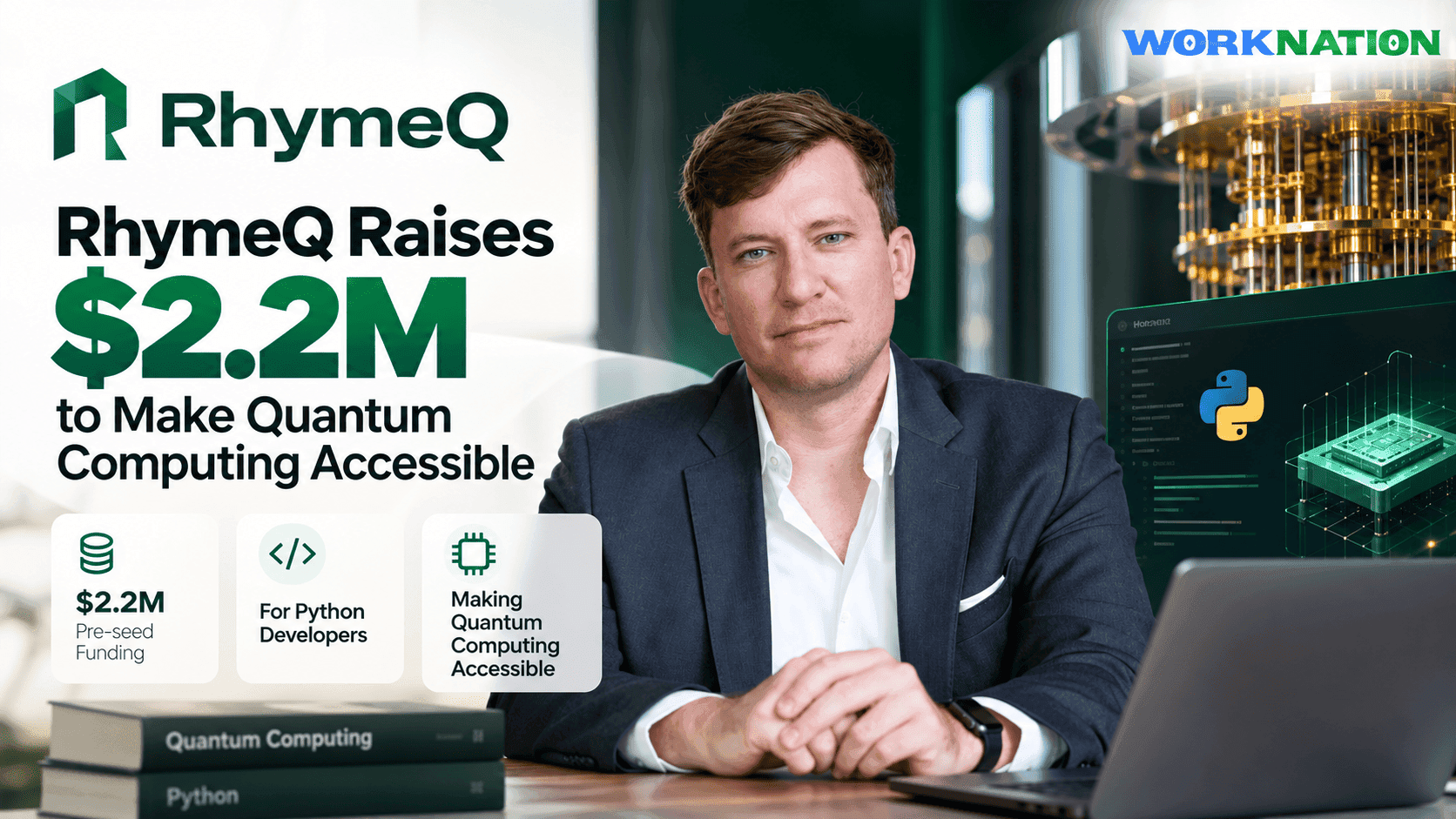
RhymeQ Raises $2.2 Million Pre-Seed Funding to Make Quantum Computing Accessible to Python Developers
Top Picks
Submit PR
Stay Ahead of the Market
Get the latest startup funding, hiring trends and global opportunities delivered to your inbox every week.
RhymeQ, a quantum computing software startup founded by former Kipu Quantum co-founder Daniel Volz, has raised $2.2 million in pre-seed funding to make quantum programming more accessible to software developers. The round was led by Ground State Ventures, with participation from Vanagon Ventures, Plug and Play, Freiraum Ventures and angel investors.
Founded in 2026, the company is developing Rhyme, a high-level programming language and software platform that allows developers to write code in standard Python and compile it into instructions that quantum hardware can execute. The goal is to reduce the technical barriers that currently limit quantum computing development to specialists with deep knowledge of quantum physics.
The fresh capital will support engineering recruitment, development of an enterprise platform and the creation of a global community of developers using Rhyme.
Who Founded RhymeQ?
RhymeQ was founded in 2026 by Daniel Volz, Tamás Varga and Christina Wu. Volz serves as a co-founder, Varga is the chief technology officer, and Wu is the chief operating officer.
Volz previously co-founded Kipu Quantum after working on quantum computing projects at McKinsey and BASF. His background also includes a PhD in chemistry and experience as a freelance journalist. After leaving Kipu Quantum following a dispute with his co-founders, he established RhymeQ to address a problem he had observed throughout his work in quantum computing: the shortage of developers capable of programming quantum machines.
Varga, who invented Rhyme, previously worked as a software engineer at Swiss Re and UBS for more than 15 years. Wu brings experience in business, finance and human resources.
RhymeQ is headquartered in Karlsruhe, Germany, and Zürich, Switzerland. The company currently employs six full-time team members, with another employee expected to join in November 2026, according to the report.
RhymeQ's $2.2 Million Pre-Seed Funding Round
The $2.2 million pre-seed round was led by Ground State Ventures, an Amsterdam-based investment fund focused on early-stage quantum technology companies.
Other participants include Vanagon Ventures, Plug and Play and Freiraum Ventures, alongside angel investors. According to Volz, the funding was raised in several stages over a period of weeks.
The investors bring experience across quantum technology, deep tech and early-stage startup development.
Ground State Ventures has invested in quantum technology businesses, including QuantWare and Rhonexum. Vanagon Ventures focuses on AI and deep tech startups, while Freiraum Ventures invests in early-stage companies and teams. Plug and Play is a global innovation platform and investor known for supporting technology startups.
The funding provides RhymeQ with resources to expand its technical capabilities and develop the infrastructure needed to support a growing developer ecosystem.
Why Quantum Computing Needs More Accessible Software
Quantum computers operate differently from conventional computers. They use quantum bits, or qubits, to process information according to the principles of quantum mechanics.
Although quantum hardware has advanced significantly, developing software for these machines remains challenging. Programming quantum computers often requires specialised knowledge of quantum algorithms, circuits and hardware constraints.
This creates a gap between the growing capabilities of quantum processors and the number of software developers who can use them effectively.
Volz believes that software accessibility will become increasingly important as quantum hardware improves and error-corrected quantum computing advances.
The talent shortage is another challenge. The article cites research discussed by the World Economic Forum, noting that McKinsey found only one qualified candidate for every three quantum-related jobs.
Meanwhile, Grand View Research forecasts that the quantum computing software market could reach $2.51 billion by 2030, growing at an annual rate of 18.5% from 2024.
These trends create an opportunity for companies developing tools that simplify quantum programming and help more developers participate in the field.
How Rhyme Works
RhymeQ's central product, Rhyme, acts as an abstraction layer between developers and quantum hardware.
Instead of requiring programmers to work directly with low-level quantum instructions, Rhyme allows them to write code using standard Python. Its compilers then translate that code into instructions suitable for quantum hardware.
The company aims to let developers use the same code across different quantum processor systems, reducing dependence on a particular hardware provider.
According to Volz, the process has two main stages: a reasoning stage, where developers express and work through a problem, and a compiler stage, which translates the resulting program into quantum circuits.
For example, a software engineer at a chemical company could develop a simulation using Python, test it on a simulator and then run it on quantum hardware when appropriate.
Rhyme can also compile directly to CUDA-Q, NVIDIA's platform for quantum programming and simulation. This enables code to run on GPU-accelerated quantum simulators and supports workflows involving quantum processors from different manufacturers.
The concept has research roots. A January 2024 paper co-authored by Varga described a high-level quantum programming language also named Rhyme, extending classical data types to include quantum ones.
By building on this approach, RhymeQ aims to make quantum computing more approachable for developers who already have conventional software engineering skills.
Investors See an Opportunity in Quantum Software
Ground State Ventures sees RhymeQ as a company addressing a critical gap between quantum hardware development and practical software use.
Kris Kaczmarek, a partner at Ground State Ventures, highlighted the need for tools that help developers translate quantum algorithms into usable applications. He also pointed to Volz's experience across chemistry, quantum computing and commercial applications as a reason for backing the company.
The broader quantum software market includes companies such as Horizon Quantum and Classiq, which are developing tools to help users build quantum applications. RhymeQ views these companies as potential partners as well as participants in the wider ecosystem.
Other businesses are also attracting investment as the quantum computing industry develops. Funding activity across hardware and software reflects investor interest in the possibility of more capable quantum machines and applications.
However, practical adoption still depends on hardware progress, software reliability, developer accessibility and the ability to solve commercially meaningful problems.
How RhymeQ Plans to Use the Funding
RhymeQ plans to use the $2.2 million to pursue three main priorities.
Expand its engineering team: Hire additional technical talent to improve its programming language, compilers and development tools.
Build an enterprise platform: Develop Rhyme into a platform suitable for business users and organisations exploring quantum computing.
Grow a global developer community: Encourage more Python developers to experiment with Rhyme and build quantum applications.
These priorities are designed to support the company's goal of making Rhyme a primary way for developers to program quantum computers as error-corrected hardware becomes available.
The strategy will require the company to demonstrate that its abstraction layer can simplify development without hiding important hardware limitations or compromising application performance.
Conclusion
RhymeQ's $2.2 million pre-seed funding round highlights an emerging opportunity in quantum computing: making advanced hardware accessible through better software.
Founded by Daniel Volz, Tamás Varga and Christina Wu, the company is developing a platform that lets developers use standard Python to create programs for quantum computers. Its approach aims to reduce the specialised knowledge required to work with quantum hardware and expand the pool of potential developers.
With backing from Ground State Ventures, Vanagon Ventures, Plug and Play and Freiraum Ventures, RhymeQ plans to strengthen its engineering team, build an enterprise platform and grow its developer community.
The next challenge will be turning its approach into a reliable, widely adopted programming environment as quantum hardware and error correction continue to advance.
Have a Funding Round or Exciting Update to Share?
Submit your press release to get featured on WorkNation and reach founders, investors, and tech leaders.