Blacksmith Raises $66 Million at $1 Billion Valuation Led by Sequoia Capital
Top Picks
Submit PR
Stay Ahead of the Market
Get the latest startup funding, hiring trends and global opportunities delivered to your inbox every week.
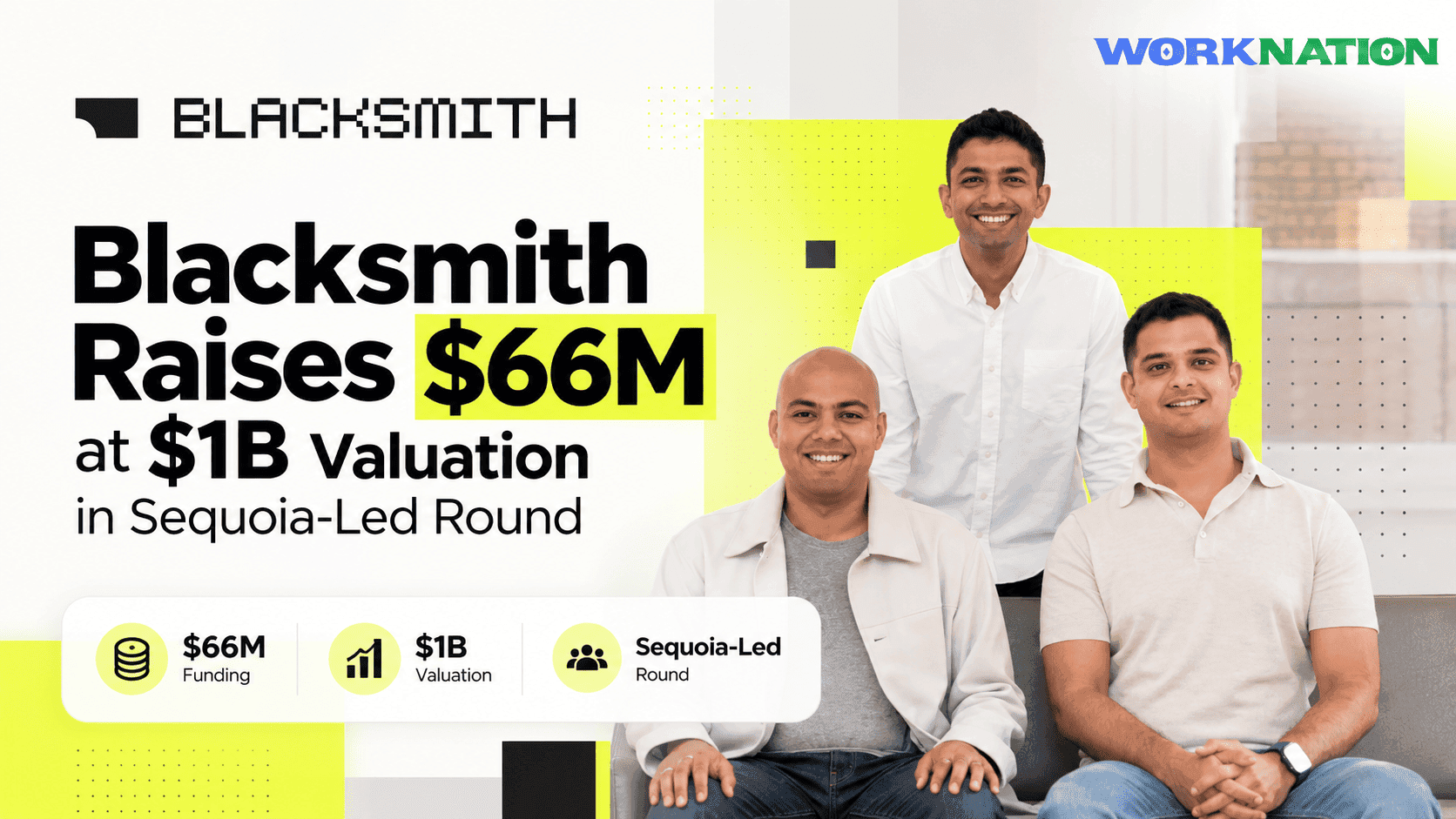
Blacksmith, an AI code testing infrastructure startup, has raised $66 million in a Series C funding round led by Sequoia Capital at a valuation of $1 billion. The round also included Premji Invest and existing investors Peak XV Partners, Google Ventures (GV) and Y Combinator.
The latest investment brings Blacksmith's total funding to $125 million. The company plans to use the capital to expand its team and computing infrastructure as demand for software development and testing tools grows alongside the adoption of AI coding agents.
Founded in 2024 by Aditya Jayaprakash, Aayush Shah and Aditya Maru, Blacksmith provides infrastructure that helps developers build, test and validate software before code is merged into a codebase.
Blacksmith's $66 Million Series C Funding Round
The Series C round values Blacksmith at $1 billion, marking a significant increase from its previous reported valuation of $550 million.
In its earlier Series B round, Blacksmith raised $45 million led by Peak XV Partners, with participation from GV and Y Combinator. The latest $66 million investment brings the company's total funding to $125 million.
Sequoia Capital led the new round, joined by Premji Invest and the existing investors. The participation of returning backers alongside new capital reflects continued investor interest in infrastructure supporting modern software development.
Blacksmith has not disclosed a detailed breakdown of how the Series C capital will be allocated beyond its plans to expand the team and computing infrastructure.
What Blacksmith Does
Blacksmith builds infrastructure for continuous integration (CI), a key part of the software development process.
When developers make changes to code, CI systems automatically build and test those changes to identify errors and help ensure that new code works with the existing application. These workflows are typically repeated throughout development, making their speed and reliability important for engineering teams.
Blacksmith provides the infrastructure required to run these jobs. Its platform is designed to help companies execute code builds and tests faster while reducing the computing costs associated with software development.
The service is used by more than 10,000 companies, according to Blacksmith. Its customers include Ashby, Granola, Handshake and LangChain.
As software teams increasingly use AI coding tools to generate code, the volume of code requiring validation can rise. Faster code generation does not eliminate the need to test changes, making reliable testing infrastructure an important part of AI-assisted development.
Blacksmith operates in this part of the software development stack, focusing on the infrastructure that helps engineering teams move code through testing workflows.
Revenue and Platform Usage Are Growing
Blacksmith reported substantial growth in both recurring revenue and platform activity during 2026.
The company said its annual recurring revenue (ARR) has grown 17 times since January 2026. ARR is a measure of the annualised value of recurring subscription revenue, rather than a direct measure of recognised revenue or profit.
The number of continuous integration jobs running on Blacksmith's platform each week has also increased from 5 million to more than 90 million over the same period.
This increase points to a sharp rise in the volume of software build and testing workloads handled by its infrastructure. However, the company has not disclosed absolute ARR figures in the supplied report, so its revenue scale cannot be determined from the growth multiple alone.
Blacksmith also says its platform runs CI jobs twice as fast and at an average cost 60% lower than the alternatives against which it compares its service. These are company-reported performance claims, and the announcement does not provide the full methodology used to calculate them.
Computing Infrastructure Across the US and Europe
Blacksmith manages nearly 10 megawatts of computing capacity across data centres in the United States and Europe.
Computing infrastructure is central to the company's business because CI workloads require resources to build applications, run tests and validate code changes. As the number of jobs grows, the company needs enough capacity to handle workloads while maintaining performance and cost efficiency.
Blacksmith plans to expand its computing capacity at least fivefold in 2027. That expansion would support its stated ambition to handle a substantially larger volume of development and testing workloads.
The planned investment also reflects the infrastructure requirements associated with AI-assisted software development. As more developers use AI coding agents, the ability to test and validate code efficiently becomes increasingly important.
Scaling computing resources, however, also requires managing infrastructure costs and maintaining reliable performance across customer workloads.
Why AI Coding Agents Could Increase Demand for Testing Infrastructure
AI coding agents are changing how developers write and modify software. These tools can generate code, make changes across files and assist with tasks that previously required more manual engineering work.
But generating code is only one part of the development process. Changes still need to be built, tested and checked before they can safely be integrated into applications.
As coding agents produce more changes, development teams may need to run more tests and validation workflows. That creates an opportunity for infrastructure providers focused on making these processes faster and more economical.
Blacksmith's business is positioned around this requirement. Rather than building an AI coding assistant itself, it provides the infrastructure that supports the testing process within software development workflows.
The opportunity will depend on whether the growth of AI-generated code translates into sustained demand for additional CI capacity and whether Blacksmith can maintain its reported speed and cost advantages as it scales.
What the Funding Means for Blacksmith
Blacksmith's $66 million Series C gives the company additional capital to expand its engineering team and computing infrastructure. The $1 billion valuation also places it among the startups attracting significant investment in software development infrastructure.
Its reported growth in ARR and weekly CI jobs suggests that platform usage has increased rapidly in 2026. At the same time, the company faces the operational challenge of expanding its computing capacity while maintaining performance and cost efficiency.
The next phase will involve scaling infrastructure, supporting more customers and meeting the testing requirements of software teams increasingly using AI coding agents.
Blacksmith's progress will ultimately depend on how well it converts demand for faster code validation into durable recurring revenue and a sustainable infrastructure business.
Have a Funding Round or Exciting Update to Share?
Submit your press release to get featured on WorkNation and reach founders, investors, and tech leaders.