Karta AI Raises $3 Million Seed Round Led by PeerCapital and Cedar Hill Capital
Top Picks
Submit PR
Stay Ahead of the Market
Get the latest startup funding, hiring trends and global opportunities delivered to your inbox every week.
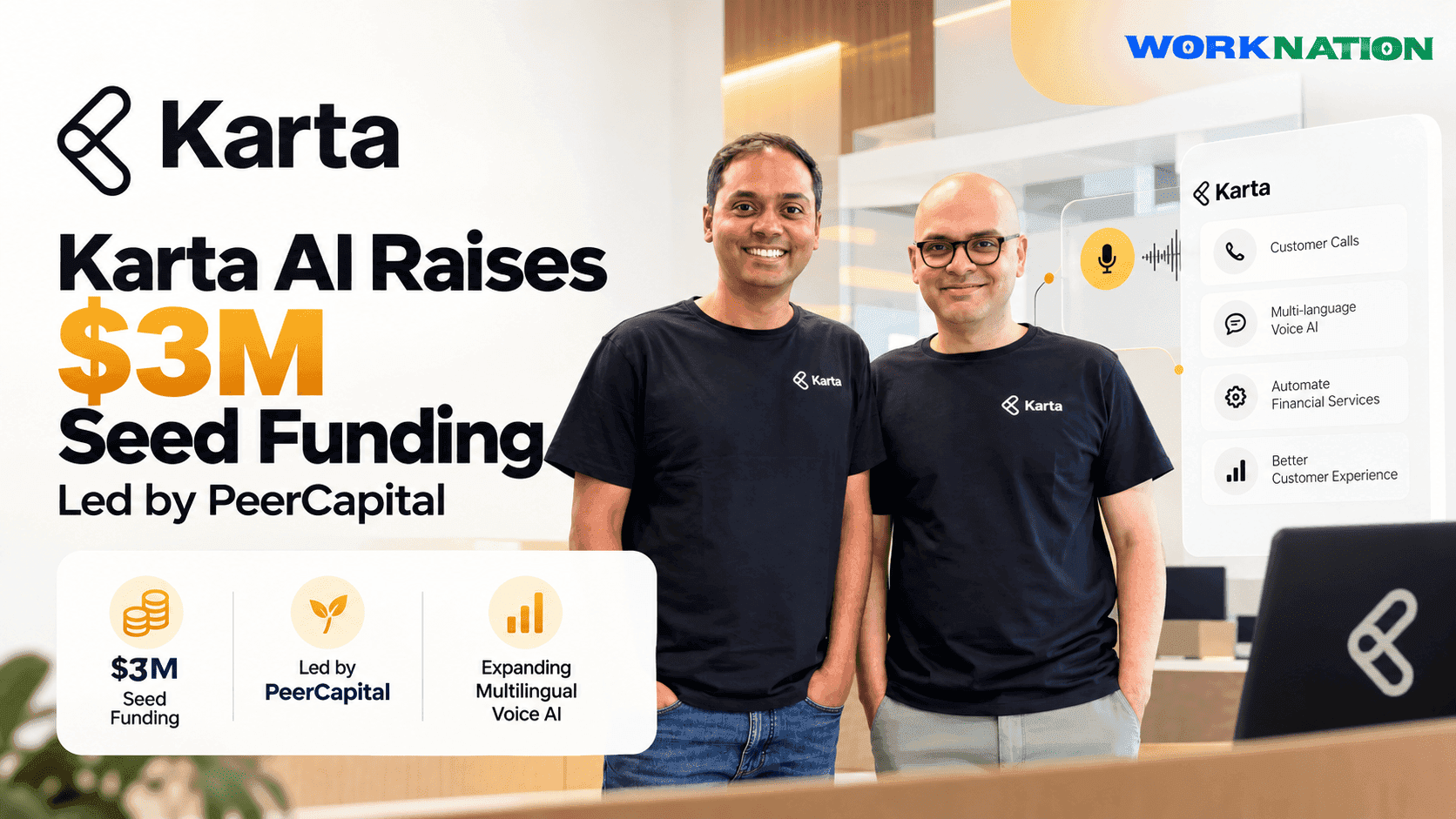
Karta AI, a Bengaluru-based voice AI startup focused on customer operations in banking, financial services and insurance (BFSI), has raised $3 million in a seed funding round led by PeerCapital and Cedar Hill Capital.
The round also saw participation from Wyser VC, CDM Capital and Seedstars. The company plans to use the fresh capital to strengthen its end-to-end automation and multilingual capabilities, expand deployments with financial institutions, and scale its engineering and go-to-market teams.
Founded in 2024 by Vijaypal Singh and Abhishek Kushwaha, Karta AI develops voice AI agents that handle inbound customer calls for banks, lenders, fintech companies and insurers. Its platform integrates with enterprise systems to answer customer queries and execute workflows without human intervention, escalating cases when required.
The startup says it is already handling around two million customer conversations each month across more than 25 languages, positioning it to serve financial institutions managing large volumes of customer interactions.
How Karta AI's Voice Agents Work
Financial institutions handle recurring customer enquiries about loan disbursements, account statements, repayment information and other account-related services. These interactions can create substantial workloads for customer support teams.
Karta AI aims to automate these inbound conversations through voice AI agents that connect with enterprise systems and carry out relevant workflows.
Unlike conventional voice bots designed to respond to a narrow set of predefined questions, Karta AI says its platform can manage multiple customer intents within a single conversation. This allows customers to move between related questions without necessarily starting a new interaction or being transferred to a human agent.
The platform is designed to resolve enquiries by combining conversational AI with access to the systems required to retrieve information and execute tasks. Human intervention remains available when an issue needs escalation.
This approach targets more than automated speech responses. The goal is to complete customer service workflows, reducing the amount of manual work required for routine interactions.
From Customer Queries to End-to-End Resolution
Karta AI reports that its inbound servicing agent resolves approximately 70% of borrower queries end to end, compared with an earlier reported baseline of 0%.
The company cites use cases such as disbursal status checks, account statements, foreclosure statements and property document release.
These workflows can involve several steps, including understanding the customer's request, retrieving relevant account information and providing the appropriate response or completing an action. Automating the full process could help financial institutions handle routine enquiries at scale.
The 70% resolution figure is a company-reported result. The funding announcement does not provide a detailed methodology, the number of interactions included in the measurement or an independent assessment of the results.
Even so, the metric highlights the type of outcome Karta AI is targeting: completing customer requests rather than simply answering questions.
A Predictive Context Engine for Conversations
Karta AI's platform includes a predictive context engine that uses information from previous interactions handled by both human agents and AI systems.
According to the company, this engine helps the platform interpret customer queries and improve decisions during conversations. The aim is to make interactions more context-aware, especially when customers raise multiple issues in a single call.
Context can be important in financial services because a customer's request may depend on earlier conversations, the status of an application or a particular account-related workflow.
By incorporating information from previous interactions, Karta AI seeks to improve how its agents handle these requests.
The company has not disclosed the technical architecture of the predictive context engine or provided separate performance figures showing how much it improves resolution rates.
Multilingual Voice AI for Financial Institutions
Karta AI says its platform handles approximately two million customer conversations per month across more than 25 languages.
Multilingual support is relevant to financial institutions serving customers across regions and language groups. A voice AI system that can operate in multiple languages may help businesses offer automated support to a wider customer base.
For lenders and fintech companies, the ability to handle high volumes of routine enquiries is particularly important as their customer bases grow. Banks and insurers also need systems that can integrate with existing enterprise infrastructure and follow the processes required for customer servicing.
Karta AI plans to strengthen its multilingual capabilities with the new funding, alongside improvements to end-to-end automation.
The company also intends to expand deployments with financial institutions, suggesting that scaling customer adoption is a key priority for its next phase.
Competition in India's Voice AI Market
Karta AI is operating in a market where startups are developing voice AI and agentic AI systems for customer service and financial workflows.
Recent funding activity cited in the source includes Desible.ai's ₹32 crore seed-plus round led by Prime Venture Partners, Navana.ai's ₹40 crore Series A led by Ronnie Screwvala, and Rezolv's $12.5 million Series A led by Norwest.
Other players include Arrowhead, which focuses on voice AI for financial services, and Gnani.ai, which is expanding its agentic AI and multilingual voice capabilities.
The competitive landscape includes companies focused on specific financial workflows, such as collections and underwriting, as well as platforms targeting broader enterprise customer support.
For Karta AI, differentiation will depend on its ability to handle complex conversations, complete workflows reliably, integrate with financial institutions' existing systems and demonstrate measurable operational benefits.
How Karta AI Plans to Use the Funding
The $3 million seed round will support three priorities: improving automation, strengthening multilingual capabilities and expanding the company's deployment and commercial teams.
Investment in engineering is expected to support further platform development, while go-to-market expansion can help the startup reach more financial institutions.
Karta AI also plans to build reusable, industry-specific capabilities over the longer term. Such capabilities could help it adapt its platform to recurring requirements across banking, lending, fintech and insurance without building every workflow from scratch.
International expansion is another longer-term objective, although the company has not disclosed specific markets or a launch timeline.
What Comes Next for Karta AI?
Karta AI's reported scale of two million monthly conversations and its claimed 70% end-to-end borrower query resolution rate provide an early indication of its deployment activity.
The next challenge is to expand that activity while maintaining reliability across customer interactions and financial workflows. Financial institutions require accurate responses, appropriate handling of sensitive information and clear escalation paths when automated systems cannot resolve a request.
The company's planned investment in multilingual support, engineering and go-to-market operations will help determine how effectively it can expand its customer base.
As financial institutions explore AI agents for customer operations, Karta AI is betting that voice systems capable of completing workflows, rather than merely answering questions, can become a useful part of their service infrastructure.
Have a Funding Round or Exciting Update to Share?
Submit your press release to get featured on WorkNation and reach founders, investors, and tech leaders.