Epoch Raises $4.25M to Help Small Importers Meet EU Deforestation Rules
Top Picks
Submit PR
Stay Ahead of the Market
Get the latest startup funding, hiring trends and global opportunities delivered to your inbox every week.
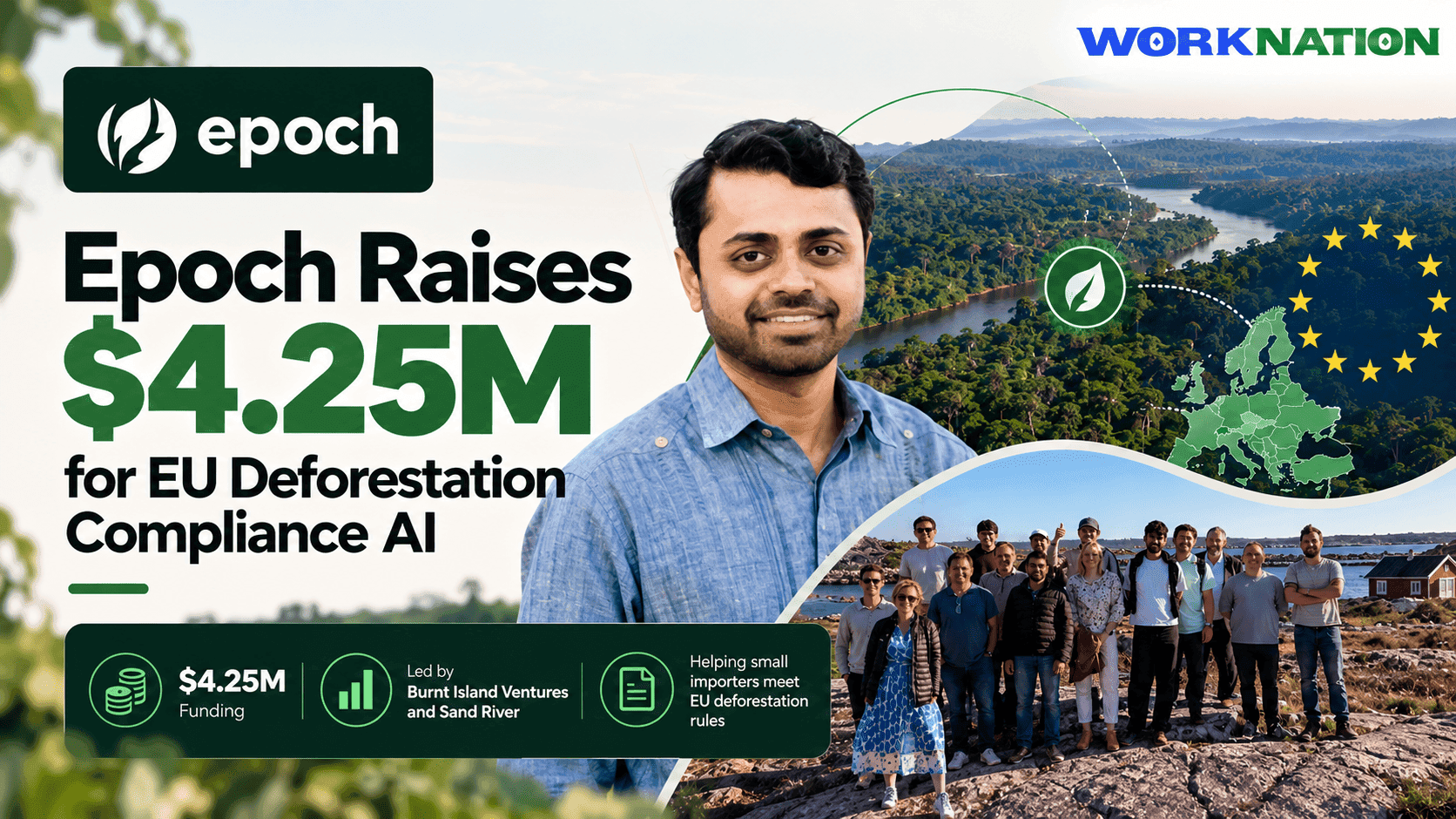
London-based supply chain technology startup Epoch has raised $4.25 million in seed funding to help small importers verify the origins of raw materials and prepare for the European Union's deforestation regulations. The round was led by Burnt Island Ventures and Sand River, bringing the company's total disclosed funding to $6.26 million.
Founded in 2023 by Jinal Surti and William Ouellette, Epoch develops software that uses geospatial artificial intelligence and AI agents to trace supply chains back to farms, plantations and other production locations. Its platform focuses on helping businesses identify environmental and legality risks associated with the origins of commodities such as cocoa, coffee and rubber.
The funding comes as businesses prepare for the EU Deforestation Regulation (EUDR), which requires covered products entering or being placed on the EU market to meet deforestation-free and legal production requirements.
Earlier in October 2026, Epoch launched a self-service product designed to automate compliance work for small and medium-sized businesses. The company plans to use the fresh capital for product development, infrastructure and commercial expansion.
Epoch Uses AI to Trace the Origins of Raw Materials
Supply chain traceability can be difficult for businesses that purchase commodities through multiple suppliers and intermediaries. Importers may need to establish where products were grown, identify the relevant land plots and collect evidence to demonstrate compliance with environmental regulations.
Traditional processes often rely on supplier questionnaires, audits and certification documents. These approaches can become challenging when suppliers do not respond or cannot provide the necessary information.
Epoch aims to simplify the process by using geospatial AI and software agents to investigate the first mile of a supply chain - the stage connecting raw materials to their original production locations.
According to the company, users can begin by providing supplier names. The platform then works to identify relevant supplier facilities and production plots, assess potential deforestation and legality risks, and compile the findings into a due diligence statement.
The resulting documentation is intended to support submission through the EU's TRACES system.
Epoch also says customers can access its capabilities through its own platform or through AI assistants such as ChatGPT, Claude and Gemini. The company states that sensitive customer business data remains in the customer's own environment.
This approach is intended to reduce the administrative burden on smaller importers that may lack the dedicated compliance teams and resources available to larger enterprises.
What the EU Deforestation Regulation Requires
The EU Deforestation Regulation covers specified commodities, including cattle, cocoa, coffee, oil palm, rubber, soya and wood, along with certain products derived from them.
Businesses covered by the regulation must demonstrate that relevant products are deforestation-free and produced in accordance with applicable legislation in the country of production. They must also meet traceability and due diligence requirements.
According to the timeline reported by Tech Funding News, the regulation is scheduled to apply to large and medium-sized operators from December 30, 2026, and to most micro and small operators from June 30, 2027.
These requirements create a practical challenge for smaller importers. They may have to trace products to individual plots of land even when their suppliers provide incomplete information or operate through complex sourcing networks.
Epoch's self-service product is designed to help these businesses investigate supply chains without depending entirely on lengthy exchanges with suppliers.
However, identifying a potential production location is not the same as proving compliance. Businesses still need reliable evidence and must satisfy the applicable regulatory requirements.
Why Mapping Accuracy Matters
A central challenge for automated deforestation compliance is the accuracy of the underlying geographic data.
Epoch highlighted this issue in a June 2026 analysis, reporting that an EU free forest map incorrectly flagged 75% of the coffee plots it surveyed. The company argued that no single map should be treated as the sole authority for determining compliance.
The finding illustrates the risks of relying on satellite maps or automated classifications without considering the characteristics of individual production sites.
Coffee, cocoa and other agricultural commodities can be grown in landscapes that include tree cover, mixed farming and agroforestry systems. A map may identify forest cover without necessarily establishing whether a particular plot violates the regulation.
For compliance technology providers, the challenge is to combine geospatial information with relevant contextual evidence and explain how a risk assessment was reached.
Epoch's approach combines geospatial AI with agent-based research to assemble evidence about supply chain origins. Its ability to provide dependable results will be important as companies prepare for regulatory deadlines.
The ultimate determination of compliance remains dependent on the evidence and applicable legal requirements, rather than the output of a single automated map.
Funding Led by Burnt Island Ventures and Sand River
The $4.25 million seed round was led by Burnt Island Ventures and Sand River. Epoch previously raised funding, bringing its total disclosed capital to $6.26 million.
Jinal Surti began his career working on moving capital into emerging markets. Before co-founding Epoch, he was an early employee at Ripple and a founding executive at Menai.
Co-founder and chief technology officer William Ouellette previously co-founded Soilwatch, a company that helped developers design projects for the voluntary carbon market.
Epoch's work extends beyond regulatory compliance. The company identifies carbon removal as one of five use cases for its first-mile supply chain data, alongside EUDR compliance and other supply chain applications.
The broader objective is to help businesses understand the environmental conditions and risks associated with the locations where their raw materials originate.
Burnt Island Ventures partner Christine Boyle said Epoch's combination of AI, earth observation data and proprietary models could help companies improve supply chain visibility and risk management. Sand River founding partner Greg Robson described the first-mile data layer as a potential source of broader business intelligence.
Competition in AI-Powered Compliance
Epoch is entering a competitive market for environmental, social and governance data, supply chain traceability and regulatory compliance software.
Other companies already provide platforms designed to help enterprises monitor supply chains and meet environmental requirements. The source report identifies osapiens, Sourcemap and Satelligence among companies operating in or adjacent to the EUDR compliance market.
Epoch's approach combines first-mile data collection with a self-service compliance product for smaller businesses. The company also provides data that platforms such as Assent and Resilinc can integrate into their existing offerings, according to the report.
This positions Epoch across two potential customer groups: businesses that want a direct compliance tool and larger platforms that need data about supply chain origins.
The company says its team has 14 members and that the new funding will support product development, infrastructure and commercial hiring.
What Comes Next for Epoch?
Epoch's immediate opportunity is tied to businesses preparing for the EU deforestation rules. Small importers may face substantial traceability work despite having fewer resources than large multinational operators.
A self-service platform that can investigate supplier origins and assemble supporting evidence could reduce some of that workload.
But adoption will depend on more than automation. Importers need reliable data, transparent assessments and documentation that meets the applicable regulatory requirements. They will also need confidence that the platform can distinguish genuine deforestation risks from inaccurate geographic classifications.
As the relevant implementation deadlines approach, Epoch will have to demonstrate that its technology can support practical compliance across different commodities and sourcing regions.
If successful, its first-mile data infrastructure could become useful beyond the initial deforestation rules, including other forms of supply chain risk management and environmental monitoring.
Have a Funding Round or Exciting Update to Share?
Submit your press release to get featured on WorkNation and reach founders, investors, and tech leaders.