Machenta Raises $40 Million Seed Round to Train Robots in Simulation
Top Picks
Submit PR
Stay Ahead of the Market
Get the latest startup funding, hiring trends and global opportunities delivered to your inbox every week.
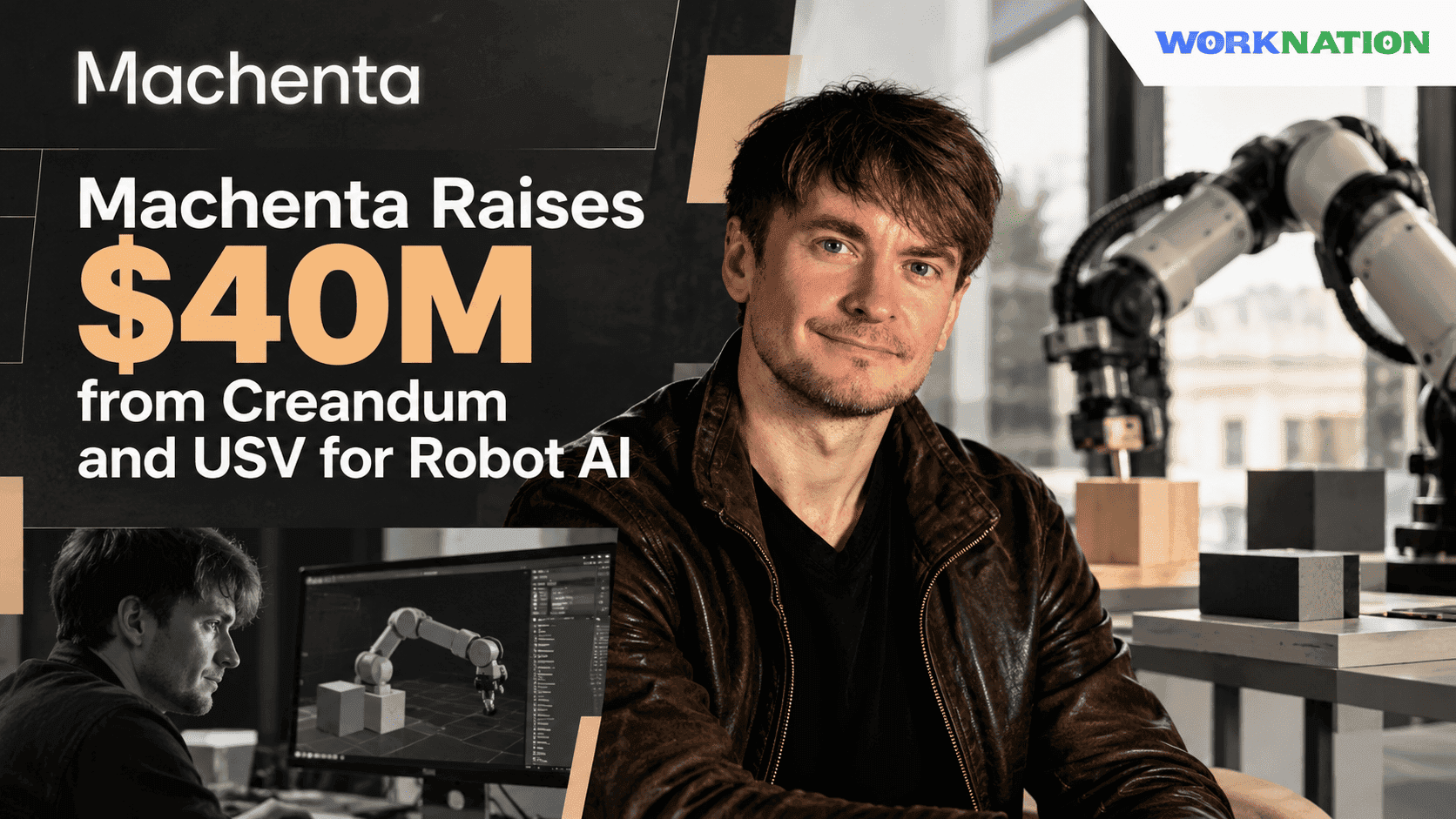
Machenta, a London-based robotics startup founded in 2025, has raised $40 million in seed funding co-led by Creandum and Union Square Ventures (USV). The company is developing AI models designed to help robots learn new tasks through simulation, reducing their reliance on repeated real-world demonstrations and additional training.
Founded by Edward Johns, whose early robotics research at Imperial College London explored how robots could learn to perform tasks autonomously, Machenta aims to make robot learning faster and more adaptable. The startup says its approach allows a robot to learn a new task from just one or two real-world demonstrations after training its model in simulation.
The company plans to use the funding to expand its team, increase computing capacity and generate more simulated training data. It is also moving into a new office and laboratory in King's Cross, London.
Teaching Robots Without Repeated Real-World Demonstrations
Training a robot to perform a new task can be a lengthy process. In many approaches, developers collect hundreds or thousands of human demonstrations, train a model and evaluate the results before the robot can perform the task reliably.
This process creates a demand for real-world training data. Some companies have begun paying people to record themselves performing everyday tasks so that robots can learn from human behaviour.
Machenta is pursuing a different approach. Rather than depending primarily on extensive real-world demonstrations, it trains its models in simulation, aiming to teach robots how to learn new tasks quickly.
The company is developing a foundation model intended to work across multiple tasks and types of robots. Once trained, the model is designed to generalise what it has learned so that a robot can perform a new task after seeing only a small number of examples.
Machenta says it has demonstrated this approach in packaging, assembly and tidying tasks, including work involving different robot platforms and humanoids.
The central idea is that robots should not need to be retrained extensively every time they encounter a new task. If the approach works reliably beyond the tasks already demonstrated, it could reduce the time and resources required to deploy robots in changing environments.
From Imperial College Research to a Robotics Startup
Machenta's origins lie in research by Edward Johns at Imperial College London. His early work explored how much additional data a robot needed after being shown a task before it could operate autonomously. According to the supplied report, the research found that approximately 30 minutes of additional data collection was needed in the setting being studied.
Johns founded Machenta in 2025 to address this broader challenge of helping robots learn more efficiently. He argues that intelligence should be measured not only by what a system can already do, but also by how quickly it can learn something new.
The startup's approach draws on the idea that people can often learn a task after seeing it performed once or twice. Machenta aims to bring a similar ability to robots through simulation-trained AI models.
The company currently has 11 employees and remains at an early research stage. It has not announced a near-term commercial launch, and the supplied report notes that complex movements and tasks requiring high precision remain difficult.
Why Simulation Could Change Robot Training
Simulation offers robotics developers a way to generate training experiences without repeatedly collecting physical demonstrations. Researchers can expose models to different scenarios, objects and task variations in a virtual environment before testing the resulting behaviour on real hardware.
For Machenta, the objective is not simply to teach robots a fixed set of actions. It is to develop models that can adapt to unfamiliar tasks after receiving limited new information.
If successful, this could help address a key limitation in robotics: the difficulty of transferring learning from one task or environment to another. A model that generalises well could potentially support a wider range of applications without requiring a separate, extensive training process for every task.
However, simulation-based learning also faces challenges. Virtual environments cannot perfectly capture every physical interaction, and skills that appear successful in simulation may not translate directly to real-world settings. Precise movements, contact with objects and unexpected environmental conditions can all complicate deployment.
Machenta's claim that a robot can learn a new task from one or two real demonstrations is therefore an important capability to validate across more tasks and conditions.
$40 Million to Expand Research and Computing Capacity
The $40 million seed round was co-led by Creandum and Union Square Ventures. According to the supplied article, the capital will support team expansion, increased computing power and the generation of additional simulated training data.
Machenta is also establishing a new office and laboratory in King's Cross, London, to support its research activities. The company has not disclosed a specific hiring target.
Creandum partner Kathi Wilhelm highlighted the team's years of robotics research and its progress in addressing a difficult technical problem. Rebecca Kaden, managing partner at USV, pointed to the potential for robots to adapt to new tasks without requiring extensive task-by-task training.
The investment reflects growing interest in physical AI: systems that interact with the physical world through robots, machines and other devices. Investors are backing approaches that could make robots more versatile and reduce the effort required to deploy them across different environments.
Competing Against Well-Funded Robotics Startups
Machenta enters a competitive field that includes Physical Intelligence, FieldAI and Skild AI. These companies are also developing AI systems intended to support more general-purpose robotic capabilities.
The competitive landscape is attracting substantial investment. The supplied report cites Skild AI's reported valuation of more than $14 billion following a $1.4 billion funding round in January 2026.
Machenta's proposed differentiation is its focus on simulation-based training and rapid learning from a limited number of real-world examples. Instead of relying heavily on large collections of physical demonstrations for each task, the company aims to develop a model that can generalise across different tasks and robot platforms.
That approach could reduce data collection requirements if it performs reliably at scale. But the company still needs to demonstrate that its models can handle precise movements and complex tasks consistently outside controlled demonstrations.
The startup is also competing against a broader industry effort to improve robotic learning. Other companies are investing in real-world data collection, model development and infrastructure to improve performance. The effectiveness of these different approaches will become clearer as they are tested across more applications.
A Growing Market for Physical AI
Funding for physical AI has increased as investors explore applications spanning industrial automation, logistics, manufacturing and humanoid robotics.
The article cites Crunchbase data showing that global venture funding for its physical AI category reached $47.4 billion across 521 deals in the first half of 2026. It also references a late-July ranking based on Dealroom data that put funding for humanoid robotics companies at $8.6 billion.
These figures reflect the level of investor interest in AI systems that can operate beyond digital environments. For robotics companies, however, attracting funding is only one part of the challenge. They must also demonstrate reliable performance in real-world conditions and identify applications where the technology creates enough value to justify deployment.
Machenta is still at the research stage, making technical validation its immediate priority rather than near-term commercialisation.
What Comes Next for Machenta?
Machenta plans to use its new funding to strengthen its team, increase computing capacity and generate more simulated training data. Its longer-term ambition is to help robots learn new tasks with far less additional training than many existing approaches require.
The key test is whether its simulation-trained models can generalise reliably across robots, environments and increasingly complex tasks. Success could reduce dependence on extensive physical demonstrations and help accelerate the development of adaptable robotic systems.
For now, the company's claims remain subject to further validation. The ability to learn a task from one or two examples is promising, but precision, reliability and real-world transfer will determine how broadly the approach can be applied.
The $40 million round gives Machenta more resources to pursue that challenge as competition in general-purpose robotics intensifies.
Have a Funding Round or Exciting Update to Share?
Submit your press release to get featured on WorkNation and reach founders, investors, and tech leaders.