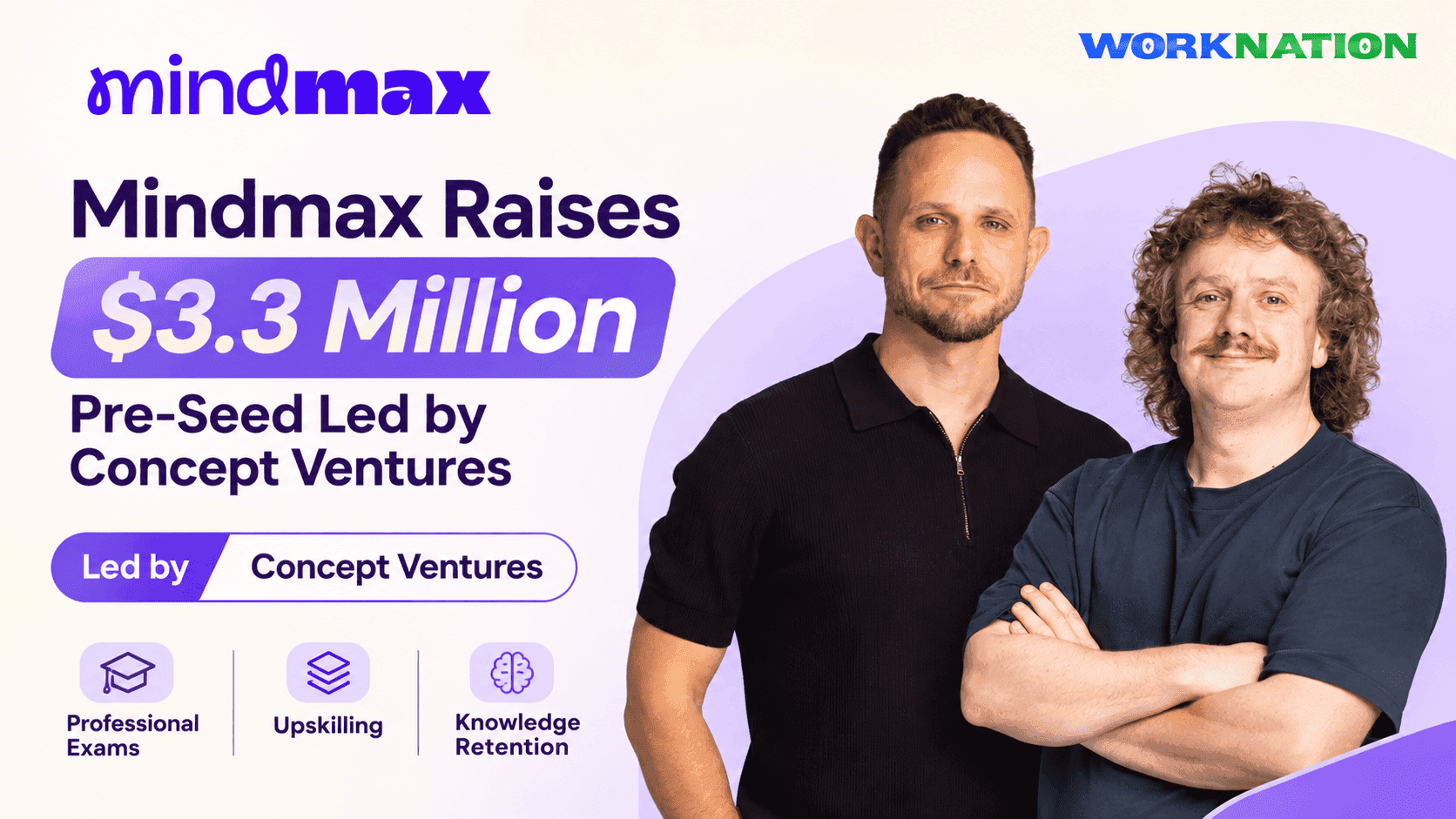
Memrise Co-Founders’ Mindmax Raises $3.3 Million Pre-Seed to Build AI-Powered Learning Tutor
Top Picks
Submit PR
Stay Ahead of the Market
Get the latest startup funding, hiring trends and global opportunities delivered to your inbox every week.
Mindmax, an AI-powered learning startup founded by former Memrise leaders Ed Cooke and Daniel Zohar, has raised $3.3 million in a pre-seed funding round led by Concept Ventures.
The round also included Redrice Ventures, Daybreak Ventures and Lerer Hippeau. Angel investors participating in the round include Maria Raga, former CEO of Depop, and Torsten Reil, co-founder of defence AI company Helsing.
The company plans to use the funding for growth and technology development as it builds an AI tutor designed to help people learn, retain information and develop professional skills.
From Memrise to a New Approach to AI Learning
Mindmax was founded by Ed Cooke and Daniel Zohar, who previously worked together at language-learning company Memrise.
Cooke became a Grand Master of Memory at the age of 23. He is known for using vivid mental imagery and memory techniques to retain information. He also taught these techniques to journalist Joshua Foer, who later won the 2006 US Memory Championship and documented the experience in his book Moonwalking with Einstein.
Zohar began coding at seven and was taking university-level courses by the age of 14. He left school at 17 without formal qualifications and later founded PicBadges, a platform that allowed users to add badges to Facebook profile pictures and reportedly reached more than 15 million users. He subsequently worked with Cooke for over a decade at Memrise as its CTO.
Memrise says its language-learning platform has helped more than 80 million people.
The founders' experience informs Mindmax's central idea: people learn differently, and learning systems should adapt to individual needs rather than rely on a single teaching method.
Building an AI Tutor That Keeps Learners Involved
Mindmax's first product is an AI tutor focused on professional exam preparation and upskilling.
Users can interact with the tutor in real time, interrupt lessons, ask questions and direct the session towards topics they need help understanding. The system can provide visual explanations and illustrations, draw diagrams, test learners and send reminders.
Lessons are designed to adapt to a user's existing knowledge, objectives and preferred learning style.
Rather than simply delivering a recorded lesson or a fixed sequence of content, Mindmax aims to create an interactive learning experience in which learners actively participate.
The app is already available globally through the Apple App Store and Google Play Store, with the United States launch receiving initial priority, according to Cooke.
The company has an eight-person team, including six full-time members based across Paris, Latvia, London and India.
Addressing AI-Driven Cognitive Offloading
A central part of Mindmax's positioning is its concern about what the company describes as AI-driven "cognitive surrender" or cognitive offloading.
As people increasingly use AI systems to generate answers, complete tasks and process information, the founders believe there is a risk that users may become less engaged in their own thinking and learning.
Mindmax wants to use AI to strengthen human learning rather than encourage dependence on automated answers.
Cooke describes the approach as using AI to counteract the cognitive offloading that AI itself may encourage. The goal is to help people build confidence in their ability to understand, retain and apply information.
The company is targeting professional exam preparation and upskilling, areas where learners need more than quick answers. They need to remember information and demonstrate that they understand it.
Accuracy and the Challenges of AI Tutoring
Accuracy is particularly important for an exam preparation product. Cooke told Tech Funding News that specialists review course content and that the company has technical checks in place.
However, Mindmax has not published error-rate figures, so there is not yet public evidence quantifying the accuracy of its tutoring system.
The company believes that combining its founders' experience in memory-based learning with large language models can improve information retention. Its longer-term product development will depend on delivering reliable explanations and measurable learning outcomes.
Funding and the Competitive Landscape
The $3.3 million pre-seed round will support Mindmax's growth and technology development.
Concept Ventures led the investment, joined by Redrice Ventures, Daybreak Ventures and Lerer Hippeau. Angel participation included Maria Raga and Torsten Reil.
Mindmax is entering a growing AI tutoring market that includes companies such as Medly AI, Speak, Futura, Preply and Lucida AI. These businesses are developing products for exam preparation, language learning, virtual tutoring and AI-assisted education.
Mindmax's positioning centres on interactive tutoring and information retention, rather than treating AI as simply a tool for generating answers.
What Comes Next for Mindmax?
Mindmax is still at an early stage, with its app live and its team focused on product and technology development.
The company aims to make learning more personalised and engaging while helping users retain knowledge and develop skills for changing professional requirements.
Its challenge will be to demonstrate that its AI tutor can deliver accurate instruction and measurable improvements in learning outcomes.
With its founders' experience at Memrise and a new pre-seed investment, Mindmax is looking to build an AI learning platform that helps people use AI without surrendering their own ability to think.
Have a Funding Round or Exciting Update to Share?
Submit your press release to get featured on WorkNation and reach founders, investors, and tech leaders.