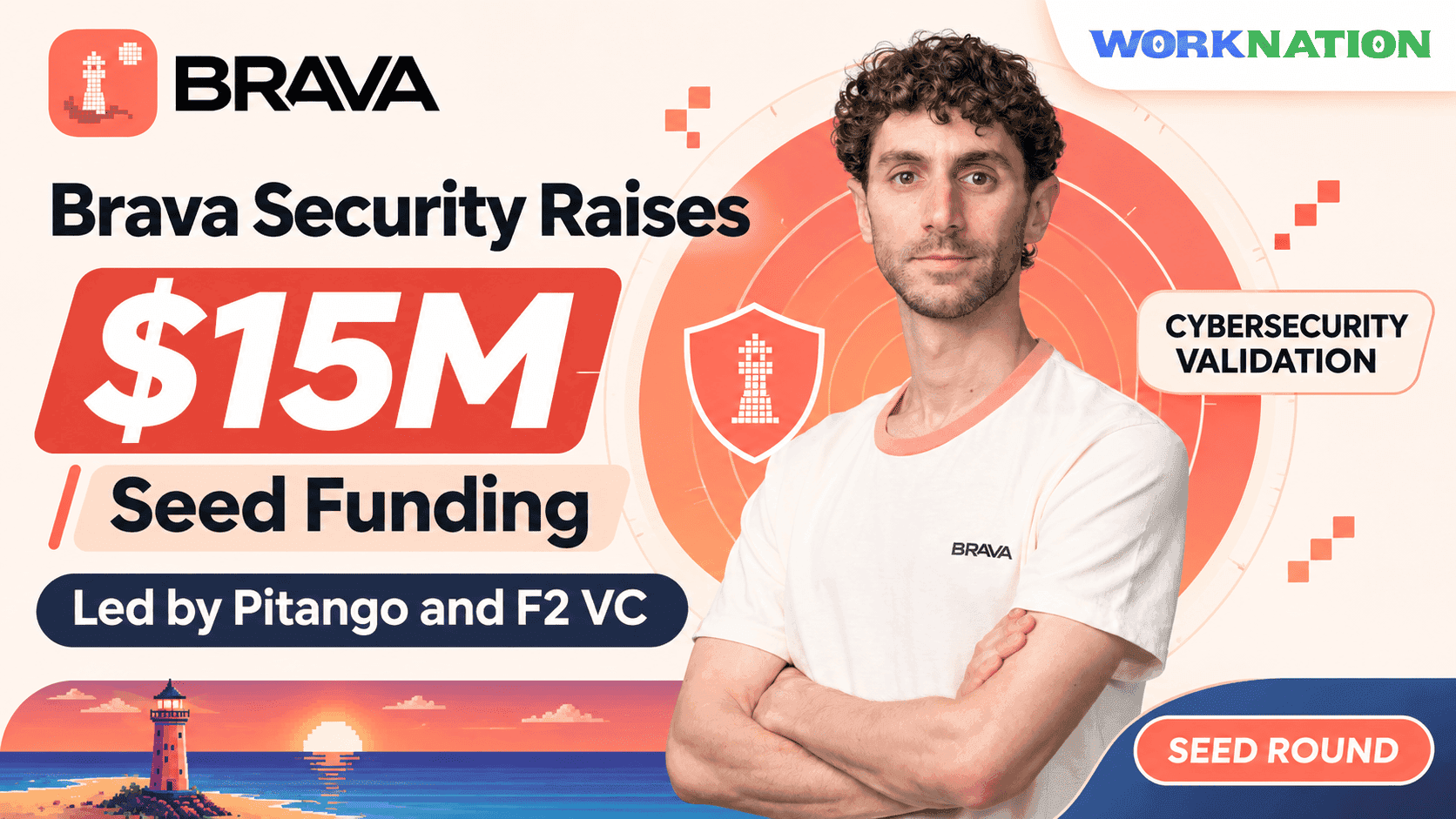
Brava Security Raises $15 Million Seed Funding Led by Pitango and F2 Venture Capital
Top Picks
Submit PR
Stay Ahead of the Market
Get the latest startup funding, hiring trends and global opportunities delivered to your inbox every week.
Israeli cybersecurity startup Brava Security has raised $15 million in seed funding to help organisations identify security gaps that traditional monitoring tools and emerging AI security agents may overlook.
The round was led by Pitango and F2 Venture Capital as the company emerged from stealth. The fresh capital will support technology development and expansion in North America, with an initial focus on financial services and government organisations.
Founded in 2024 by Idan Basre and Itay Gabbay, Brava Security is developing a multi-agent AI platform that tests whether an organisation's existing security infrastructure can detect simulated cyberattacks without actually carrying out attacks.
Founded by former Microsoft Defender product leader
Brava Security was co-founded by Idan Basre, who previously led product management for Microsoft Defender, and Itay Gabbay, who serves as the company's Chief Technology Officer.
Basre's experience at Microsoft exposed a challenge facing security operations teams: investigations can be limited by missing telemetry and incomplete security data. Even when organisations deploy advanced detection systems, those tools cannot identify threats if the necessary evidence is never collected.
The founders established Brava to address this problem by testing whether security infrastructure can actually observe and detect potential attacks before those attacks occur.
Testing security visibility without executing attacks
Brava's platform uses multiple AI agents to model attacker behaviour and generate simulated attack logs, also known as telemetry.
Instead of executing real attacks against customer systems, the platform determines how specific attacker techniques would appear in an organisation's environment and checks whether its existing security tools would identify the resulting activity.
The process helps security teams identify weaknesses such as:
Missing security logs and telemetry.
Broken data pipelines that prevent important information from reaching monitoring systems.
Detection rules that fail to identify specific attack techniques.
Gaps between the security evidence available and the threats organisations need to investigate.
Once the platform identifies a gap, Brava helps security teams update detection rules and data feeds so that future suspicious activity is more likely to be recognised.
These detection rules can then be incorporated into Security Information and Event Management (SIEM) platforms, which collect, analyse and search security logs across an organisation.
According to co-founder and CTO Itay Gabbay, understanding exactly how an attack would appear across an organisation's different log sources is a central challenge the company's technology is designed to solve.
Supporting the next generation of AI-powered security operations
Security Operations Centres (SOCs) are increasingly adopting AI agents to investigate alerts, analyse evidence and automate security workflows.
However, Brava argues that automating investigations is not enough if the underlying security infrastructure fails to capture the evidence required to identify an attack.
Its platform focuses on validating that foundation before organisations rely more heavily on AI-driven security decisions.
The company says it can provide initial insights within 10 to 15 minutes of onboarding. It integrates with Splunk, Google SecOps, CrowdStrike and more than 70 other sources and destinations.
Brava also says its platform does not require organisations to replace their existing security tools or execute actual attacks to evaluate their detection capabilities.
Fortune 100 customers and enterprise adoption
Brava says it already works with Fortune 100 companies across retail, energy and hospitality.
Its named customers include Cushman & Wakefield and WELL Health, one of Canada's largest healthcare companies.
The company currently has approximately 20 employees, with research and development operations based in Israel and a growing commercial team in the United States.
The funding will help Brava further develop its platform, strengthen its commercial operations and expand its customer base across North America.
A growing market for AI security operations
The funding comes as organisations increasingly invest in AI-powered cybersecurity tools.
According to MarketsandMarkets, the AI security operations market is projected to grow from $18.10 billion in 2026 to $47.07 billion by 2031.
Several startups are developing AI agents to automate security operations. Torq raised $140 million in a Series D round at a $1.2 billion valuation in January 2026, while Exaforce secured $125 million in Series B funding. French startup Qevlar AI is also applying generative AI to security alert investigations.
Brava is targeting a different part of the security workflow. Rather than focusing primarily on investigating alerts after they are generated, it tests whether the systems responsible for detecting threats can identify them in the first place.
Other companies are also working on security validation. Fig Security raised $38 million across seed and Series A funding in March 2026, while Pentera raised $60 million in March 2025 to test organisations' security defences through simulated attacks.
Brava's approach is focused on generating simulated telemetry without executing attacks against customer environments.
Funding to accelerate North American expansion
The $15 million seed round led by Pitango and F2 Venture Capital will support Brava's product development and expansion across North America.
The company is initially targeting financial services and government organisations, where reliable security monitoring and threat detection are particularly important.
As businesses introduce more AI agents into security operations, Brava is positioning its technology as a validation layer that checks whether those systems have the necessary evidence to make informed decisions.
Its next challenge will be convincing security leaders to validate their detection infrastructure before handing more security responsibilities to autonomous AI systems.
Have a Funding Round or Exciting Update to Share?
Submit your press release to get featured on WorkNation and reach founders, investors, and tech leaders.