Quint Computing Raises €9.1 Million to Reduce Quantum Error-Correction Overhead by 100x
Top Picks
Submit PR
Stay Ahead of the Market
Get the latest startup funding, hiring trends and global opportunities delivered to your inbox every week.
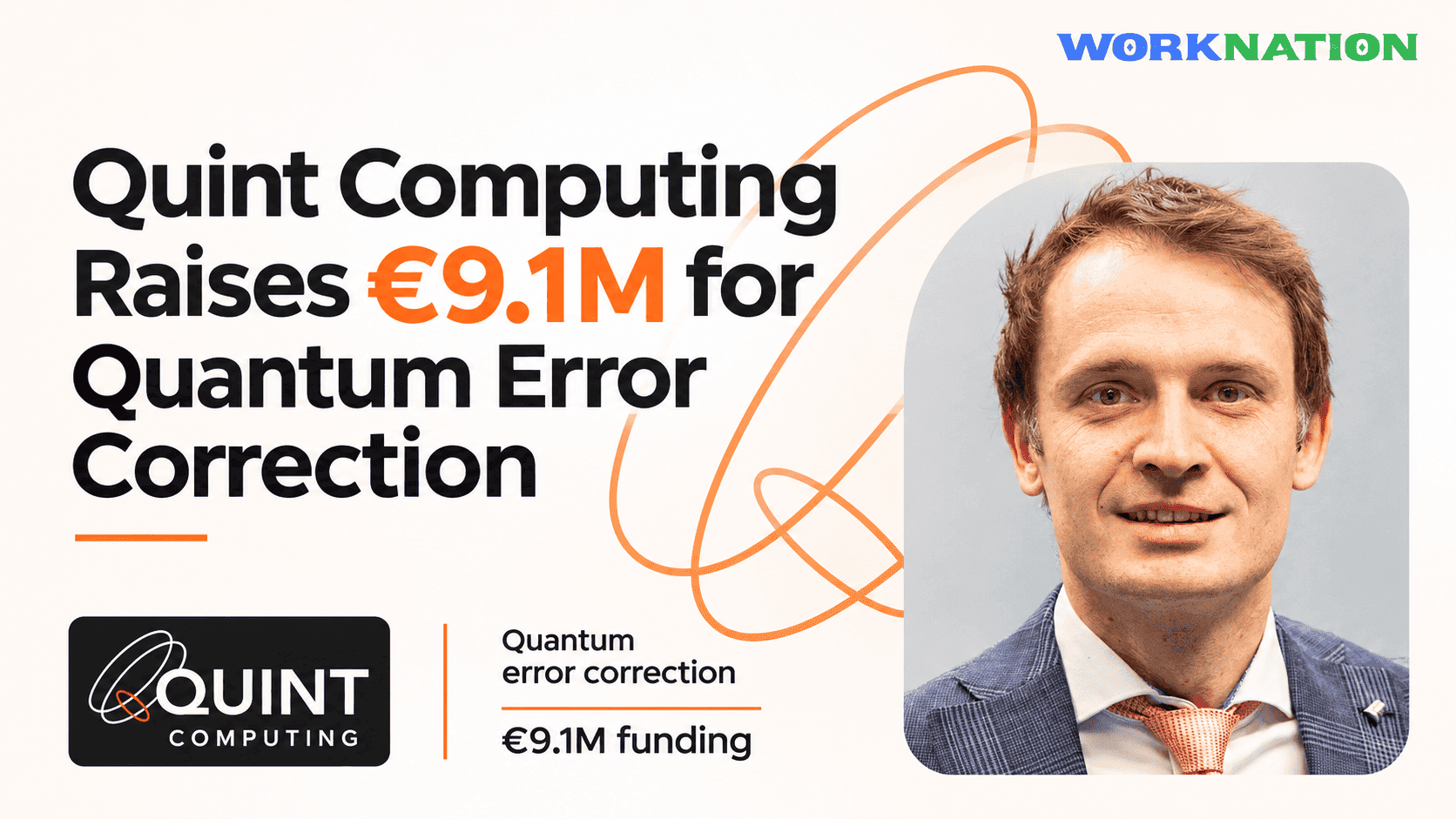
German quantum computing startup Quint Computing has raised €9.1 million in its first funding round, led by Vsquared Ventures, as it works to reduce one of the biggest barriers to commercially viable quantum computers: the hardware overhead required for error correction.
Based in Erlangen, the company is also supported by a €2.2 million European Innovation Council (EIC) Pathfinder grant. Founded in October 2025, Quint is developing superconducting quantum processors designed to integrate fault tolerance and error correction directly into the chip architecture.
The company says its approach could reduce the hardware resource overhead required for quantum error correction by a factor of 100, potentially making fault-tolerant quantum processors less complex and energy-intensive.
Founded by quantum researchers and an industry-focused co-founder
Quint Computing was founded by Prof. Christopher Eichler, who serves as CEO, Prof. Michael Hartmann, the company's CTO, and economist Dr. Jona Stinner.
The startup emerged from Friedrich-Alexander-Universität Erlangen-Nürnberg and is part of the Munich Quantum Valley, a research and innovation ecosystem focused on advancing quantum technologies.
The founding team brings experience from academic research and the commercial quantum computing industry. Before joining Erlangen, Eichler worked at ETH Zurich, where he was involved in research on error-corrected superconducting qubits. According to Hartmann, the team achieved a result in 2022 that preceded Google's public announcement in this area.
Hartmann also brings industry experience from Google Quantum AI and has led projects involving German companies. The founders have already tested selected use cases with Bosch, BASF and Boehringer Ingelheim, which Eichler expects could become among Quint's first customers.
The company's advisory board includes Prof. Florian Marquardt, director at the Max Planck Institute for the Science of Light; Dr. Reinhard Ploss, former CEO of Infineon Technologies; and Dr. Markus Hoffmann, former partnerships lead at Google Quantum AI.
Tackling the quantum error-correction bottleneck
Quantum computers use qubits to process information, but these systems are highly sensitive to errors caused by environmental disturbances and imperfections in hardware operations.
Error correction is therefore essential to building reliable quantum computers capable of running complex computations. One widely used approach is the surface code, which combines multiple physical qubits to create a more reliable logical qubit.
However, this approach requires a substantial number of physical qubits. Eichler estimates that a commercially useful processor built using conventional methods, with performance comparable to or better than current processors, could require around one million physical qubits.
Quint Computing is developing an alternative architecture that integrates fault tolerance into the processor from the beginning rather than treating error correction as an additional layer.
Its chip design uses a hierarchy of error probabilities to support more efficient error-correcting codes. The company has also designed its qubits to work in coordination with their control systems, integrating error correction more deeply into the overall processor architecture.
According to Eichler, this approach could reduce the hardware resources required for error correction by approximately 100 times.
The company still faces a significant technical challenge: implementing two-qubit gates while maintaining the error hierarchy on which its architecture depends. Demonstrating that the approach works at the processor level will be an important milestone.
Investors back the development of fault-tolerant quantum processors
Vsquared Ventures led Quint Computing's €9.1 million funding round. Other participants included Quantonation, Nucleus Capital, Faber, Vanagon Ventures and ZOHO.VC.
Prof. Mikko Möttönen, co-founder of IQM and QMill, also participated in the round.
Alongside the private investment, Quint secured a €2.2 million EIC Pathfinder grant to support its research and development efforts.
The funding comes as quantum computing companies continue to attract investment to address the technical challenges involved in scaling quantum processors. Other companies working on quantum error correction and scalable systems include Paris-based Alice & Bob, London-based Riverlane and Munich-based planqc.
For Quint, the immediate priority is translating its research into working processors and demonstrating that its architecture can deliver the promised reduction in error-correction overhead.
Hiring and commercial milestones ahead
Quint currently employs 10 people and plans to hire approximately 15 additional employees by the end of 2027. Its longer-term goal is to build a team of 40 to 50 people within two years.
The company is also working on an ongoing project to deploy processors at universities, while pursuing early commercial traction and further technical demonstrations.
Among its key milestones is demonstrating quantum error correction with record-high efficiency in the coming years.
The broader market opportunity is substantial. The McKinsey Quantum Technology Monitor 2026 estimates that quantum technologies could generate between $1.3 trillion and $2.7 trillion in economic value by 2035.
However, commercial scalability remains a major challenge for the industry. For Quint Computing, the next critical test will be whether its first processors can demonstrate the error suppression and hardware efficiency promised by its architecture.
Have a Funding Round or Exciting Update to Share?
Submit your press release to get featured on WorkNation and reach founders, investors, and tech leaders.