Oxford Spinout FluoRok Raises $30 Million Series A to Develop Hydrofluoric Acid-Free Battery Chemicals
Top Picks
Submit PR
Stay Ahead of the Market
Get the latest startup funding, hiring trends and global opportunities delivered to your inbox every week.
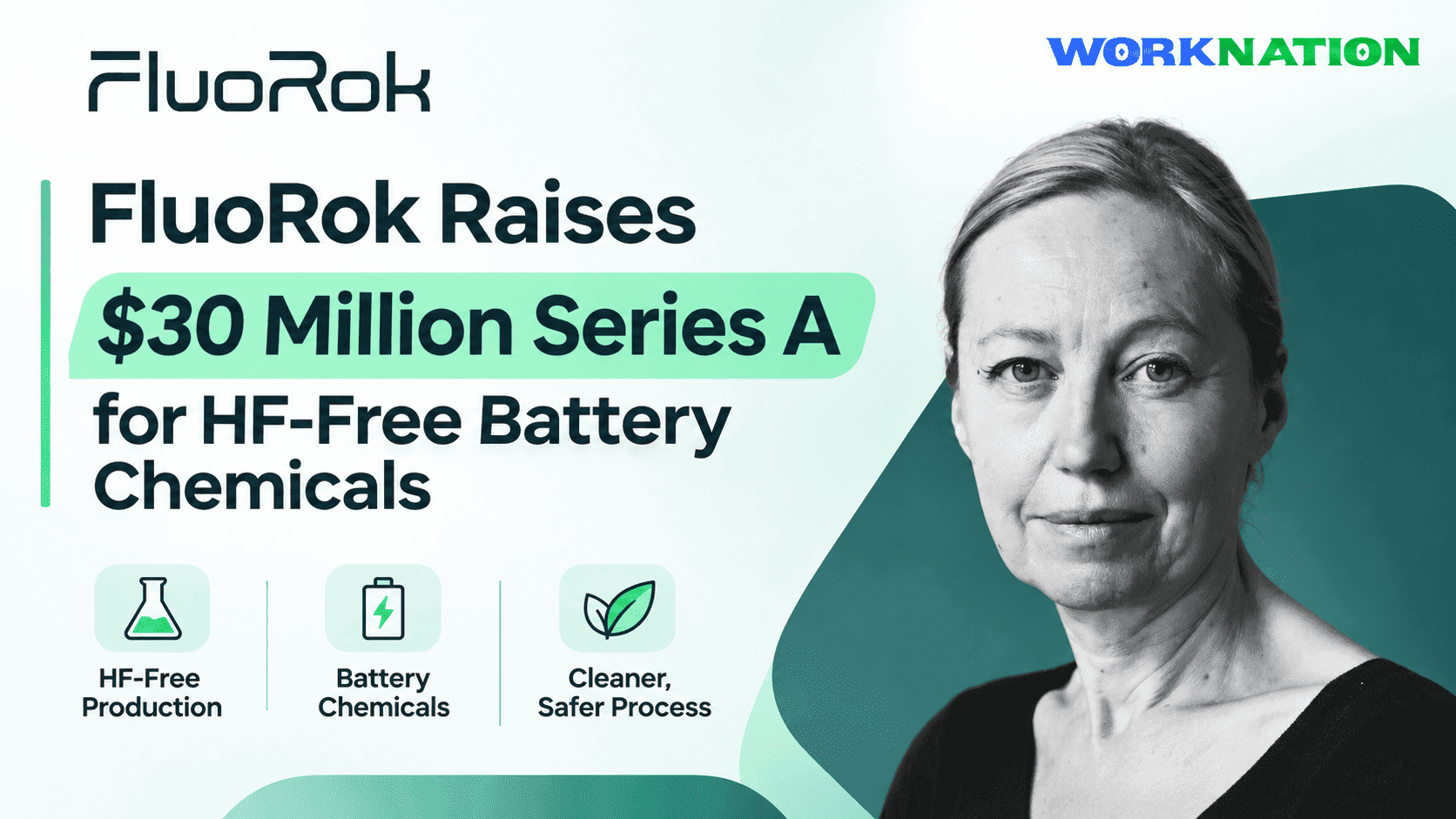
UK-based chemical technology startup FluoRok has raised $30 million in a Series A funding round to scale its hydrofluoric acid-free manufacturing process for specialty chemicals used in batteries and pharmaceuticals.
The round was led by Orano Venture Fund and Supernova Invest. Bidra Innovation Ventures also participated, alongside returning investors Oxford Science Enterprises, BGF, Green Generation Fund, Volta Energy Technologies and the University of Oxford.
Other participants included CPI Enterprises, EverQuest Capital Partners, WS Investment and several angel investors. The round also included approximately $1.3 million in Innovate UK grant funding through its Investor Partnerships programme.
FluoRok will use the capital to establish demonstrator facilities for chemical reagents and battery electrolyte salts, expand its team, validate products with customers at scale and develop commercial partnerships.
Reducing Dependence on Hydrofluoric Acid
Founded in 2022, FluoRok is an Oxford University spinout developing an alternative process for producing fluorochemicals without conventional hydrogen fluoride (HF).
The company was co-founded by Oxford chemistry professor Véronique Gouverneur and Gabriele Pupo, who previously worked as a postdoctoral researcher in Gouverneur's Oxford research group.
Hydrogen fluoride is highly toxic and is used in conventional fluorochemical manufacturing. Its hazardous nature creates significant safety and operational challenges, including restrictions on where production facilities can be located.
FluoRok's technology aims to remove the need for this chemical in the production process, potentially making fluorochemical manufacturing safer and more flexible.
Its platform is designed to produce chemicals for applications including lithium-ion batteries and pharmaceuticals.
Addressing Battery Supply Chain Concentration
One of the company's key target markets is lithium hexafluorophosphate (LiPF6), a widely used electrolyte salt in lithium-ion batteries.
According to the source report, China produces approximately 85-90% of global LiPF6 supply. This concentration creates a supply-chain challenge for battery manufacturers and regions seeking to develop domestic production capabilities.
Conventional LiPF6 manufacturing relies on hydrogen fluoride, adding another safety and infrastructure challenge to expanding production.
FluoRok aims to offer an alternative through its mechanical activation process. The company says the technology can operate using standard equipment and can work with lower-grade fluorspar or fluoride recovered from industrial waste.
By developing an alternative production route, FluoRok is targeting both the safety challenges associated with conventional manufacturing and the broader need for more geographically diversified battery chemical supply chains.
From Oxford Research to Industrial Scale
FluoRok's origins are closely connected to the University of Oxford's chemistry research ecosystem.
Gabriele Pupo completed his PhD at the Max Planck Institute for Coal Research in Germany before joining Véronique Gouverneur's Oxford research group as a postdoctoral researcher in 2017. Gouverneur is a Royal Society fellow and received the 2021 Moissan Prize for fluorine chemistry.
The company initially received a £3 million investment from Oxford Science Enterprises, announced in July 2023. In September 2024, it raised a £7.7 million round led by BGF and Green Generation Fund.
Before the latest Series A, FluoRok had also received more than $13 million in UK and European public funding. The company had previously raised approximately $14 million in equity funding.
With the new investment, its total equity funding stands at approximately $44 million, according to the source report.
Moving Beyond Pilot Production
FluoRok has demonstrated its process at pilot scale. The next challenge is translating that progress into industrial manufacturing.
The company plans to establish demonstrator facilities for reagents and battery electrolyte salts. These facilities are intended to support larger-scale production, customer validation and the development of commercial partnerships.
The distinction matters: demonstrating that a chemical process works at pilot scale does not automatically establish that it can operate reliably and economically at industrial volumes. Manufacturing consistency, customer qualification and production economics will be important milestones in the company's next phase.
Competition and Europe's Industrial Ambitions
FluoRok is entering a market served by established chemical manufacturers, including Orbia's Koura operation, Do-Fluoride, Tinci, Capchem and Foosung.
Koura is developing a lithium hexafluorophosphate manufacturing facility in Louisiana with planned capacity of up to 10,000 tonnes per year, according to the source report.
At the same time, European policymakers are seeking to strengthen regional supply chains for critical raw materials and industrial inputs. The EU's ReSourceEU plan and FluoRok's European Innovation Council project are part of this broader push towards greater supply-chain independence.
Orano Venture Fund's investment also reflects the strategic importance of technologies that can support safer and more geographically diversified industrial production.
What Comes Next for FluoRok?
The $30 million Series A gives FluoRok additional capital to move its technology towards industrial-scale deployment.
Its immediate priorities include building demonstrator facilities, expanding its workforce, validating products with customers and developing commercial partnerships.
If the company can successfully scale its hydrofluoric acid-free process, it could offer battery and chemical manufacturers another route to producing essential fluorochemicals while addressing some of the safety and supply-chain constraints associated with conventional methods.
The next major test will be proving that its process can move from pilot-scale performance to dependable commercial manufacturing.
Have a Funding Round or Exciting Update to Share?
Submit your press release to get featured on WorkNation and reach founders, investors, and tech leaders.