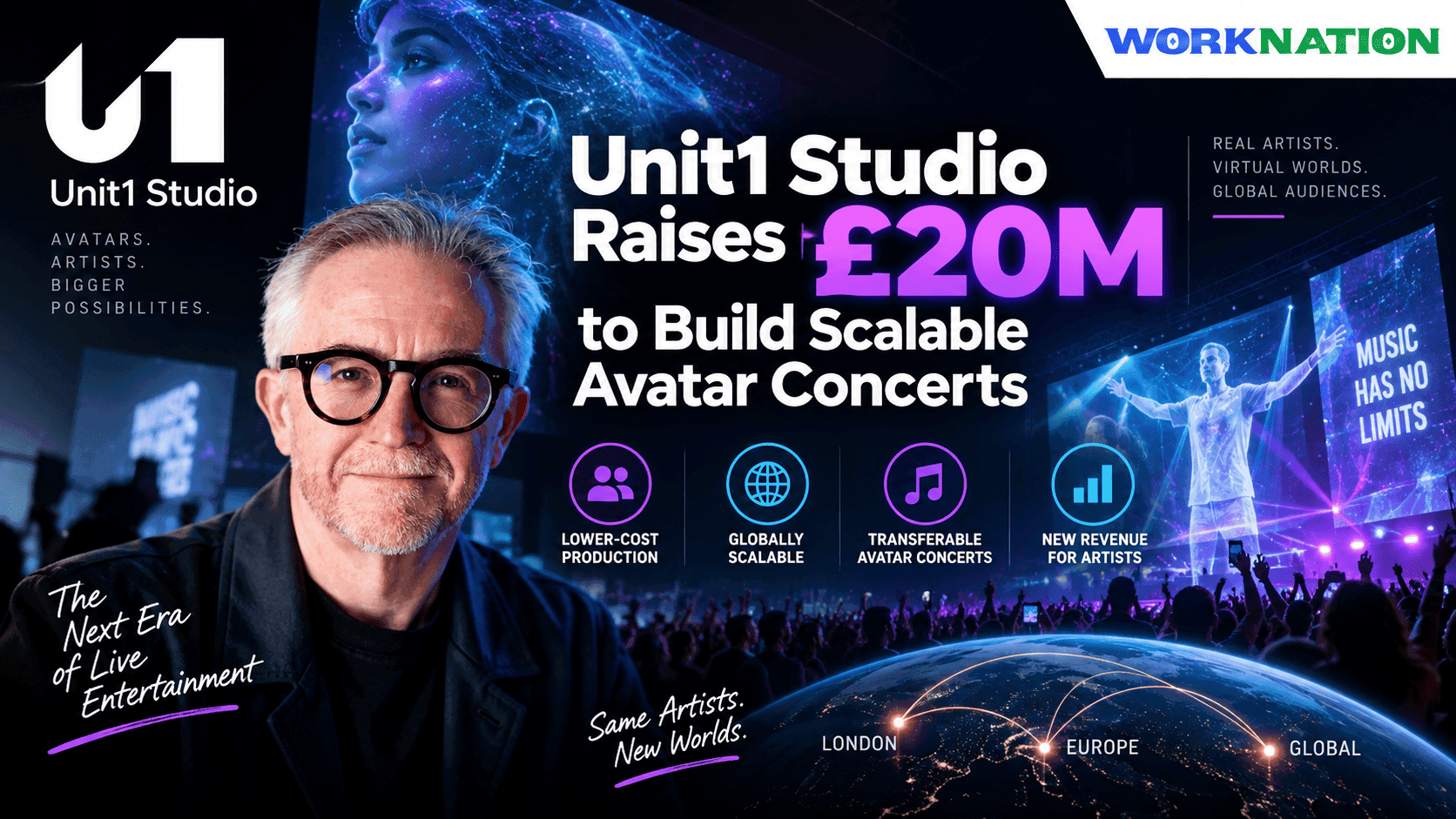
Unit1 Studio Raises £20M to Make Avatar Concerts Commercially Viable
Top Picks
Submit PR
Stay Ahead of the Market
Get the latest startup funding, hiring trends and global opportunities delivered to your inbox every week.
Unit1 Studio, a London-based startup focused on avatar-based live entertainment, has raised £20 million in equity and production funding as it seeks to make large-scale avatar concerts more commercially viable.
The funding round was led by Balderton Capital, with existing investors Mercuri, Gilston Music and Paul McGuinness, the long-time manager of U2, also participating. The company plans to use the capital to develop new avatar concerts and demonstrate a production model that can be replicated across venues without the enormous costs associated with existing productions.
The company's approach addresses one of the biggest challenges facing the avatar concert industry: the cost and complexity of creating a large-scale show.
ABBA Voyage, which opened in London in 2022, has sold more than three million tickets. The production reportedly cost approximately £140 million to create. That level of upfront investment has made it difficult for other artists and entertainment companies to adopt a similar model.
Unit1 believes it can significantly reduce those costs while making avatar productions easier to move and reproduce.
Building a more flexible avatar concert model
Unit1 Studio was established in October 2025 by Barney Wragg, Jonathan Butterell and Pavle Mihajlovic.
Wragg serves as CEO and previously held senior digital roles at Universal Music, EMI and AEG. He most recently served as head of Andrew Lloyd Webber's Really Useful Group, bringing experience across music, entertainment and digital media.
Jonathan Butterell is the company's creative director. He is known for his work on the West End musical and BAFTA-nominated film "Everybody's Talking About Jamie."
Pavle Mihajlovic serves as technical director and previously co-founded video game companies Electric Saint and Flavourworks.
Together, the founders are attempting to combine music, live entertainment, visual effects and gaming technology into a new production format for artists who cannot or do not want to undertake conventional tours.
Unit1 creates full-scale avatar concerts using CGI to digitally represent musicians performing in a live-style environment. The productions incorporate screens, lighting, sound and stage design rather than simply presenting a digital character on stage.
The company's target market includes artists who are unable to tour, giving them another potential way to perform for audiences without requiring the artist to physically travel between venues.
The four-day venue transfer
One of Unit1's key demonstrations has focused on whether an avatar concert can actually be moved from one venue to another.
A demonstration production featuring a digital version of musician KT Tunstall was initially running at Brompton Technology's testing site in Gunnersbury from late 2025.
According to Unit1, the company subsequently transferred the complete production, including the screens, to a permanent studio at Tileyard in London in just four days.
The CGI production was also modified to match the lighting and acoustics of the new venue.
This capability is central to Unit1's business proposition.
Rather than creating a highly customized production that can only operate in one purpose-built venue, the company wants its avatar concerts to behave more like touring productions. If the technology can be reliably adapted to different locations, the same show could potentially reach audiences in multiple markets without recreating the entire production from scratch.
That could significantly change the economics of avatar entertainment.
The £140M challenge created by ABBA Voyage
ABBA Voyage demonstrated the potential audience for large-scale avatar performances, but the production also illustrates the financial challenge involved.
The show launched in London in 2022 and has since sold more than three million tickets. Its production reportedly required an investment of approximately £140 million.
The scale of that investment makes the model difficult to replicate.
An artist or entertainment company considering an avatar concert has to account for digital production, visual effects, screens, venue infrastructure, lighting, sound, staging and other technical requirements. If the resulting production can only operate in one location, the economics become even more dependent on the long-term performance of that venue.
Unit1's strategy is based on reducing that barrier.
The company says its technology and production model can allow shows to be developed at a fraction of the cost and then replicated across different locations.
The objective is not necessarily to reproduce ABBA Voyage itself, but to create a more flexible production infrastructure that could allow more artists to experiment with avatar concerts.
Competing technologies already exist
Unit1 is entering a market that already includes companies developing digital performances featuring both living and deceased artists.
Base Hologram has previously developed touring productions featuring artists including Roy Orbison, Buddy Holly and Whitney Houston.
Eyellusion has worked on productions featuring Ronnie James Dio, while HologramUSA operates a permanent venue in Los Angeles.
However, Unit1 says its approach differs because it is designing avatar productions that can be moved and adapted between venues.
The company compares the concept to touring stage productions, where a show can be transported to different locations and adjusted to fit the requirements of each venue.
That flexibility is particularly important for Unit1's commercial model. The company is not simply trying to create a technological demonstration. It is attempting to create a repeatable production system that can support multiple concerts and potentially multiple artists.
Experienced visual effects talent joins Unit1
To support this strategy, Unit1 has hired VFX specialists Greg Meeres Young and Sefki Ibrahim.
Meeres Young has worked on productions including "Planet of the Apes" and "The Lord of the Rings." Ibrahim was also involved in the production of ABBA Voyage.
Their experience provides Unit1 with expertise in visual effects and large-scale digital entertainment production as the company develops its own production capabilities.
The combination of entertainment leadership, creative direction, technical expertise and VFX experience reflects the multidisciplinary nature of avatar concerts.
Unlike a conventional software product, these productions require technology and creative production to work together, from the digital representation of the performer through to the physical screens, lighting, acoustics and audience experience.
Balderton backs the production model
Balderton Capital led Unit1's latest £20 million funding round.
Daniel Waterhouse, a general partner at Balderton who led the investment, highlighted the structural challenge Unit1 is attempting to address within the entertainment industry.
Existing investors Mercuri and Gilston Music also participated, alongside Paul McGuinness, who has spent decades working in the music industry and is known for his long-term management of U2.
The combination of venture capital and investors with music industry experience provides Unit1 with both financial resources and industry connections as it develops its productions.
The company has raised the capital as both equity and production funding, reflecting the fact that its business requires investment not only in software and technology but also in the creation of physical entertainment productions.
Artists have not yet been announced
Unit1 has not publicly revealed which artists it plans to develop future avatar concerts for.
The company says artist names will be announced when tickets for the productions go on sale.
That means the commercial validation of the model is still ahead.
The company has demonstrated that it can transfer an avatar concert between venues, but the next step is turning that production capability into commercially successful shows that attract paying audiences.
The company is therefore attempting to solve two problems simultaneously: reducing the cost of developing avatar concerts and making the resulting productions flexible enough to operate in multiple locations.
Making avatar concerts scalable
The central challenge for Unit1 is scalability.
A successful avatar concert requires more than a convincing digital representation of an artist. It needs a complete production environment capable of delivering the experience consistently across different venues.
If Unit1 can develop a standardized production model, the economics could potentially become more attractive.
A show could be developed once and then adapted for different locations rather than requiring a completely new production for every venue. Artists who cannot tour traditionally could potentially reach audiences in multiple cities while avoiding the logistical demands of conventional touring.
The company believes this could open the market to a much larger number of artists.
For fans, the model could also create opportunities to see artists who are unable to perform live in a traditional format.
What comes next for Unit1 Studio
The £20 million funding round gives Unit1 the resources to move beyond its demonstrations and develop commercially available productions.
The company will focus on creating new avatar concerts, expanding its team and continuing to refine the technology required to transfer productions between venues.
Its four-day transfer of the KT Tunstall demonstration provides an early indication of what the company is trying to achieve, but the larger test will come when its commercial productions launch and begin selling tickets.
With Balderton Capital leading the latest funding and investors from the music industry participating, Unit1 is now positioned to pursue its ambition of turning avatar concerts from highly expensive, venue-specific productions into a more flexible form of touring entertainment.
If the company's production model can deliver convincing performances at substantially lower costs and allow shows to move between venues, it could create a new commercial model for artists and entertainment companies looking to reach audiences without traditional touring.
Have a Funding Round or Exciting Update to Share?
Submit your press release to get featured on WorkNation and reach founders, investors, and tech leaders.