Primo Raises €6.9M to Deploy Autonomous AI Agents for IT Teams
Top Picks
Submit PR
Stay Ahead of the Market
Get the latest startup funding, hiring trends and global opportunities delivered to your inbox every week.
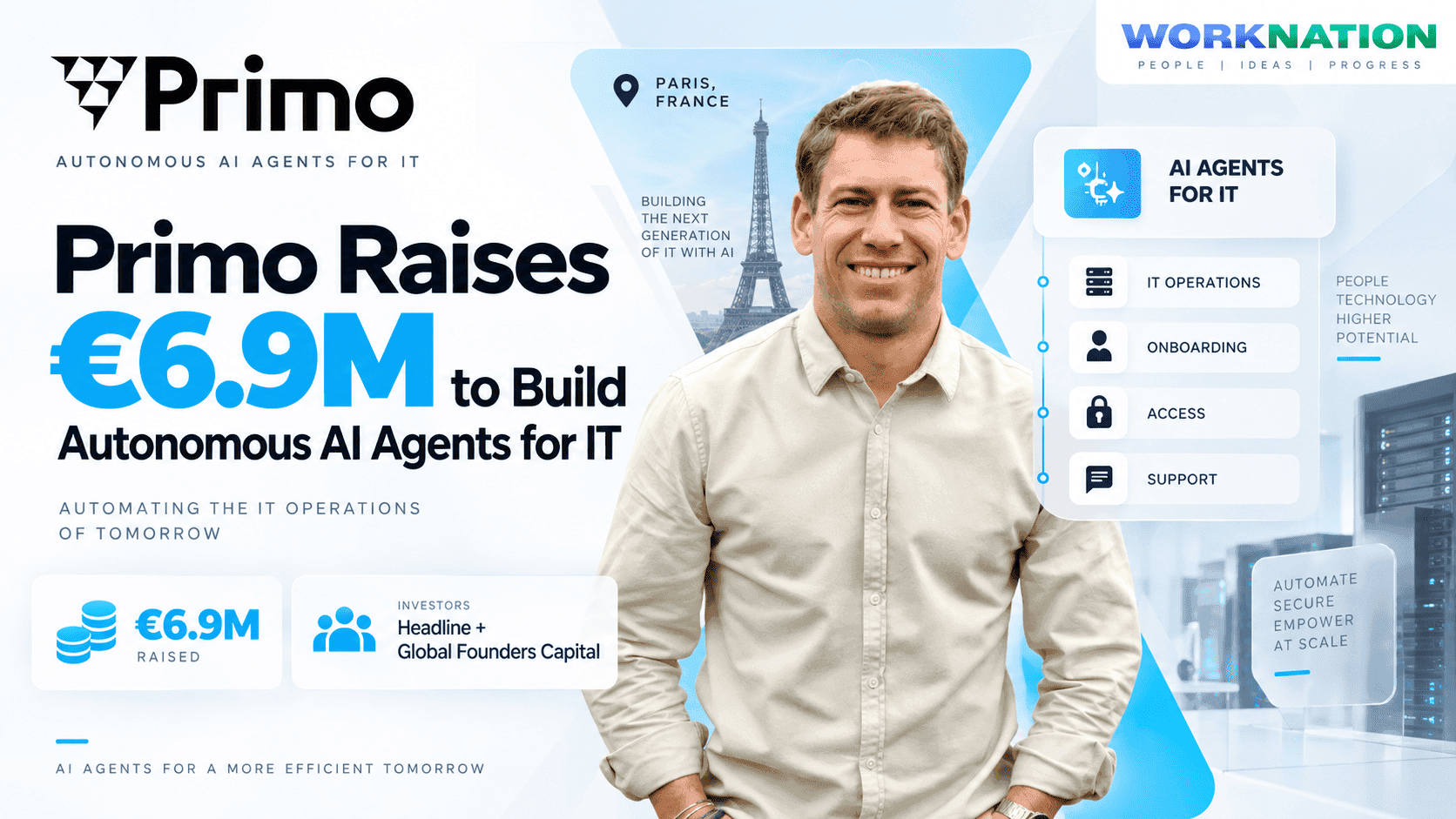
Paris-based Primo, an AI-powered IT management platform, has raised €6.9 million ($8 million) in fresh funding to expand its autonomous AI agents for corporate IT operations and accelerate international growth.
The round was led by California-based Headline and Global Founders Capital, the venture capital platform associated with Rocket Internet. The funding also includes backing from Arthur Waller, co-founder and co-CEO of French accounting platform Pennylane, and Romain Niccoli, co-founder and co-CEO of planning software company Pigment.
Founded in 2022 by Martin Pannier, Primo has built a unified platform that brings together device management, SaaS applications, employee identities and IT support. The company is now adding autonomous AI agents that can execute IT processes rather than simply provide recommendations or answer questions.
Building an autonomous IT operations platform
Primo's platform is designed to give companies a centralized view of their IT environment.
The system brings together information about employees, devices, SaaS applications, permissions and IT support processes.
This creates a common data layer that Primo's AI agents can use to perform operational tasks.
The company's focus is on processes that are repetitive but can involve multiple systems.
Employee onboarding is one example.
When a new employee joins an organization, several IT tasks typically need to happen. Hardware needs to be ordered and configured, applications need to be provisioned, permissions need to be assigned and internal support processes need to be initiated.
Primo's agents are designed to execute these steps automatically.
According to the company, an agent can detect a new employee through the HR system, order the required hardware, pre-configure the computer, assign SaaS access according to the employee's role and create a welcome ticket.
The same infrastructure can also support employee offboarding.
When an employee leaves, the agent can revoke access and remove permissions, including sensitive access rights.
Moving beyond AI assistants
Primo is positioning its technology differently from conventional AI assistants.
Many enterprise AI tools are designed to answer questions, summarize information or recommend what an employee should do next.
Primo's agents are intended to actually perform the work.
The company says this is possible because its platform already has access to the context required for IT operations.
That includes employee information, device data, application access, permissions and internal policies.
The platform also includes integrations that allow agents to take action across different systems.
Customers can establish guardrails around those actions, giving organizations control over what their AI agents are allowed to execute.
This combination of context, integrations and rules is central to Primo's approach.
A unified data layer for IT
Corporate IT operations often span multiple systems.
Human resources platforms contain employee information. Device-management tools track computers and other hardware. SaaS applications maintain user accounts and permissions. Help desks manage support requests.
When these systems operate independently, IT teams can spend significant amounts of time moving information between them.
Primo's strategy is to connect these systems into a unified platform.
The AI agents can then use that shared context to execute processes across the IT environment.
Instead of requiring an IT employee to manually coordinate multiple applications, Primo wants its agents to perform the sequence of actions automatically.
Growing customer base
Primo says it has signed more than 400 customers across ten countries.
Its customer base includes startups, scaleups and small and medium-sized businesses with between 50 and 2,000 employees.
The company counts ASL Airlines and Attio among its customers.
Primo also reports strong financial growth.
Its revenue has quadrupled year over year and annual recurring revenue has now surpassed €3.4 million ($4 million).
International customers already account for more than half of Primo's user base.
That international footprint is an important part of the company's next stage of growth.
Expanding across Europe
Primo plans to use the new funding to expand internationally and strengthen its presence in markets where it already has customers.
The company specifically plans to deepen its operations in the UK, Germany, the Benelux countries and the Nordic region.
The international expansion comes alongside plans to increase hiring.
The company is aiming to build its team while continuing to develop its AI agent technology.
For an enterprise IT platform, international growth also requires adapting to different organizational structures, regulations and technology environments.
Primo's existing presence across ten countries provides an initial base for that expansion.
IT as an operational function
Primo's broader vision is to change the role of IT inside companies.
Traditional IT departments are often responsible for maintaining devices, managing software access, supporting employees and enforcing security policies.
Many of these responsibilities involve repetitive administrative processes.
Primo believes AI agents can automate a growing portion of this work.
The company wants IT teams to spend less time manually executing routine processes and more time on higher-value initiatives.
Its CEO and co-founder Martin Pannier describes the company's ambition as turning IT from a cost-focused function into a lever for the organization.
Human oversight and control
Despite its focus on autonomous execution, Primo emphasizes that its agents operate within customer-defined guardrails.
This is particularly important because IT systems contain sensitive information and control access to corporate applications and devices.
An AI system that can provision accounts, revoke permissions or order hardware needs clearly defined rules around what it can and cannot do.
Primo's platform is designed to combine automation with traceability and customer controls.
The company says its agents can execute processes end to end while maintaining the oversight required by organizations.
Backing from European technology founders
The new funding round includes several investors with experience building European enterprise technology companies.
Headline and Global Founders Capital led the round.
Arthur Waller, co-founder and co-CEO of Pennylane, participated alongside Romain Niccoli, co-founder and co-CEO of Pigment.
The participation of founders from accounting and business software companies gives Primo additional backing from entrepreneurs familiar with enterprise software adoption and workflow automation.
A growing AI agent market
Primo is entering a broader market where startups are increasingly developing AI agents designed to perform operational work.
The difference between AI assistants and agents is becoming increasingly important in enterprise software.
Assistants typically provide information or recommendations, while agents are designed to execute actions across connected systems.
Primo is applying that model specifically to IT operations.
Its agents can operate across employee lifecycle processes, including onboarding and offboarding, while using information from multiple enterprise systems.
The company's strategy is therefore not simply to add a chatbot to an IT management platform, but to use AI as an execution layer across corporate IT workflows.
What comes next
Primo will use its €6.9 million funding to hire additional employees, expand internationally and accelerate development of autonomous AI agents.
The company already has more than 400 customers across ten countries, with international customers accounting for more than half of its user base.
Its revenue has quadrupled year over year and ARR has surpassed €3.4 million.
Founded by Martin Pannier in 2022, Primo is now attempting to make autonomous AI agents a central part of corporate IT operations.
Its next phase will focus on expanding across Europe while developing agents capable of handling increasingly complex IT workflows.
The company's broader proposition is straightforward: if an AI system has access to the right company context, integrations and rules, it can potentially move beyond answering IT questions and actually execute the work.
Have a Funding Round or Exciting Update to Share?
Submit your press release to get featured on WorkNation and reach founders, investors, and tech leaders.