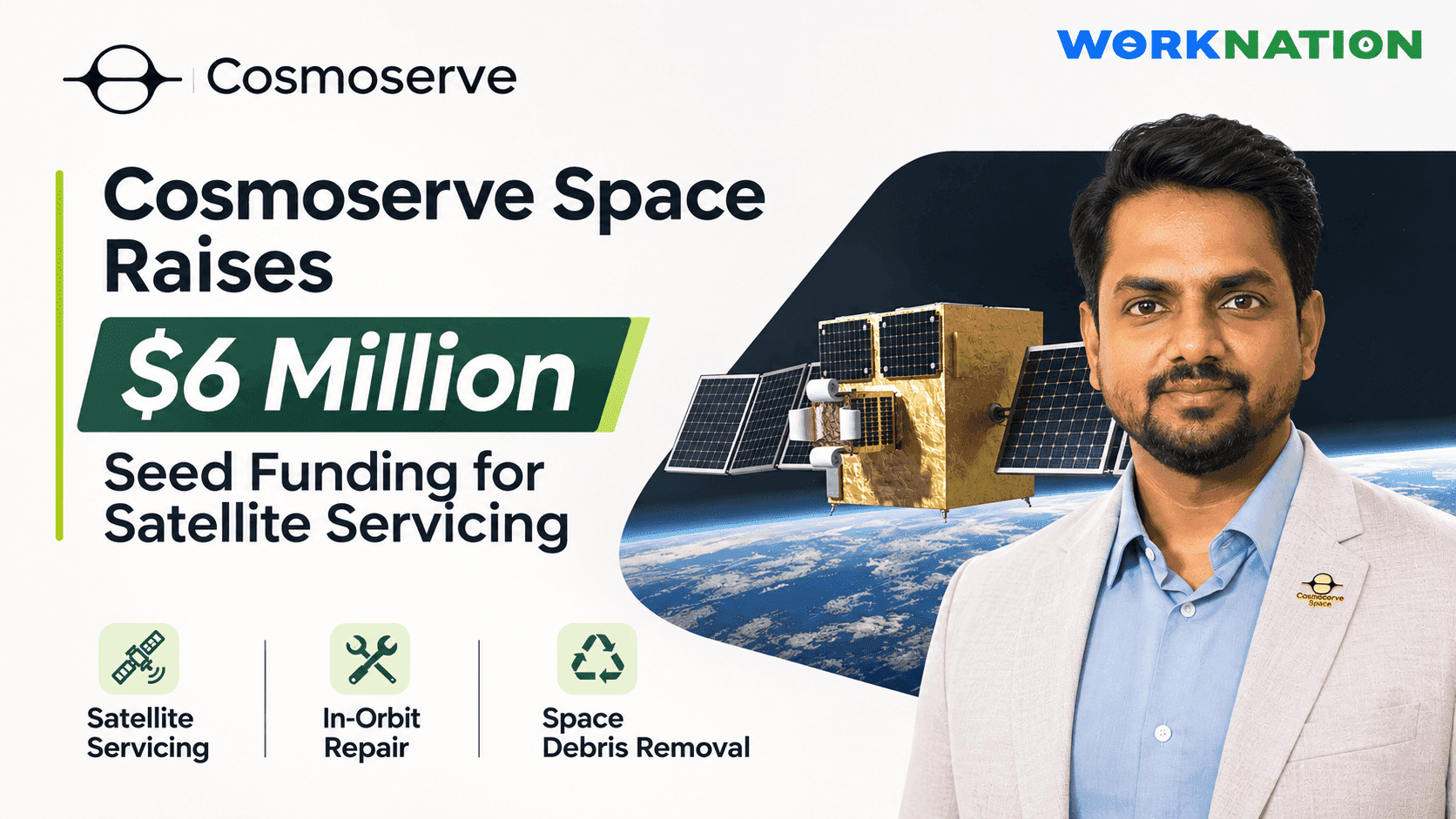
Cosmoserve Space Raises $6 Million Seed Funding to Develop Satellite Servicing and Space Debris Removal Technology
Top Picks
Submit PR
Stay Ahead of the Market
Get the latest startup funding, hiring trends and global opportunities delivered to your inbox every week.
Hyderabad-based spacetech startup Cosmoserve Space has raised $6 million in a seed funding round to advance its technologies for satellite servicing, in-orbit repairs and space debris removal.
The round attracted investments from Japan-based Rebright Partners, Aranya Holdings and Naandi Ventures, alongside existing investors AUM Ventures and Shakti VC.
The latest funding takes Cosmoserve's total capital raised to more than $9 million. The company plans to use the proceeds to develop its Base 1 facility, conduct technology demonstrations and support two upcoming space missions.
Building Infrastructure for In-Orbit Satellite Servicing
Cosmoserve has inaugurated Base 1, a private facility dedicated to developing technologies for space debris removal and satellite servicing.
The facility is designed to support the development and testing of systems for in-orbit repairs, satellite refuelling and the recovery of defunct satellites.
According to the company, Base 1 is the world's sixth facility equipped with space vision effects and microgravity simulation capabilities.
It brings together infrastructure for designing, building, testing and operating technologies required for satellite servicing and space debris recovery.
The facility is expected to play an important role in preparing the company's systems for future demonstrations and missions.
A Different Approach to Satellite Servicing
Founded in 2025 by Chiranjeevi Phanindra, Cosmoserve is developing a proprietary Dual Spacecraft Architecture intended to make orbital servicing more cost-efficient.
The approach uses two spacecraft to service multiple satellites instead of relying on a conventional one-to-one recovery model.
Cosmoserve estimates that its architecture could reduce satellite servicing costs from approximately $10 million to below $1 million per satellite.
If demonstrated successfully, this approach could make certain in-orbit servicing operations more economically viable. However, the projected cost reduction remains a company estimate that will need to be validated through operational demonstrations.
First Mission and Technology Development
In July 2026, Cosmoserve flew its first payload, Mission Embrace, aboard Skyroot Aerospace's Vikram-1 rocket.
The company developed the flight hardware in under four months, completing it six months ahead of schedule, according to its announcement.
However, the mission encountered a technical setback: its robotic capture petals did not deploy as planned.
The flight still provided data that Cosmoserve can use to improve its capture technology and prepare for subsequent demonstrations.
The company plans to test its robotic capture systems through microgravity flights, reflight Mission Embrace and conduct a full-scale space debris capture demonstration in 2027.
Strengthening India's Space Manufacturing Capabilities
Cosmoserve currently sources nearly 60% of its mission components locally.
The startup aims to increase domestic manufacturing by developing critical technologies in-house and reducing dependence on imported optics, avionics and space-grade electronics.
Its Base 1 facility is part of this broader effort to build domestic capabilities for technologies used in satellite servicing and orbital infrastructure.
The company's focus also aligns with the growing range of activities in India's private space sector, which includes launch vehicles, satellite manufacturing, space data and other orbital technologies.
Funding History and Investor Backing
The $6 million seed round follows Cosmoserve's $3.17 million pre-seed funding round in September 2025.
That earlier round was led by Alan Rutledge, with participation from AUM Ventures and Shakti VC.
The latest investment brings total funding to more than $9 million, with Rebright Partners, Aranya Holdings and Naandi Ventures joining the existing investor group.
The fresh capital will support Base 1 development, technology demonstrations and two upcoming missions.
What Comes Next for Cosmoserve Space?
Cosmoserve's immediate priorities include further testing its robotic capture systems, conducting microgravity experiments and preparing for another attempt at Mission Embrace.
The company is also targeting a full-scale space debris capture demonstration in 2027.
Its longer-term ambition is to make satellite servicing more accessible through a reusable, multi-spacecraft approach and greater domestic development of critical space technologies.
The next major milestone will be demonstrating that its robotic capture systems can operate successfully in space. That progress will be essential to validating both its technical approach and its projected reduction in servicing costs.
Have a Funding Round or Exciting Update to Share?
Submit your press release to get featured on WorkNation and reach founders, investors, and tech leaders.