Daytona Raises $60M Series B at $1B Valuation to Build Cloud Infrastructure for AI Agents
Top Picks
Submit PR
Stay Ahead of the Market
Get the latest startup funding, hiring trends and global opportunities delivered to your inbox every week.
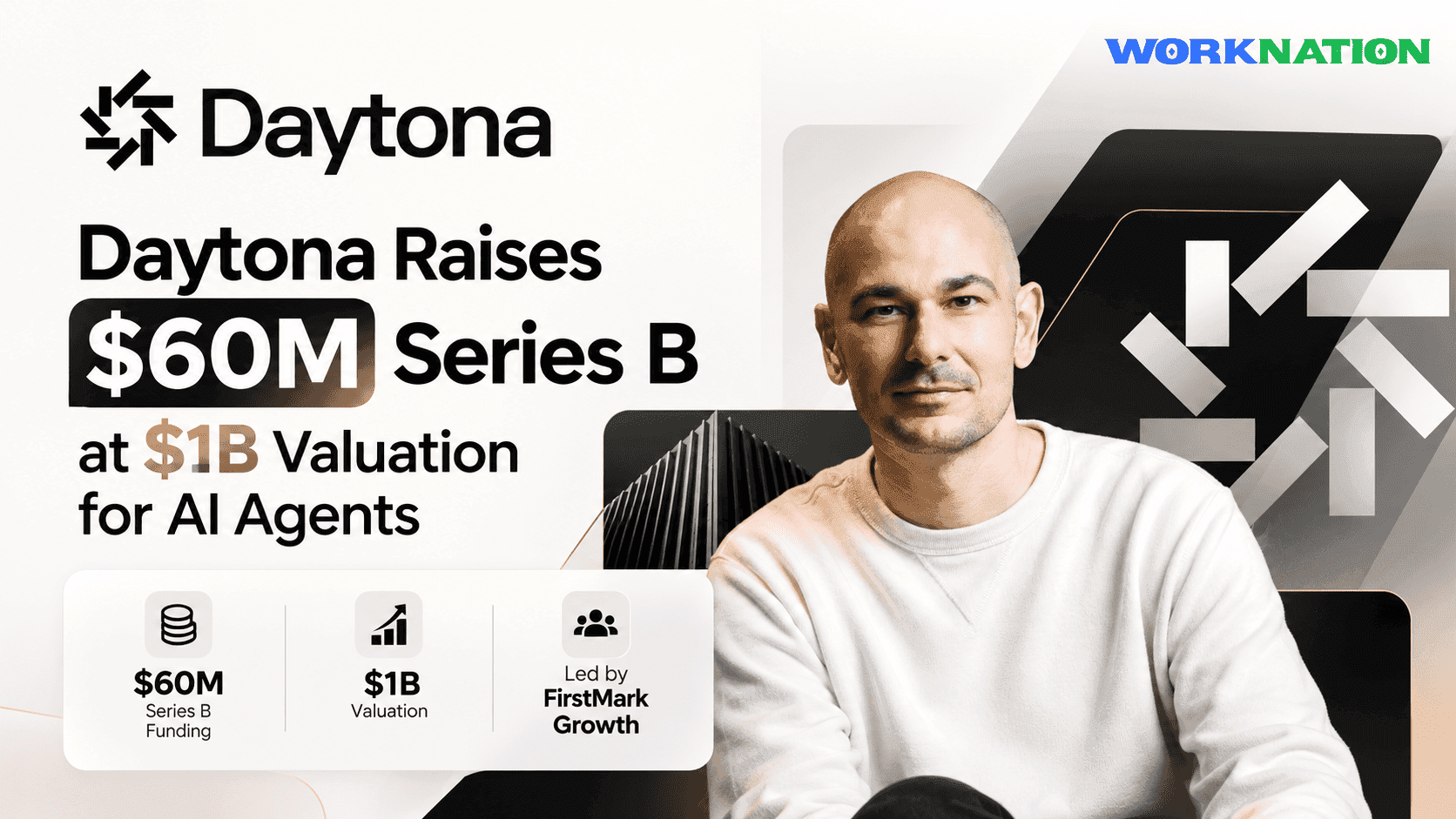
Daytona, a San Francisco-based startup building cloud infrastructure for artificial intelligence agents, has raised $60 million in a Series B funding round at a $1 billion valuation. The investment brings the company's total funding to $91 million as it expands its platform for running AI agents in secure, isolated computing environments.
The round was led by FirstMark Growth and included investments from prominent technology founders, strategic corporate investors and existing backers. Daytona plans to use the new capital primarily to expand its sales team, hire engineers and develop its platform beyond its existing sandbox infrastructure.
The company says its revenue run rate has grown approximately 25-fold since January 2026, although it has not disclosed its absolute revenue figures.
Daytona's $60M Series B Funding Round
Announced on October 20, 2026, the $60 million Series B values Daytona at $1 billion. FirstMark Growth led the round, continuing its support for the company after leading its $24 million Series A in February 2026.
The investment also attracted several well-known technology entrepreneurs as angel investors, including Patrick Collison of Stripe, Tobi Lütke of Shopify, Aravind Srinivas of Perplexity, Eric Yuan of Zoom, Olivier Pomel of Datadog, Adam D'Angelo of Quora and Brendan Foody of Mercor.
Strategic investors Qualcomm Ventures, Samsung Next and Okta Ventures participated alongside Evergreen Fund, Alumni Ventures and Torch Capital.
Existing investors also contributed significantly. According to CEO Ivan Burazin, approximately $50 million of the round came from existing investors, demonstrating continued backing from the company's current investor base.
Daytona's funding history includes a $2 million pre-seed round in 2023, a $5 million seed round led by Upfront Ventures in 2024 and its $24 million Series A in February 2026. The latest round brings its total funding to $91 million.
From Developer Tools to a Cloud Built for AI Agents
Founded in 2023 by Ivan Burazin, Vedran Jukić and Goran Draganić, Daytona initially focused on automating software development environments for large companies. The founders subsequently shifted the company's direction after identifying a growing need for dedicated computing environments for AI agents.
Rather than simply adding agent-related features to its existing product, the company rebuilt its platform around this requirement. Burazin told Fortune that Daytona handed customers to competitors during the transition and relaunched with approximately three months of revenue remaining in the bank.
The resulting platform is designed to give every AI agent its own computing environment, allowing it to execute tasks without directly accessing a company's broader systems.
These environments, known as sandboxes, allow AI agents to run code, browse the web and interact with software in isolated spaces. Daytona says its infrastructure can launch a sandbox in approximately 60 milliseconds.
Agents can also pause and resume environments or duplicate them to explore multiple approaches simultaneously. The company says its platform supports Linux, Windows, macOS and GPU environments.
This approach is particularly relevant as businesses experiment with AI systems capable of performing complex tasks with limited human intervention. Such agents need more than a language model: they also need computing resources, software tools, persistent state and controlled access to systems.
Daytona aims to provide that underlying infrastructure.
Major AI Companies Already Use Daytona
Daytona says it supplies infrastructure to Anthropic, OpenAI, NVIDIA, Cursor and Cognition. Other customers named by the company include Meta, Cohere, Mercor, Handshake, Surge AI, SambaNova, Postman, Bolt.new, n8n and Clay.
Many of these use cases involve allowing AI models to practise tasks repeatedly during training and testing. Isolated environments can help developers evaluate agent behaviour, execute code and experiment with different approaches without exposing the surrounding infrastructure to unnecessary risk.
Security is another central part of Daytona's proposition. As AI agents gain access to enterprise credentials and business tools, companies face the challenge of preventing errors or unexpected actions from affecting critical systems.
Daytona's sandbox model is designed to contain agent activity within dedicated environments. The company argues that each agent needs a safe space to execute tasks and make mistakes without creating wider disruption.
This becomes increasingly important if businesses begin managing thousands of digital agents alongside their human employees.
Revenue Run Rate Grows 25-Fold
Daytona reports that its revenue run rate has increased approximately 25-fold since January 2026. It also says customers that were already using its platform six months ago are spending nearly three times as much with the company today.
However, Daytona has not disclosed its absolute revenue or the starting figure behind its reported growth. As a result, the available information does not establish the company's current revenue scale or allow a direct comparison between its valuation and those of competitors using the same metrics.
The $1 billion valuation therefore reflects investor expectations about Daytona's future growth and the potential demand for infrastructure designed specifically for AI agents.
The broader market is attracting substantial investment. Modal, another company offering infrastructure and sandbox capabilities for AI agents, announced a $750 million funding round at a $15.75 billion valuation on October 14, 2026. Temporal, which focuses on durable workflow execution, raised $550 million at a $12.55 billion valuation in September 2026.
These companies address different parts of the infrastructure stack, but their funding rounds highlight growing investor interest in the systems required to operate AI applications reliably at scale.
Competition from Cloud Giants Remains a Challenge
Daytona is entering a market where established cloud providers such as Amazon Web Services, Microsoft Azure and Google Cloud already offer virtual machines and other computing infrastructure.
The company's argument is that infrastructure designed primarily for human developers and traditional applications may not be sufficient for a future in which autonomous agents continuously create, execute and evaluate tasks.
Daytona aims to differentiate itself through rapid environment startup, persistent state, sandbox management and tools that enable agents to write code, use Git and execute tasks securely.
FirstMark partner Matt Turck has described this transition as a move from human-centric cloud infrastructure toward agent-native infrastructure. Qualcomm Ventures has similarly highlighted the need for secure environments in which agents can execute code, call tools, browse the web and learn through reinforcement learning.
Nevertheless, Daytona must prove that its technical advantages can translate into sustainable growth while larger cloud providers expand their own AI infrastructure offerings.
Hardware availability could also become a constraint. In February 2026, Daytona said it was facing hardware limitations. Burazin has since predicted that conventional processors could become an increasingly important part of AI infrastructure spending, potentially creating additional supply constraints.
How Daytona Plans to Use the New Funding
Daytona plans to direct most of its new capital toward sales hiring, with additional investment in engineering. The company had approximately 35 employees, up from 20 in February 2026, and intends to recruit across San Francisco, Croatia and Singapore.
Beyond expanding its existing sandbox offering, Daytona wants to build a broader platform for running AI agents in production environments.
The opportunity is linked to the expected growth of enterprise AI adoption. Gartner forecasts that spending on enterprise cross-functional AI agents and assistants will exceed $23 billion in 2030, with a compound annual growth rate of 59%. This forecast covers spending on agents and assistants rather than the infrastructure beneath them, so it provides broader market context rather than a direct estimate of Daytona's addressable market.
The challenge will be converting growing interest in AI agents into sustained enterprise demand for dedicated infrastructure.
With $91 million in total funding, a $1 billion valuation and a reported 25-fold increase in revenue run rate, Daytona has secured substantial backing for its vision. Its next phase will test whether it can scale deployments, maintain its performance advantages and compete effectively as cloud providers invest further in AI-native computing.
Have a Funding Round or Exciting Update to Share?
Submit your press release to get featured on WorkNation and reach founders, investors, and tech leaders.