WaterSense Raises €5.75M to Predict Water Pollution 72 Hours Ahead
Top Picks
Submit PR
Stay Ahead of the Market
Get the latest startup funding, hiring trends and global opportunities delivered to your inbox every week.
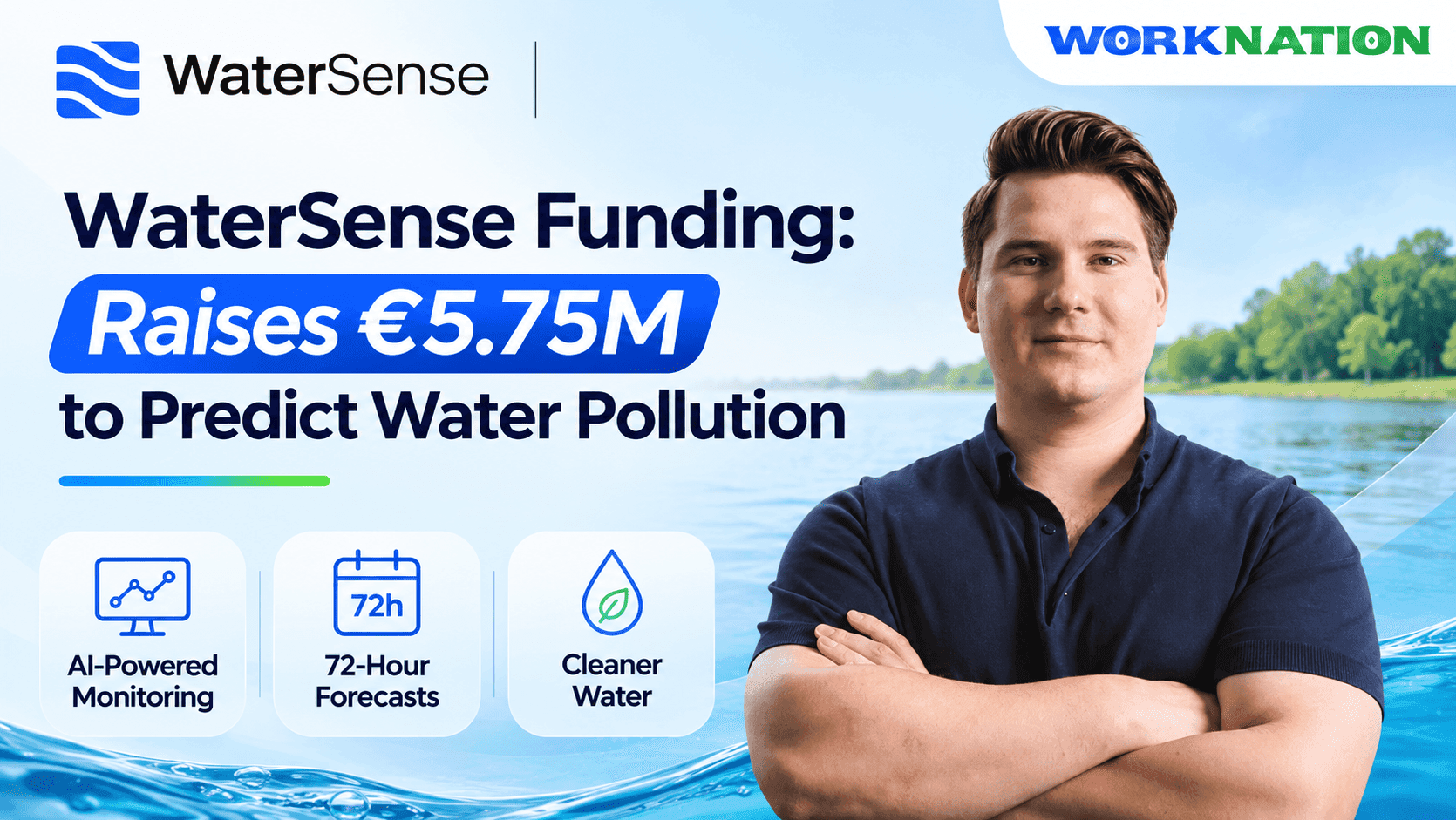
Polish water technology startup WaterSense has raised €5.75 million in pre-seed funding and grants, combining investment co-led by b2venture and Movens Capital with non-dilutive support from Poland's National Centre for Research and Development. The company is developing an AI-powered monitoring platform that can predict changes in water quality up to 72 hours in advance.
Founded by Filip Budny, WaterSense combines autonomous monitoring stations, low-cost disposable sensors, satellite data and deep learning models to identify potential changes in rivers and other water systems. The company says it already serves more than 30 customers across four European countries, monitoring over 80 locations.
Its business model is built around subscriptions to water-quality data rather than selling monitoring equipment to customers. The next major step is a full monitoring rollout along the Oder River.
How WaterSense's €5.75M funding is structured
The €5.75 million funding announcement combines equity investment and grant support.
The equity portion is approximately €2.25 million, co-led by:
b2venture: Co-lead investor.
Movens Capital: Co-lead investor.
Vastpoint: Participating investor.
Alongside the equity round, Poland's National Centre for Research and Development (NCBR) has provided €3.5 million in non-dilutive funding to support the company's research and technology development.
This distinction matters because grant funding does not dilute existing shareholders in the same way as an equity investment.
The round was reportedly three times oversubscribed, according to CEO Filip Budny. The company had also secured earlier grant support through research and development projects connected to Warsaw University of Technology.
From a biomedical sensor research project to water monitoring
WaterSense's technology originated in Filip Budny's doctoral research at Warsaw University of Technology.
His original research focused on developing low-cost printed biosensors for biomedical applications. The idea was to create inexpensive sensors that could be used for measurements such as sweat pH.
Budny began exploring whether a similar approach could be applied to water monitoring.
The challenge was different. Sensors placed in rivers and lakes are exposed to flowing water, changing environmental conditions and biological growth. Over time, algae and bacteria can accumulate on sensor surfaces, a problem known as biofouling, which can affect measurement reliability and increase maintenance requirements.
Instead of relying on one expensive sensor designed to remain in the water for long periods, WaterSense developed a system built around hundreds of small, inexpensive printed sensors that are automatically replaced.
The approach is intended to reduce maintenance and support continuous water-quality monitoring across more locations.
How WaterSense predicts water pollution up to 72 hours ahead
WaterSense combines measurements from its monitoring stations with satellite data and processes the information through deep learning models.
The platform analyses changes in water conditions and generates forecasts of potential water-quality changes up to 72 hours in advance.
Its system brings together three main components:
1. Autonomous monitoring stations
The stations collect water-quality measurements from rivers, lakes and other water systems. Their sensor design uses small printed sensors that can be automatically replaced.
2. Satellite data
Satellite observations provide additional information beyond the exact locations where physical monitoring stations are installed. This helps extend the platform's view of wider water systems.
3. Predictive analytics
Deep learning models combine sensor readings and satellite information to forecast changes in water quality. The platform can then provide alerts and insights to customers.
Budny reports forecast error figures in the range of approximately 5% to 8%, including at the end of the 72-hour forecast window. These are company-reported performance figures and should be evaluated across different water bodies, pollutants and environmental conditions.
WaterSense sells water data, not monitoring devices
Rather than operating primarily as a hardware manufacturer, WaterSense follows a Data-as-a-Service business model.
The company installs and operates monitoring stations, while customers pay subscriptions to access the resulting water-quality data.
This allows several customers to use information from the same monitoring infrastructure instead of each organisation having to purchase, install and maintain its own monitoring equipment.
Its customer base includes:
Water utilities.
Industrial operators.
Cities and municipal agencies.
Regional authorities.
The company's first customers included Warsaw Waterworks and a Warsaw city agency.
WaterSense says it now has more than 30 customers across Poland, Germany, Austria and Switzerland. Its monitoring network covers more than 80 locations, ranging from Alpine lakes to urban water systems.
CEO Filip Budny also said the company generates approximately $450,000 in annual recurring revenue (ARR).
That figure is an important indicator of commercial traction for a company at the pre-seed stage. However, ARR is a recurring-revenue run rate, not the same as audited annual revenue or cash collected during a financial year.
The Oder River is WaterSense's next major deployment
The startup's next major objective is to expand from individual monitoring sites towards a full monitoring network along the Oder River.
The river became a major focus for Budny after a toxic algal bloom in 2022 resulted in the deaths of approximately 360 tonnes of fish.
The incident exposed a serious monitoring challenge: when water conditions deteriorate across a large river system, limited monitoring coverage can make it difficult to identify what is happening and where the problem began.
WaterSense aims to address this by building a more connected picture of water quality across the river.
A full Oder rollout would move the company beyond isolated monitoring points towards a system-wide view that could serve multiple customers along the same river.
The longer-term opportunity is to make the same underlying water-quality data available to utilities, industrial facilities, public authorities and other organisations that depend on the river.
Building a subscription business around shared infrastructure
WaterSense's model has an important commercial advantage if it can scale successfully.
A single monitoring network can potentially serve several customers. A water utility may need information about intake quality, while an industrial operator may use the same data to manage its processes and a public authority may need it for environmental monitoring.
Instead of building separate monitoring infrastructure for each customer, WaterSense can provide access to a shared data layer.
As more stations are deployed, the company also collects information across more locations and environmental conditions. This growing dataset could improve its ability to identify patterns and forecast changes.
The business therefore combines physical infrastructure with recurring data subscriptions and predictive software.
The challenge will be maintaining reliable measurements, forecast performance and customer value as the network expands.
What WaterSense will do with the new funding
The new capital will support the company's expansion across European rivers, lakes and other water systems.
Its priorities include:
Expanding monitoring infrastructure: Deploy more autonomous stations across additional water bodies.
Scaling the Oder River rollout: Move towards monitoring an entire river system rather than isolated locations.
Improving predictive models: Develop the data layer connecting sensor measurements, satellite observations and forecasting.
Growing commercial operations: Serve more industrial operators, water utilities, cities and regional authorities.
Developing decision-support capabilities: Move beyond providing raw water-quality data towards alerts, recommendations and operational insights.
The company is also working to expand the range of substances its sensors can detect, including nutrients, heavy metals and E. coli through its research and development programmes.
What WaterSense's €5.75M funding means for water technology
Water quality monitoring remains an important challenge for utilities, industrial facilities and public authorities.
Traditional approaches often depend on manual sampling and laboratory analysis, which can provide accurate measurements but may not offer continuous visibility into rapidly changing conditions.
WaterSense is trying to close that gap by combining autonomous sensor networks with satellite observations and predictive software.
Its existing customer base and reported recurring revenue suggest the company has moved beyond a purely research-driven project. The next test is whether it can scale its monitoring infrastructure and maintain reliable predictions across larger river systems.
WaterSense's €5.75 million pre-seed funding and grant support gives the company resources to pursue that expansion, with the planned Oder River rollout representing its most important upcoming milestone.
Frequently Asked Questions
How much funding has WaterSense raised?
WaterSense announced €5.75 million in combined pre-seed funding and grants. This includes approximately €2.25 million in equity investment and €3.5 million in non-dilutive grant funding.
Who invested in WaterSense?
The equity round was co-led by b2venture and Movens Capital, with participation from Vastpoint. Poland's National Centre for Research and Development provided the €3.5 million grant.
Who founded WaterSense?
WaterSense was founded by Filip Budny, who developed the underlying sensor technology during his doctoral research at Warsaw University of Technology.
What does WaterSense do?
WaterSense develops autonomous water-quality monitoring stations and an AI-powered platform that combines sensor measurements with satellite data to forecast changes in water quality.
How far ahead can WaterSense predict water pollution?
The company's deep learning models can forecast changes in water quality up to 72 hours ahead.
How does WaterSense make money?
WaterSense operates a Data-as-a-Service model. It installs and operates monitoring stations and sells customers subscriptions to continuous water-quality data rather than selling the devices themselves.
How many customers does WaterSense have?
The company reports more than 30 customers across Poland, Germany, Austria and Switzerland, with monitoring coverage at over 80 locations.
What is WaterSense's ARR?
CEO Filip Budny reported approximately $450,000 in annual recurring revenue.
What is WaterSense's next major project?
The company plans a full monitoring rollout along the Oder River, moving from individual monitoring sites towards a connected view of the wider river system.
Editorial Analysis: Five things worth watching
The funding headline combines two different sources of capital. The €5.75 million total includes €2.25 million in equity and €3.5 million in grants. That makes the equity portion considerably smaller than the headline amount might suggest.
WaterSense already has commercial traction at pre-seed. More than 30 customers, over 80 monitoring locations and approximately $450,000 in reported ARR are meaningful early indicators. The next question is how quickly that recurring revenue grows.
The subscription model could scale more efficiently than hardware sales. If one monitoring network can serve several customers, WaterSense may generate recurring revenue without having to build separate infrastructure for every buyer.
The Oder rollout is the real operational test. Monitoring more than 80 individual locations is different from building a connected picture of an entire river system. The planned deployment will test the company's ability to scale its technology and deliver useful forecasts across a much larger area.
Forecast accuracy needs independent validation. The reported 5% to 8% error range is promising, but accuracy can vary by pollutant, location, weather and forecast horizon. Wider independent testing will be important before treating the figures as representative of all deployments.
Have a Funding Round or Exciting Update to Share?
Submit your press release to get featured on WorkNation and reach founders, investors, and tech leaders.