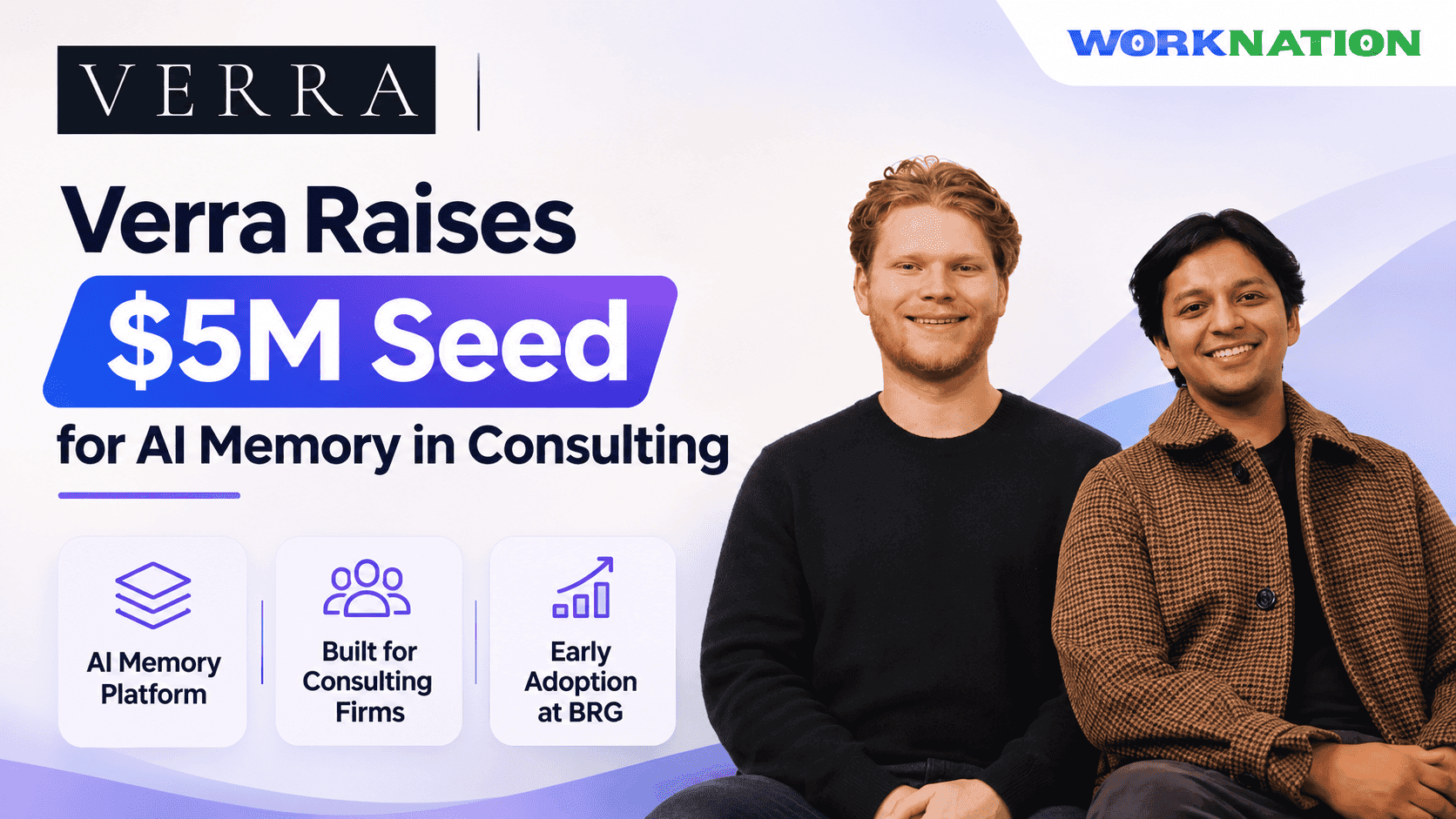
Verra Raises $5M Seed to Build AI Memory for Consulting Firms
Top Picks
Submit PR
Stay Ahead of the Market
Get the latest startup funding, hiring trends and global opportunities delivered to your inbox every week.
Verra has raised $5 million in seed funding to help consulting firms turn years of accumulated research, client work and institutional expertise into reusable AI-powered knowledge. The New York-based startup secured the round led by Kearny Jackson, with participation from Petra, a16z Speedrun and strategic angel investors.
Founded in 2025 by Kashyap Nathan, formerly of OpenAI and Palantir, and Christopher Farrington, formerly of Deloitte, Verra is building an AI institutional memory platform for consulting and professional services firms.
The company says it reached seven-figure revenues within months of commercialisation. Its early customers include Berkeley Research Group (BRG) and The Keystone Group. The new funding will support product development, hiring and integrations with enterprise knowledge systems.
Why consulting firms need an AI memory layer
Consulting firms accumulate years of research, financial models, presentations, client insights and industry-specific expertise. But much of that knowledge remains distributed across internal folders, documents, spreadsheets and project systems.
When a new engagement begins, consultants often have to search through previous work to find relevant information, reconstruct analyses and rebuild deliverables that may already exist elsewhere in the organisation.
This creates duplicated effort and makes it difficult for firms to use their collective experience consistently.
Verra is targeting this problem with an institutional memory layer that connects a firm's existing knowledge to AI tools. Instead of treating every new project as a separate starting point, the platform aims to make previous work available to the next consultant and engagement.
How Verra's AI platform works
Verra connects to a consulting firm's existing knowledge sources, including proposals, financial models, reports and presentations. It processes this material to identify reusable knowledge, workflows and methods developed across different projects.
Consultants can then use AI agents to:
Find relevant precedents from previous engagements.
Build analyses using the firm's accumulated knowledge.
Create financial models and supporting documents.
Generate presentations and client deliverables.
Retrieve information from internal documents without manually searching through multiple systems.
The platform works directly within Microsoft Word, Excel and PowerPoint, allowing consultants to use it inside familiar applications rather than switching to a separate AI interface.
A central feature is source traceability. Verra links claims in generated outputs back to their underlying material, including specific document pages and spreadsheet cells. This gives consultants a way to check where information came from before using it in client-facing work.
Built around enterprise data control
Consulting firms handle sensitive client information, financial models and commercially confidential research. That makes data access and security central to whether an AI platform can be adopted across an organisation.
Verra says its platform operates inside a firm's own cloud environment. Its design also aims to preserve the original access permissions attached to company files and provide traceability for AI-generated outputs.
The founders have built the product around three enterprise requirements:
Client information must remain within the firm's controlled environment.
AI-generated work must be traceable to its sources.
Consultants should be able to use the technology within the Office applications they already rely on.
These requirements are important because consulting firms cannot simply prioritise AI productivity if it creates new risks around client confidentiality or the reliability of deliverables.
Berkeley Research Group adoption provides early traction
One of Verra's most significant early deployments is at Berkeley Research Group.
Following an initial proof of concept, BRG expanded the platform to 1,000 people within two months, driven by internal demand, according to Verra.
The company reports that BRG consultants have used the platform to generate 105,000 files and make 145,000 edits directly inside open Office documents since August 2026.
More than 87% of consultants in onboarded teams reportedly use Verra every week. The company also estimates that the platform saves thousands of analyst hours each week.
BRG's Global Managing Director of AI Solutions, Raghav Vadlamani, said the platform gives teams finished, sourced first drafts for engagements that previously started from a blank page.
The Keystone Group is another early customer. Its Managing Partner, Amar Shah, said the platform has helped democratise institutional knowledge and support the firm's knowledge-management initiatives.
These deployments provide an early indication of how Verra wants to grow: not simply by selling individual AI subscriptions, but by becoming part of the operating workflow across entire professional services firms.
Kearny Jackson leads the $5 million seed round
Kearny Jackson led Verra's $5 million seed round, with Petra, a16z Speedrun and strategic angel investors also participating.
Kearny Jackson's Sriram Krishnan said his experience in consulting helped him recognise how much time firms spend repeating work because their accumulated knowledge is difficult to reuse.
The investment thesis centres on Verra's adoption within customer organisations. Rather than relying only on initial interest in AI, the company points to consultants using the platform regularly and requesting wider deployment.
The new funding will be directed towards:
Further product development.
Hiring across the company.
Integrations with enterprise knowledge systems.
Expanding the platform's capabilities across consulting practices.
The company has not disclosed its valuation or the individual investment amounts contributed by each investor.
Verra's next opportunity extends beyond consulting
Verra's initial focus is consulting firms, where historical research, financial models and client deliverables represent a significant source of institutional knowledge.
However, the company sees opportunities in adjacent professional services markets, including accounting, advisory services and investment research.
Its longer-term ambition is to move from supporting individual consulting practices towards firmwide intelligence, where accumulated knowledge can be reused across teams and engagements.
This could make the platform more valuable as it connects a larger share of an organisation's work. The challenge will be maintaining relevant permissions, source accuracy and quality as the volume of connected information increases.
Five original editorial insights
1. Verra is targeting the knowledge-reuse problem, not just document generation.
Many AI tools help users create documents faster. Verra's deeper proposition is to make previous work reusable, so firms do not have to repeatedly reconstruct analyses and expertise. That is a broader enterprise workflow opportunity.
2. Adoption inside a firm could be more important than individual subscriptions.
The BRG rollout to 1,000 people within two months suggests Verra is pursuing organisation-wide deployment. If it becomes embedded across multiple practices, replacing it could become more difficult than replacing a standalone AI assistant.
3. Source traceability is a commercial requirement in consulting.
Consultants need to defend their recommendations and show where supporting information came from. Linking AI-generated claims to original documents and spreadsheet cells directly addresses a practical barrier to using AI in client deliverables.
4. Enterprise permissions may become a competitive differentiator.
A consulting firm's knowledge is not universally accessible to every employee. Verra's ability to preserve access controls while making information searchable will matter as firms connect more sensitive project material.
5. The real test is whether productivity gains translate into better economics.
Verra reports substantial usage and time savings at BRG. The longer-term business case will depend on whether these gains improve project delivery speed, consultant utilisation, margins and the amount of work firms can take on.
Frequently asked questions
How much funding did Verra raise?
Verra raised $5 million in seed funding led by Kearny Jackson, with participation from Petra, a16z Speedrun and strategic angel investors.
Who founded Verra?
Verra was founded in 2025 by Kashyap Nathan, formerly of OpenAI and Palantir, and Christopher Farrington, formerly of Deloitte.
What does Verra do?
Verra builds an AI institutional memory platform that helps consulting firms reuse knowledge from previous projects, reports, proposals, financial models and presentations.
How does Verra work with Microsoft Office?
Its AI agents work directly inside Word, Excel and PowerPoint, helping consultants find previous work, build analyses and generate client deliverables.
Who uses Verra?
Its early customers include Berkeley Research Group and The Keystone Group. Verra says BRG expanded the platform to 1,000 people within two months of its initial proof of concept.
How much revenue does Verra generate?
The company says it reached seven-figure revenues within months of commercialisation. It has not disclosed a precise revenue figure in the funding announcement.
What will Verra use the funding for?
The $5 million will support product development, hiring and integrations with enterprise knowledge systems.
Turning institutional knowledge into an AI advantage
Verra's $5 million seed round highlights a growing opportunity in enterprise AI: helping organisations use the knowledge they have already created.
For consulting firms, the value of AI may not be limited to producing a first draft faster. It could also come from making years of previous work accessible to every new engagement.
Verra is betting that firms will increasingly treat institutional memory as an operational advantage. Its early adoption at BRG gives the company a starting point, but the next challenge is proving that the model can scale across more firms, industries and complex client environments.
Have a Funding Round or Exciting Update to Share?
Submit your press release to get featured on WorkNation and reach founders, investors, and tech leaders.