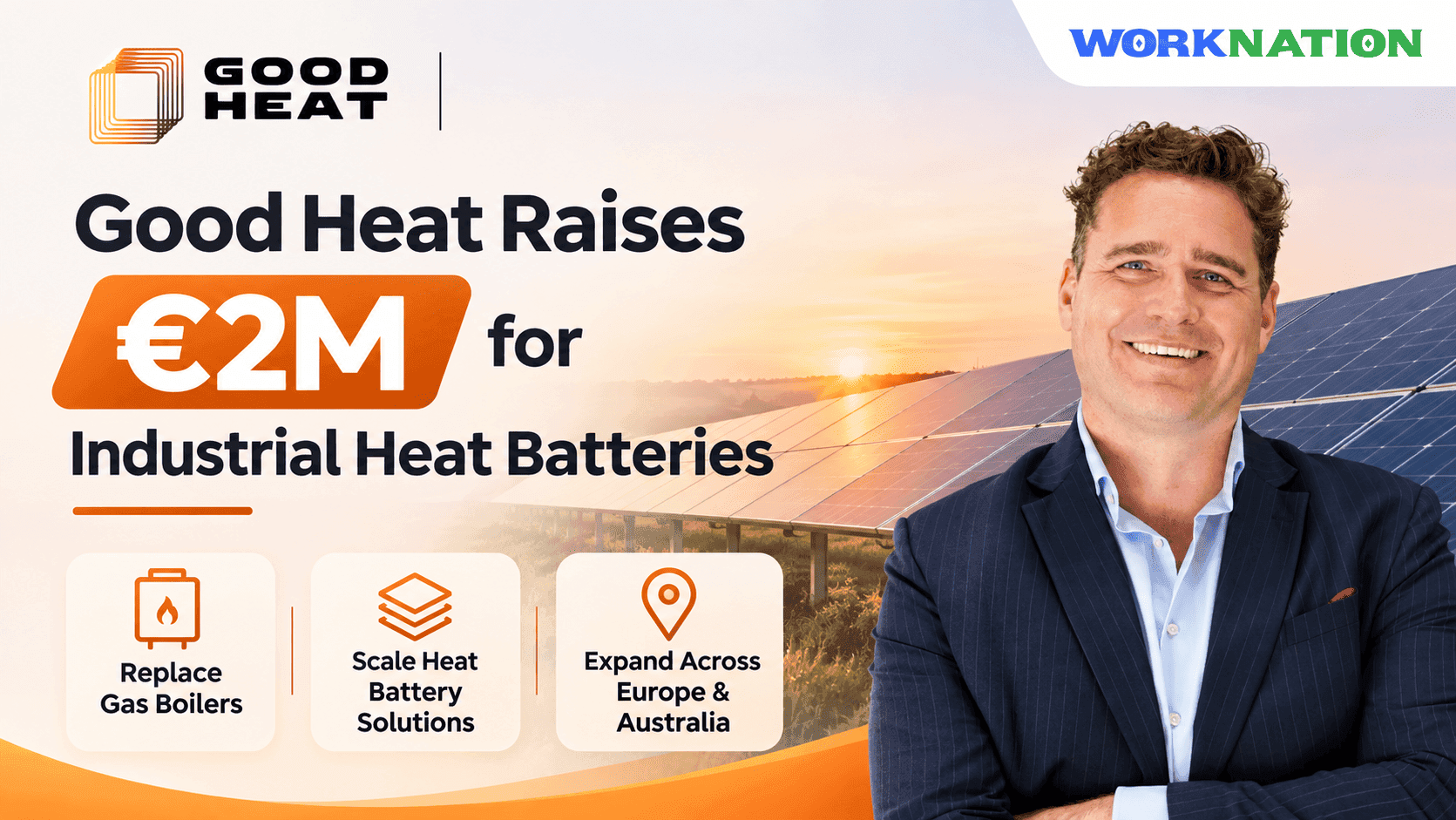
Good Heat Raises €2M to Scale Industrial Heat Battery Projects
Top Picks
Submit PR
Stay Ahead of the Market
Get the latest startup funding, hiring trends and global opportunities delivered to your inbox every week.
Good Heat has raised €2 million to expand its industrial heat battery business, which aims to replace gas-fired boilers at factories with electrified thermal energy storage systems. The Amsterdam-based startup, founded by Bauke van Gent, Tom Geiser and Bruis van Vlijmen, secured the funding in a round led by SET Ventures, with participation from Shell Ventures and existing investor Investible.
Rather than selling heat battery equipment to industrial customers, Good Heat develops, finances, owns and operates the systems itself. Customers buy the steam produced by these installations through long-term Heat Purchase Agreements, avoiding the upfront capital investment and operational responsibility of running the equipment.
The funding will support team expansion and software development as Good Heat works to advance its project pipeline across Europe and Australia.
How Good Heat is changing the industrial heating model
Industrial facilities use large quantities of heat for processes such as food production, chemical manufacturing, textiles and paper production. Much of this demand is still met by burning natural gas and other fossil fuels.
Good Heat uses electrified thermal energy storage, or eTES, to convert electricity into stored heat. The systems can charge when electricity is available at lower prices and release heat when factories need it.
The company is positioning itself as an industrial heat provider rather than a hardware manufacturer. It takes responsibility for project development, financing, equipment ownership, electricity procurement and ongoing operations.
This approach is designed to remove two major barriers for industrial customers: the high upfront cost of replacing existing heating infrastructure and the complexity of managing a new energy system.
Customers pay for steam, not the equipment
Good Heat's business model centres on long-term Heat Purchase Agreements (HPAs).
Under these contracts, the company installs and operates the heat battery at an industrial customer's site. The customer commits to purchasing a minimum annual volume of heat, typically under a 10-, 15- or 20-year agreement.
Pricing can be fixed or structured as a discount against a gas benchmark. This gives customers greater visibility over long-term heating costs than they might get from shorter-term gas purchasing arrangements.
Good Heat also manages electricity procurement to protect project economics. It uses long-term power purchase agreements to hedge input costs and can monetise flexibility in when its heat batteries charge.
The model resembles independent power producers that finance and operate renewable energy assets before selling electricity to customers under long-term contracts. Good Heat is applying a similar structure to industrial heat.
More than 100 MWt of projects across Europe
Good Heat reports a prospective European project pipeline exceeding 100 MWt across the Netherlands, Belgium, Germany and Poland.
The pipeline includes six projects under exclusivity:
Two in the Netherlands
Two in Belgium
One in Germany
One in Poland
The Dutch and Belgian projects are described as the most advanced. Potential customers operate in chemicals, food production and general manufacturing, although Good Heat has not publicly named them.
The company is also developing projects in Australia, where its flagship Project Arcadia is moving towards a major financing milestone.
Project Arcadia targets financial close in 2027
Project Arcadia is a 200 MWh electrified thermal energy storage deployment being developed for a food manufacturing facility in Victoria, Australia.
The system is designed to store renewable electricity as high-temperature heat and supply steam to the factory on demand. Good Heat says the project is expected to displace a large majority of the facility's gas consumption.
The project has both a technology provider and an industrial offtaker in place. Good Heat is targeting financial close in April 2027.
The project is an important test of the company's model because it requires more than proving that a heat battery can work. It must also demonstrate that a developer can structure the contracts, secure project financing and operate the asset economically over the long term.
Why SET Ventures backed the company
SET Ventures led the €2 million round, joined by Shell Ventures and Investible.
For SET Ventures, the investment marks its first in industrial heat. Managing partner Anton Arts said the challenge in industrial heat is not simply the availability of technology, but the complexity of delivering and financing projects.
The fund sees a parallel with the development of wind and solar markets, where independent project developers helped turn technology into investable infrastructure.
Good Heat plans to use the new capital primarily to expand its team and develop software. It had five people at the time of the funding announcement and intends to add five more to its Amsterdam team, with further hiring expected in Sydney.
What the funding means for industrial decarbonisation
Good Heat is entering a market where industrial customers need alternatives to fossil-fuel heating but may be unwilling to commit large amounts of capital to unfamiliar technology.
Its model shifts the investment and operating burden from the factory to a specialist developer. That could make electrified heat easier to adopt, particularly for manufacturers that prefer to spend capital on their core production businesses.
However, the model is capital-intensive for Good Heat itself. Long-term customer contracts, electricity hedging and project-level infrastructure financing will all be important to making the business scalable.
Five original editorial insights
1. Good Heat is building an energy-services business, not a battery manufacturer.
The company is not primarily trying to win by selling more hardware. Its value proposition is taking responsibility for the entire project and selling industrial heat as an ongoing service.
2. The customer contract is as important as the technology.
A heat battery can store energy, but a 10- to 20-year purchase agreement creates the predictable revenue stream needed to support project financing. Contract quality may become a major competitive advantage.
3. The model moves the capital problem rather than eliminating it.
Factories avoid upfront investment, but Good Heat must finance or arrange financing for the assets. Its ability to attract infrastructure capital will be central to expansion.
4. Electricity-market expertise could differentiate the company.
Buying electricity at the right time, managing charging flexibility and matching stored heat to factory demand are essential to the economics. This makes energy-market optimisation a core part of the business, not just a supporting software feature.
5. Arcadia is a meaningful commercial test.
The 200 MWh Australian project and its planned April 2027 financial close will help show whether Good Heat can translate its development pipeline into financed, operating infrastructure.
Frequently asked questions
How much funding did Good Heat raise?
Good Heat raised €2 million in a round announced on November 24, 2026.
Who invested in Good Heat?
The round was led by SET Ventures, with participation from Shell Ventures and existing investor Investible.
What does Good Heat do?
Good Heat develops, finances, owns and operates electrified thermal energy storage systems that supply steam to industrial customers as an alternative to fossil-fuel boilers.
How does Good Heat make money?
It sells industrial heat under long-term Heat Purchase Agreements. Customers commit to buying a minimum annual volume of heat, typically over 10, 15 or 20 years.
Where does Good Heat operate?
The company is headquartered in Amsterdam and is developing projects across the Netherlands, Belgium, Germany and Poland, as well as Australia.
What is Project Arcadia?
Project Arcadia is a 200 MWh thermal energy storage project being developed for a food manufacturing facility in Victoria, Australia. Good Heat is targeting financial close in April 2027.
The next milestone is project financing
Good Heat's €2 million raise gives it additional resources to expand its team and advance a pipeline of industrial heat projects. Its longer-term opportunity depends on proving that heat batteries can be deployed through a repeatable, financeable service model.
Project Arcadia's planned financial close in April 2027 will be an important milestone. If Good Heat can secure project financing and move its European pipeline towards construction, it could help establish a new model for supplying industrial heat without requiring factories to own and operate the underlying infrastructure.
Have a Funding Round or Exciting Update to Share?
Submit your press release to get featured on WorkNation and reach founders, investors, and tech leaders.