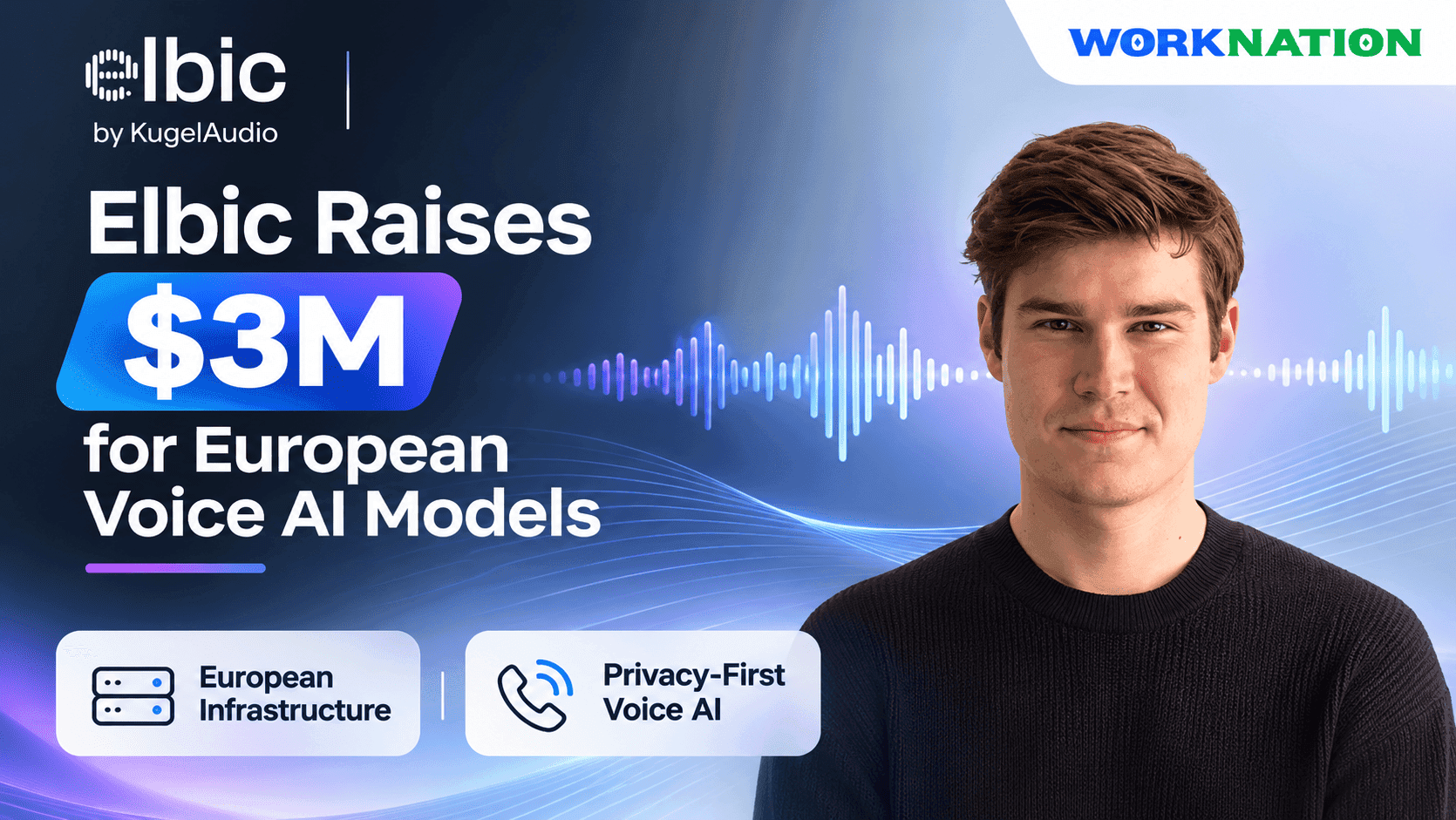
Elbic Raises $3M Pre-Seed to Build European Voice AI
Top Picks
Submit PR
Stay Ahead of the Market
Get the latest startup funding, hiring trends and global opportunities delivered to your inbox every week.
Berlin-based Elbic has raised $3 million in pre-seed funding to develop voice AI models that allow companies to handle customer phone calls without routing conversations through US infrastructure. Formerly known as KugelAudio, the startup secured the round led by Repeat Ventures, with participation from Rebel Fund, Y Combinator and several angel investors.
Founded in 2025 by Kajo Kratzenstein and Viktor Presber, Elbic builds speech models for telecom operators and contact centre software providers. Its models can run in European data centres or directly on customer-owned servers, giving businesses more control over where their voice data is processed.
The funding will primarily support computing capacity for the next generation of models and deployment across enterprise customers in Europe.
Why Elbic wants to keep AI phone calls off US servers
Companies are increasingly using AI to answer customer calls, handle routine enquiries and support contact centre operations. But these systems often depend on third-party cloud infrastructure and AI providers.
For European businesses, this creates questions about where customer conversations are processed, how sensitive information is handled and which external infrastructure providers are involved.
Elbic is targeting companies that want voice AI without relying on US-hosted infrastructure. Its models can operate in European data centres or on a customer's own servers.
This approach gives telecom operators and contact centre providers more control over their deployment environments and customer data.
Data sovereignty is therefore central to Elbic's positioning. Rather than competing only on voice quality, the company is selling the ability to deploy speech AI under European infrastructure and data-control requirements.
Two models handle the conversation
Elbic has developed specialised voice models for two core parts of a phone conversation: understanding what a caller says and generating a spoken response.
These models are designed for telecom operators and contact centre software vendors that want to integrate voice AI into their existing products.
The company says its cloud-based voice system can respond in under 100 milliseconds, an important consideration for natural phone conversations where long pauses can make an AI assistant feel unnatural.
In November 2026, Elbic also introduced Fluid, its speech-to-speech model.
Fluid moves beyond the traditional speech-to-text workflow
Many conventional voice AI systems follow a sequence:
Convert the caller's speech into text.
Send that text to a language model to generate a response.
Convert the generated text back into speech.
Fluid is designed to listen and respond directly in spoken language, reducing the need to treat every exchange as a separate transcription and speech-generation process.
When a conversation requires an action, such as retrieving a customer's account information, Fluid can pass the task to a text-based language model selected by the customer. It then uses the result to continue the spoken conversation.
This separation allows Elbic to focus on the speech interaction while leaving business logic and information retrieval to the customer's chosen language model.
The distinction matters for enterprise deployments: businesses may want to choose their own language models and internal systems without handing control of the entire phone interaction to one provider.
sipgate and Deutsche Telekom are working with Elbic
Elbic already has activity with established telecommunications companies.
German telecom provider sipgate runs Elbic's voice models on its own servers. This is a relevant example of the company's on-premise deployment proposition being used in a real business environment.
Deutsche Telekom is also working with Elbic. Sebastian Schumann, senior architect for network and services international at Deutsche Telekom, said the project required a purely European solution and highlighted the naturalness of the voices and their range.
At sipgate, Laura Grimm, product manager for AI innovations, described the partnership as focused on improving the quality of real telephone conversations.
These relationships give Elbic an early route into the telecom and contact centre market, where voice quality, latency, infrastructure control and reliability are important purchasing considerations.
A small research team with a growing voice AI footprint
Elbic was founded by Kajo Kratzenstein and Viktor Presber in 2025.
Kratzenstein studied computer science at the Hasso Plattner Institute in Potsdam and spent two years working on natural speech synthesis. That research contributed to the company's first open-source model.
Presber previously co-founded full-house.io and brings experience in building and commercialising software businesses.
The founders were accepted into Y Combinator's Spring 2026 batch. Elbic says its first open-source model has received more than 150,000 downloads.
The company has a five-person team in Berlin and says it wants to remain a small research lab focused on building its own speech models.
Repeat Ventures leads the $3 million pre-seed round
Repeat Ventures led Elbic's $3 million pre-seed round. Other participants include:
Rebel Fund
Y Combinator
Maik Mahlkow, co-founder of fastgen
David Nordhausen, co-founder of fastgen
Erik Ziegler, co-founder of voize
Other angel investors
Repeat Ventures founder and managing partner Dan Jones said the team stood out for its expertise in voice AI and model compression, as well as its ability to turn research into models already being used in production.
The new capital will primarily go towards computing resources for the next generation of voice models and deploying the technology to enterprise customers across Europe.
The company has not disclosed its valuation or the individual investment amounts from participating investors.
Competing in Europe's voice AI market
Elbic is entering a competitive market that includes specialised speech AI companies and larger, well-funded model developers.
The funding announcement points to competition from companies such as ElevenLabs and other voice AI providers. Its differentiation is not simply that it generates speech, but that it combines its own speech models with European and customer-controlled deployment options.
The company also faces competition from European startups developing speech-to-speech systems, including Deepslate and Gradium.
Elbic's challenge is to demonstrate that its models can compete on quality, latency and reliability while maintaining the infrastructure control that European customers want.
Its small team and $3 million pre-seed round are modest compared with the capital available to larger competitors. That makes focused product development and enterprise adoption particularly important.
Five original editorial insights
1. Data sovereignty is Elbic's commercial entry point.
Elbic is not trying to win every voice AI customer. It is targeting organisations for which the location and control of customer conversations are important buying criteria. That gives the company a specific market position rather than forcing it to compete only on general model performance.
2. On-premise deployment can change the buying decision.
Running models on customer-owned servers may appeal to telecom operators and contact centres with strict infrastructure requirements. However, it also creates deployment and maintenance responsibilities that Elbic must support as it grows.
3. Fluid's architecture gives customers more flexibility.
By separating speech interaction from the text model responsible for tasks such as account lookups, Elbic can potentially fit into different enterprise AI environments. This could reduce dependence on a single end-to-end AI provider.
4. Telecom partnerships offer a practical route to distribution.
Working with companies such as sipgate and Deutsche Telekom gives Elbic access to real communication environments and potential enterprise deployments. Converting these relationships into repeatable commercial contracts will be a key growth test.
5. A small team must prove it can compete on reliability, not just privacy.
European hosting is a useful differentiator, but customers will still expect natural speech, low latency, accurate recognition and dependable operation. Elbic needs to deliver on all of these to win against larger voice AI providers.
Frequently asked questions
How much funding did Elbic raise?
Elbic raised $3 million in a pre-seed funding round announced on November 25, 2026. EU-Startups reported the equivalent as approximately €2.7 million.
Who led Elbic's funding round?
Repeat Ventures led the round, with participation from Rebel Fund, Y Combinator and angel investors.
Who founded Elbic?
Elbic was founded in 2025 by Kajo Kratzenstein and Viktor Presber. The company was previously known as KugelAudio.
What does Elbic do?
Elbic develops AI speech models for phone assistants and contact centre systems. Its technology can understand callers and generate spoken responses.
What is Fluid?
Fluid is Elbic's speech-to-speech model, designed to listen to spoken language and respond directly in speech rather than relying entirely on a sequential speech-to-text and text-to-speech workflow.
How does Elbic keep calls off US servers?
Its models can run in European data centres or on customer-owned servers, allowing businesses to avoid using US infrastructure for the voice model deployment.
Which companies are working with Elbic?
sipgate runs Elbic's models on its own servers, while Deutsche Telekom is also working with the startup.
What will Elbic use the funding for?
The company plans to invest primarily in computing resources for next-generation speech models and enterprise deployments across Europe.
The next test is enterprise adoption
Elbic's $3 million pre-seed funding gives the Berlin startup additional resources to develop its voice models and expand its enterprise deployments.
Its proposition addresses a clear concern for European businesses: using AI for customer conversations without depending on US infrastructure.
But data sovereignty alone will not determine the winner in voice AI. Elbic must also prove that its models can deliver the accuracy, naturalness and reliability required for real customer interactions.
Its work with sipgate and Deutsche Telekom provides an early foundation. The next phase will show whether a five-person research team can turn that foundation into a scalable European voice AI business.
Have a Funding Round or Exciting Update to Share?
Submit your press release to get featured on WorkNation and reach founders, investors, and tech leaders.