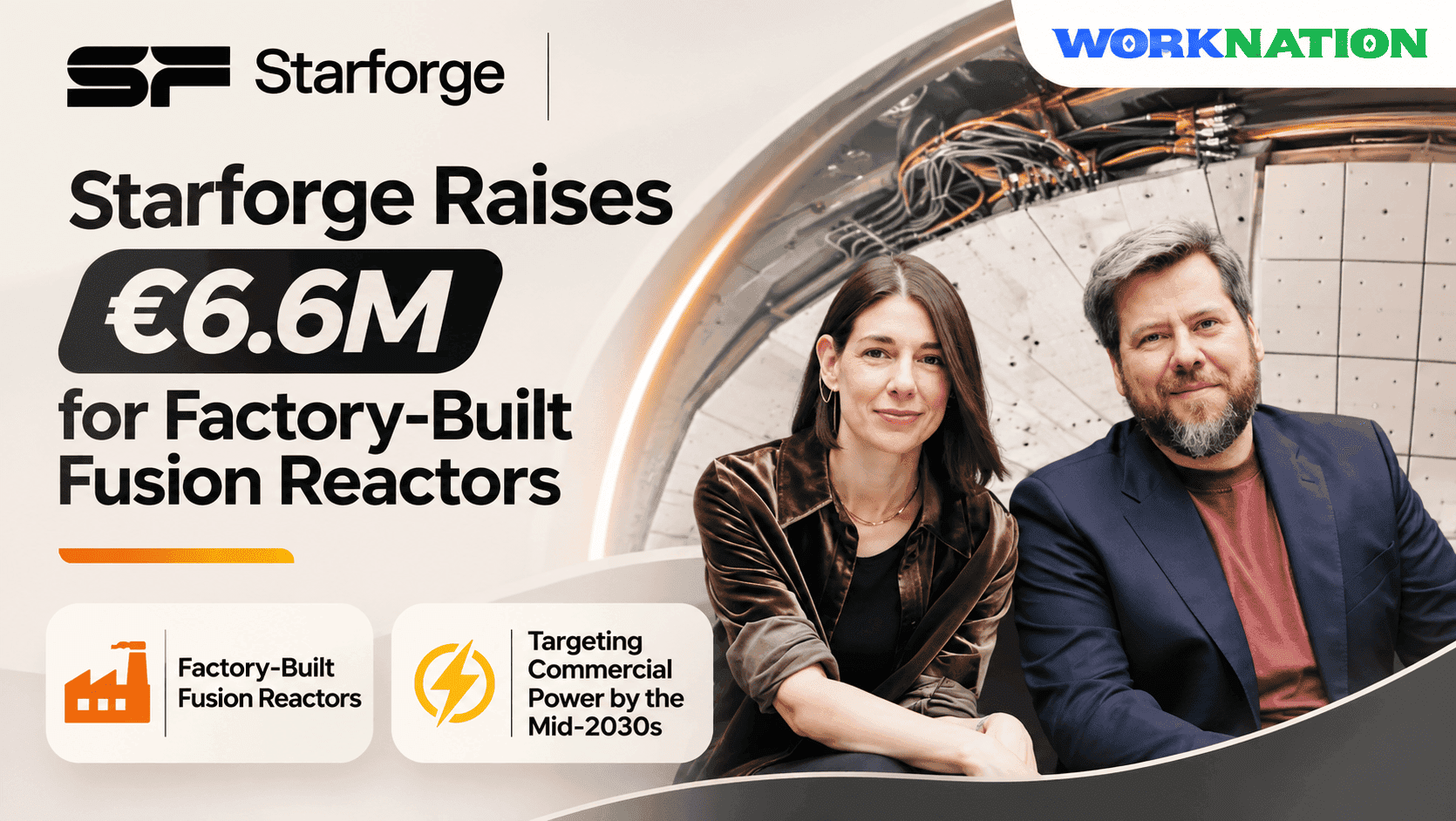
Starforge Raises €6.6M to Build Factory-Made Fusion Reactors
Top Picks
Submit PR
Stay Ahead of the Market
Get the latest startup funding, hiring trends and global opportunities delivered to your inbox every week.
Munich-based fusion energy startup Starforge has raised €6.6 million in pre-seed funding to develop compact fusion reactors designed for production-line manufacturing. The round was co-led by AENU and First Momentum Ventures, with participation from Auxxo, Kvanted, Silicon Roundabout Ventures, UnternehmerTUM Funding for Innovators and Arcas.
Founded in March 2026, Starforge is taking a manufacturing-first approach to commercial fusion. Rather than developing and operating complete power plants, the company plans to build standardised reactor systems that utilities, governments and infrastructure owners can integrate into their own energy projects.
Starforge is targeting commercial operations by the mid-2030s and estimates that its reactors could eventually deliver electricity at around €0.05 per kilowatt-hour at fleet scale. These are long-term company targets, not demonstrated commercial costs.
A Factory-Manufacturing Approach to Nuclear Fusion
Fusion energy has attracted decades of scientific research and billions in private investment. Yet turning experimental progress into commercially deployable electricity remains a major engineering and manufacturing challenge.
Many fusion projects involve complex, custom-built machines. Starforge believes this approach makes reactors expensive and difficult to reproduce at scale.
Its strategy is to design a reactor that can be manufactured repeatedly on production lines, with standardised components and a modular architecture. The company intends to sell these systems to utilities and other infrastructure operators rather than build and operate entire power plants itself.
The model draws a comparison with conventional nuclear fission, where specialist reactor manufacturers supply the reactor while utilities and project developers manage the wider power-generation infrastructure.
If the approach works, customers could add reactor capacity through repeat purchases rather than commissioning a completely bespoke fusion facility each time.
Compact Spherical Tokamak Designed for 200–300 MWe
Starforge is developing a compact spherical tokamak with a planned electricity-generation capacity of 200 to 300 megawatts electric (MWe).
Tokamaks use powerful magnetic fields to confine extremely hot plasma, creating the conditions required for fusion reactions. Starforge's design focuses not only on plasma performance but also on how the reactor can be assembled, serviced and manufactured repeatedly.
One of its proposed design features is the use of remountable high-temperature superconducting magnets. The company says this architecture would allow components to be replaced and serviced in the field without rebuilding the entire reactor.
Starforge is designing its reactors around an expected operating lifetime of more than 40 years. That lifetime is a design objective, not an operating record.
The Manufacturing Economics Behind Starforge's Model
The company's central thesis is that fusion costs can fall through manufacturing repetition.
Starforge assumes that every doubling of production could reduce manufacturing costs by approximately 15%. At fleet scale, it believes this could support an electricity cost of around €0.05 per kWh.
The target is ambitious. It depends on several factors, including reactor performance, component reliability, manufacturing yields, maintenance requirements, financing costs and the ability to secure repeat orders.
The company points to the cost reductions achieved in industries such as solar and batteries as evidence that standardisation and production scale can transform energy technology economics.
However, fusion reactors have different technical and regulatory requirements. Starforge will need to demonstrate that its manufacturing assumptions hold up under the conditions of an actual reactor programme.
Who Founded Starforge?
Starforge was founded in Munich in March 2026 by Dr Ana Koller and Jonathan Janssen.
Koller is the company's CEO and has a background in plasma physics and fusion engineering. She previously worked at Commonwealth Fusion Systems, MIT and the Max Planck Institute for Plasma Physics.
Janssen serves as COO and brings experience in industrial manufacturing and complex hardware development. His previous roles include work at Lilium and GE.
The wider team includes professionals with experience at EUROfusion, Tokamak Energy, Airbus, McLaren and Red Bull Racing.
The combination of fusion research and industrial manufacturing experience is central to Starforge's proposition: designing a reactor that can move beyond a one-off scientific machine and become a repeatable industrial product.
Starforge Enters a Competitive Fusion Energy Market
Starforge is entering a global fusion market where startups are pursuing different reactor architectures and commercialisation strategies.
Some of the companies operating in the space include:
Tokamak Energy: The UK-based company is developing spherical tokamaks and high-temperature superconducting magnet technology, making its technical direction one of the closer comparisons to Starforge.
Proxima Fusion: The Munich-based startup is developing stellarator technology, a different magnetic-confinement approach to the tokamak.
Marvel Fusion: The German company is pursuing laser-driven inertial fusion rather than magnetic confinement.
Commonwealth Fusion Systems: The US-based company is developing its SPARC demonstration machine and the planned ARC commercial power plant.
Starforge's differentiation is not simply its reactor geometry. Its central proposition is to make manufacturing repeatability a core part of reactor design from the beginning.
That puts the company in competition not only on plasma physics, but also on production engineering, component costs, reliability and the ability to deliver reactors to customers.
How Starforge Plans to Use the €6.6 Million
The fresh capital will support the company's development programme over the next 24 months.
Starforge plans to:
Expand its engineering and technical team.
Advance key reactor technologies.
Complete the conceptual design of its first reactor, called Unit One.
Secure initial commitments from potential reactor customers across Europe.
The company describes Unit One as its prototype, first-of-a-kind reactor and intended first commercial product.
That is an ambitious development path. The next major milestone is to translate the current reactor concept into a detailed design and demonstrate that its technical and manufacturing assumptions can be engineered into a working system.
Starforge is also positioning Germany as an important base for development, citing the country's growing support for fusion research, testing infrastructure and funding programmes.
Editorial Analysis: What Starforge's Funding Signals
1. Fusion is becoming a manufacturing challenge as much as a physics challenge.
The sector has spent decades demonstrating progress in plasma science. Starforge is betting that the next commercial breakthrough will depend on designing reactors that can be built repeatedly, serviced efficiently and delivered at predictable costs.
2. The company is selling a reactor product, not a complete power plant.
This distinction matters. Starforge wants utilities and infrastructure owners to integrate its equipment into their own energy projects. That could reduce the need for the startup to develop every part of a power plant, but it also means its success depends on customers accepting and integrating a new reactor technology.
3. The €0.05/kWh target is an ambition, not a current price.
The projected electricity cost depends on fleet-scale manufacturing and several technical and commercial assumptions. Investors and future customers will need evidence from reactor development and operation before the economics can be validated.
4. Unit One is the milestone to watch.
The first reactor is expected to serve as both a prototype and the foundation for the company's commercial product. Completing its conceptual design is an early step; construction, commissioning and sustained power generation would be much larger milestones.
5. Starforge's team combines two capabilities that are difficult to assemble.
Fusion engineering requires deep scientific expertise, while repeatable reactor manufacturing requires industrial systems, supply-chain development and hardware production experience. The founders' backgrounds are intended to bridge those disciplines.
Frequently Asked Questions
How much funding did Starforge raise?
Starforge raised €6.6 million in a pre-seed funding round co-led by AENU and First Momentum Ventures.
Who invested in Starforge?
The round also included Auxxo, Kvanted, Silicon Roundabout Ventures, UnternehmerTUM Funding for Innovators and Arcas.
What is Starforge developing?
Starforge is developing compact spherical tokamak fusion reactors designed for standardised, production-line manufacturing.
How much electricity could a Starforge reactor generate?
The company is targeting a capacity of 200 to 300 megawatts electric per reactor.
When does Starforge expect commercial operations to begin?
Starforge is targeting its first commercial operations for the mid-2030s. This is a company target, not a confirmed deployment date.
What is Starforge's target electricity cost?
The company is targeting around €0.05 per kilowatt-hour at fleet scale. This has not yet been demonstrated.
Who founded Starforge?
Starforge was founded in March 2026 by Dr Ana Koller, its CEO, and Jonathan Janssen, its COO.
Conclusion
Starforge's €6.6 million pre-seed funding gives the Munich startup capital to advance its factory-manufactured fusion reactor concept. Its approach shifts the focus from building one complex fusion machine at a time to developing a standardised product that could be manufactured repeatedly and supplied to utilities.
The challenge now is execution. Starforge must turn its reactor design, manufacturing assumptions and cost targets into a working system. Whether it can do that will determine if factory-built fusion reactors can become a commercially viable part of the future energy mix.
Have a Funding Round or Exciting Update to Share?
Submit your press release to get featured on WorkNation and reach founders, investors, and tech leaders.