Sequent Raises $2.2M Pre-Seed to Prove Software Safety with AI
Top Picks
Submit PR
Stay Ahead of the Market
Get the latest startup funding, hiring trends and global opportunities delivered to your inbox every week.
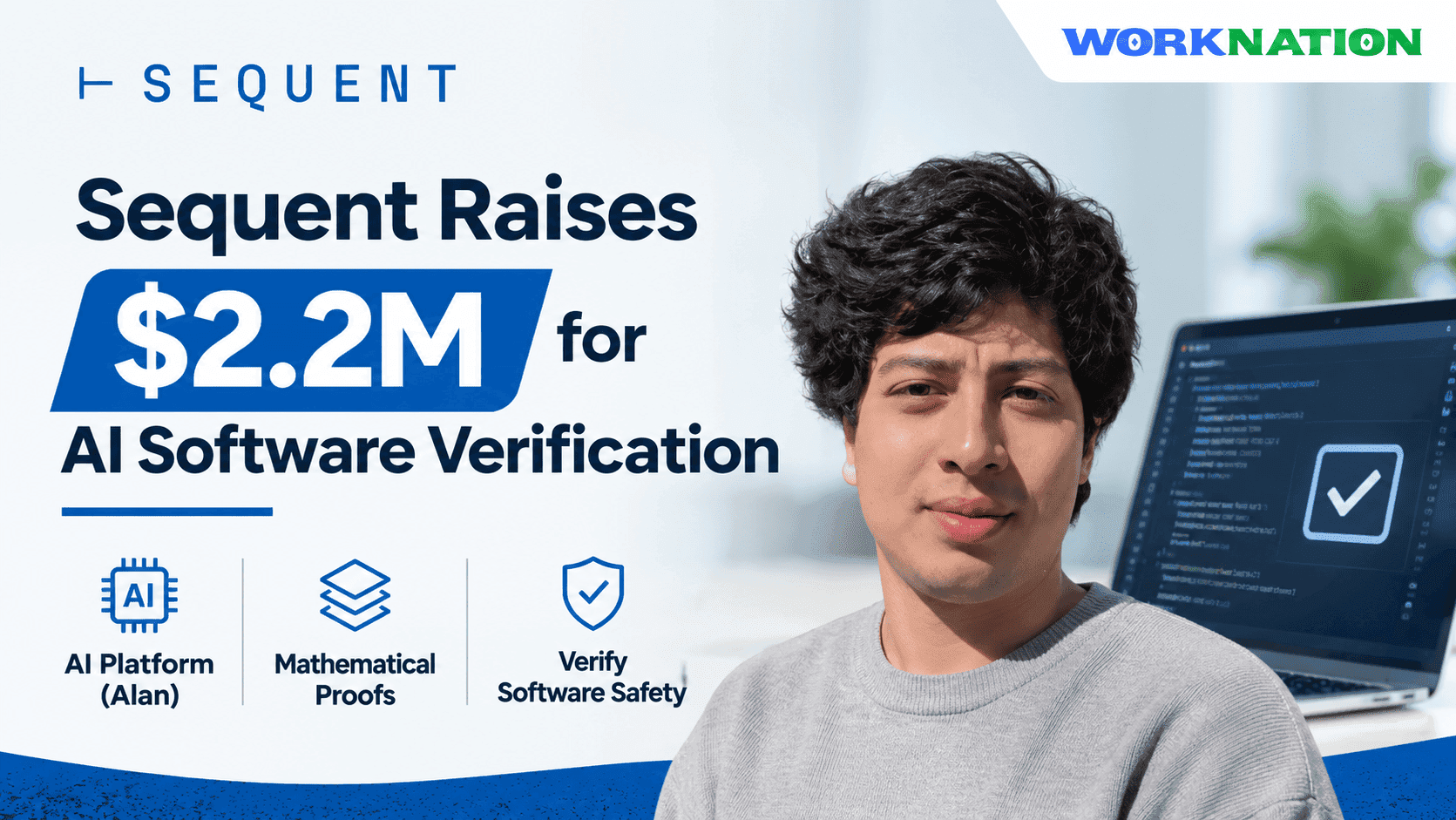
London-based Sequent has raised $2.2 million in pre-seed funding to develop Alan, an AI-powered platform that uses mathematical proofs to verify whether software follows its specified safety rules. The round was co-led by Frachtis and Metaplanet, the investment firm of Skype co-founder Jaan Tallinn.
Founded in January 2026 by Charles Cooper and Ramana Kumar, Sequent is tackling a problem that conventional software testing cannot fully solve: proving that code behaves according to its defined rules across all possible inputs and executions covered by the proof.
Alan uses AI to search for mathematical proofs, but it does not get to approve its own work. Every proof must pass HOL4, an independent mathematical proof checker that validates each step without relying on AI.
The company has already secured Curve Finance as its first paying customer. The new funding will support product development, hiring and the expansion of Alan beyond its initial focus on Vyper smart contracts.
Why software testing is not enough
Software testing is essential for identifying bugs, but it generally checks a programme against scenarios that engineers have selected.
Even extensive testing cannot guarantee that every possible execution path has been examined. A vulnerability may remain hidden until an unexpected combination of inputs or actions exposes it.
Formal verification takes a different approach.
Instead of checking selected scenarios, engineers define mathematical properties that software must satisfy. A formal verification system then attempts to prove that the code follows those properties.
For example, a financial application might have a rule stating that no user should be able to withdraw more money than their available balance.
Traditional testing can check many withdrawal scenarios. A successful mathematical proof can establish that the specified rule holds across all inputs and executions covered by the verified model.
Historically, creating these proofs required specialist mathematical expertise and substantial manual work. This made formal verification expensive and difficult to apply to ordinary software projects.
Sequent believes AI can reduce the effort involved in finding proofs and make formal verification more accessible to software engineering teams.
How Alan uses AI to find mathematical proofs
Alan is designed to help engineers describe the safety properties their software should maintain.
The workflow begins with engineers defining requirements in plain language. Alan helps translate these requirements into formal specifications and searches for mathematical proofs that the code satisfies them.
The process has an important safeguard: AI-generated proofs are not accepted automatically.
Every proof must pass HOL4, an independent proof checker that verifies the mathematical steps. If a proof is incorrect, it is rejected.
Alan can return three types of outcomes:
Proven: A machine-checked mathematical proof establishes the specified property.
Refuted: An executable counterexample demonstrates how the property can fail.
Not yet tractable: The system has not found a proof within the available search budget.
This distinction is important. Failure to find a vulnerability is not treated as proof that software is safe.
Engineers must also review and approve the specifications themselves. A mathematical proof only establishes the property that was actually defined. If the original safety rule fails to capture the intended requirement, even a valid proof may not provide the protection engineers expect.
The Vyper compiler incident behind Sequent
Sequent's origins are closely connected to the security history of Ethereum smart contracts.
Charles Cooper, Sequent's CEO, leads development of Vyper, a programming language used to write smart contracts on Ethereum.
In 2021, Cooper inadvertently introduced a flaw into the Vyper compiler, the software that translates contract code into instructions executed on the blockchain.
Although the issue was fixed within months, smart contracts already deployed using affected compiler versions could not simply be updated.
In July 2023, attackers exploited the vulnerability to drain funds from older Curve Finance pools and other projects.
The Curve losses were reported at approximately $70 million in the supplied Tech Funding News article. Other coverage has cited more than $50 million or approximately $60 million across affected projects, depending on which incidents and pools are included. These figures should not be treated as identical accounting estimates.
Following the incident, Ramana Kumar offered to help prove the Vyper compiler correct.
Kumar previously worked on AI safety research at Google DeepMind and co-created CakeML, a compiler that was formally verified down to the machine instructions it produces.
The collaboration eventually led to Sequent and its effort to make mathematical software verification more practical.
Curve Finance becomes Sequent's first paying customer
Curve Finance is Sequent's first paying customer and an early example of Alan being applied to a live financial system.
The platform has been used to prove a specific safety property for Curve's two-coin StableSwap pools holding standard tokens.
The proof establishes that no user can withdraw more than a defined limit from depositors, regardless of the sequence of actions covered by the verified model.
During this work, Alan also identified minor accounting and rounding errors. According to the company, none of these errors breached the specified withdrawal limit.
Curve founder Michael Egorov said the verification work gives the protocol a way to prove that depositor funds remain protected by the same limit when pool code changes.
This is different from a conventional security audit, which reviews a particular version of code and identifies issues discovered during that review.
With formal verification, the specified safety property can be checked again as the software changes.
However, the existing Curve proof does not establish that the entire Vyper compiler is correct. Sequent is separately working towards proving the compiler itself, which is significant because the original vulnerability existed in that part of the software pipeline.
Metaplanet and Frachtis lead the $2.2 million round
Sequent's $2.2 million pre-seed round was co-led by Frachtis and Metaplanet.
Frachtis is a $20 million pre-seed fund focused on crypto and AI founders. Metaplanet is the investment firm of Skype co-founder Jaan Tallinn, who led Anthropic's $124 million Series A round in 2021.
The investment brings backing from investors interested in AI, software infrastructure and security.
Metaplanet managing partner Rauno Miljand highlighted the growing need for reliable software verification as AI accelerates code production.
The funding will be used for:
Engineering hires.
Sales and marketing expansion.
AI computing costs.
Taking Alan from early access towards full launch.
Expanding support for additional programming languages and platforms.
Sequent has not disclosed its valuation or the individual investment amounts contributed by the investors.
Expanding beyond Vyper smart contracts
Alan currently works with Vyper smart contracts, but Sequent plans to expand its supported technologies.
The development roadmap includes:
Solidity smart contracts.
Solana smart contracts.
Rust.
C.
TypeScript.
Python.
The company is also developing verification of the Vyper compiler itself.
This expansion could take Sequent beyond blockchain security into broader software assurance. Financial institutions, governments and companies operating complex legacy systems all have software where a failure can carry significant financial or operational consequences.
The challenge is that each programming language and software environment introduces different verification requirements. Supporting more languages will require Sequent to demonstrate that its proofs cover the relevant source code or compiled artifacts, rather than relying on broad claims of software safety.
A different approach to the growing AI security market
Sequent enters a market where AI is increasingly being used to identify software vulnerabilities and automate security testing.
Companies such as Backslash Security, XBOW, Escape and Bynario are developing AI-powered security products, but their approaches differ.
Some focus on finding vulnerabilities, analysing application behaviour or automating offensive security testing.
Sequent is pursuing a more specific approach: mathematically proving that defined software properties hold.
This distinction matters because vulnerability detection and formal verification answer different questions.
A security scanner may identify suspicious code or potential attack paths. A formal verification system attempts to establish a mathematical guarantee about a particular property, subject to the assumptions and scope of the proof.
Sequent's opportunity is to make this stronger form of assurance practical for more development teams.
What Sequent's funding means for software assurance
AI is accelerating software development, but faster code production also increases the volume of software that needs to be tested, reviewed and secured.
Human reviewers cannot examine every possible execution path, and relying on another AI system to approve AI-generated code introduces its own trust problem.
Sequent's approach is to use AI to search for proofs while keeping the final verification process independent of AI.
If the company can make this workflow reliable and affordable, formal verification could move beyond specialised safety-critical applications and become a more routine part of software development.
Five original editorial insights
1. Sequent is selling evidence, not another AI security opinion.
Many AI security products produce recommendations, risk scores or vulnerability reports. Alan aims to produce mathematical proof artifacts that another party can independently check. That is a fundamentally different product proposition.
2. The human-approved specification is as important as the proof.
A mathematically correct proof can still be commercially useless if the property being proved does not represent the actual business requirement. Keeping engineers responsible for approving the specification is therefore central to the product's trust model.
3. The Curve relationship gives Sequent a strong starting point.
The company is not only demonstrating a research concept. It has a paying customer in a financial protocol where software vulnerabilities can result in direct financial losses. This gives the product a concrete commercial use case.
4. Compiler verification could be a bigger opportunity than smart contract auditing.
The original Vyper incident exposed how a flaw in a compiler can affect software that appears correct at the source-code level. Proving compilers correct could eventually address a deeper layer of software supply-chain risk.
5. The biggest challenge is expanding proof coverage without overstating guarantees.
Supporting more programming languages and real-world applications is essential for growth. But every proof must clearly identify which property, assumptions and software artifact it covers. That precision will determine whether enterprises trust the platform.
Frequently asked questions
How much funding did Sequent raise?
Sequent raised $2.2 million in pre-seed funding, co-led by Frachtis and Metaplanet.
Who founded Sequent?
Sequent was founded in London in January 2026 by Charles Cooper and Ramana Kumar. Cooper leads Vyper development, while Kumar previously worked on AI safety research at Google DeepMind.
What does Sequent do?
Sequent develops Alan, an AI-powered formal verification platform that searches for mathematical proofs showing whether software follows specified safety properties.
What is formal verification?
Formal verification uses mathematical methods to establish whether software satisfies defined requirements. Unlike conventional testing, it can prove properties across all inputs and executions covered by the formal model.
How does Alan verify its proofs?
Alan uses AI to search for proofs, but every result must pass HOL4, an independent mathematical proof checker that does not rely on AI.
Who is Sequent's first customer?
Curve Finance is Sequent's first paying customer. Alan has been used to prove a withdrawal safety property for a specific type of Curve StableSwap pool.
Who invested in Sequent?
The $2.2 million pre-seed round was co-led by Frachtis and Metaplanet, the investment firm of Skype co-founder Jaan Tallinn.
What programming languages will Alan support?
Alan currently works with Vyper smart contracts. Sequent is developing Solidity and Solana support, with Rust, C, TypeScript and Python on its roadmap.
How much does Alan cost?
The supplied announcement lists subscriptions starting at $99 per month for individuals, $200 for auditors and $500 for teams.
From AI-generated code to mathematically verified software
Sequent's $2.2 million pre-seed funding highlights an emerging opportunity in AI-driven software security.
As AI tools make it easier to generate code, proving that critical software behaves correctly could become increasingly important.
Sequent is betting that AI can make formal verification faster and more affordable without making the verification process dependent on trusting AI itself.
Its work with Curve Finance provides an early commercial example. The next milestone is expanding Alan beyond Vyper and demonstrating that machine-checked mathematical proofs can become a practical part of software development.
Have a Funding Round or Exciting Update to Share?
Submit your press release to get featured on WorkNation and reach founders, investors, and tech leaders.