Niro Raises €1.65M to Give AI Coding Agents a Live Map of Code
Top Picks
Submit PR
Stay Ahead of the Market
Get the latest startup funding, hiring trends and global opportunities delivered to your inbox every week.
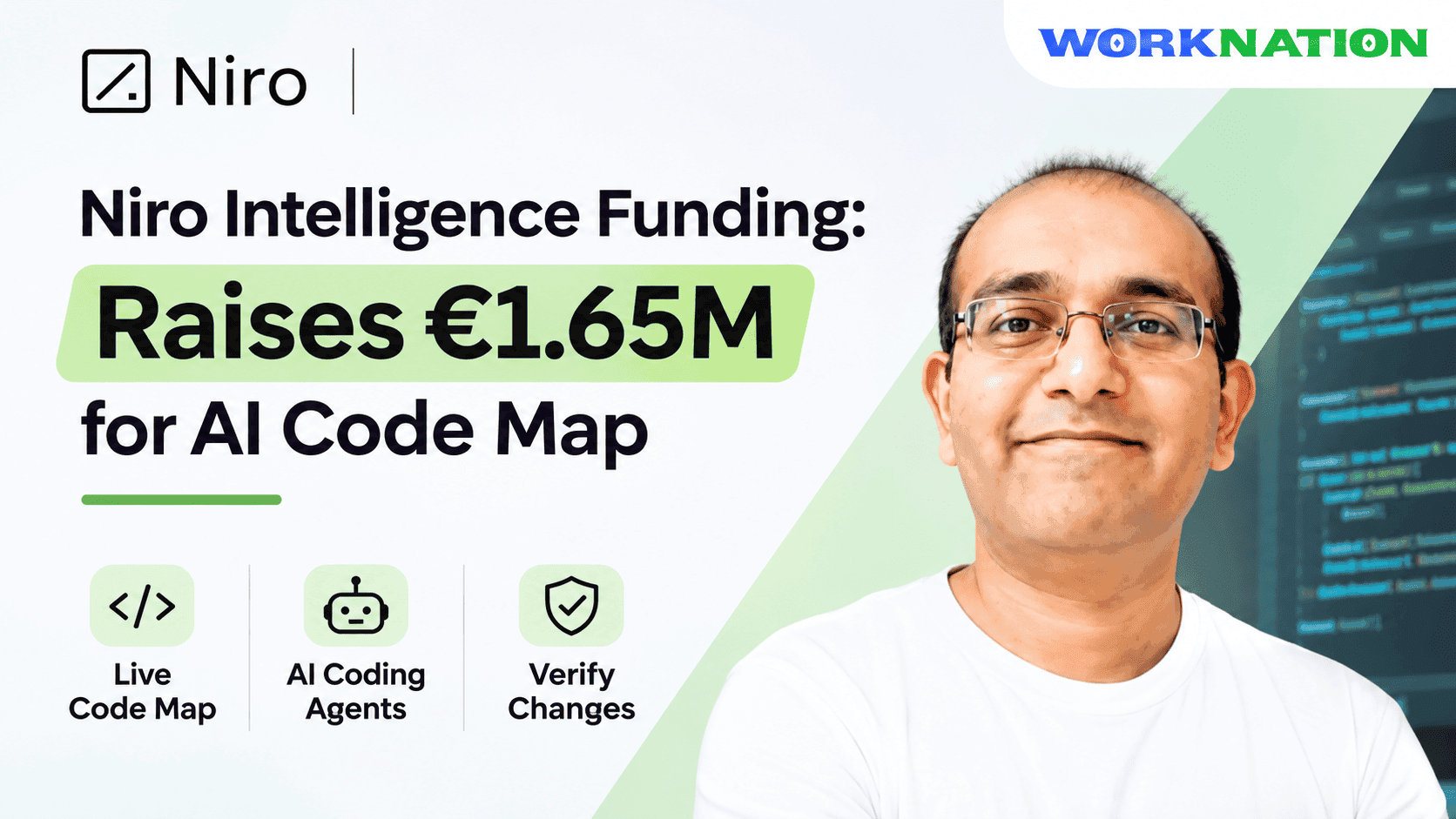
Niro Intelligence has raised €1.65 million to help AI coding agents understand how entire software systems work, rather than searching through code one file at a time. The London-based startup's funding round was co-led by Voima Ventures and Maki.vc, with participation from several angel investors.
Founded by Nilay Oza and Niraj Aswani, Niro is building a live map of code behaviour that developers and AI agents can use to understand dependencies, assess changes and investigate software problems. The founders previously built e-commerce search company Klevu together, spending more than a decade growing the business before its exit.
The funding arrives as AI coding tools generate more software, creating a growing challenge for engineering teams: understanding, reviewing and verifying what those tools produce.
Why AI coding agents need a better understanding of code
AI coding agents can write and modify software quickly, but understanding a large codebase is a different problem.
In complex systems, code is spread across repositories, services, APIs, databases and configuration files. A change in one place can affect components elsewhere, making it difficult for an AI agent to understand the full impact by examining individual files.
This creates several challenges for engineering teams:
Limited visibility: Developers and AI agents may not have a complete picture of how different parts of a system interact.
Higher AI costs: Agents can spend time and additional tool calls searching for relevant context.
Slower debugging: Tracing an incident across services can require significant investigation.
Uncertain changes: Engineers need to understand what a proposed code change could affect before approving it.
Niro's approach is to build a shared reference point for engineers and AI agents: a continuously updated map of how the code actually behaves.
How Niro's code graph works
Rather than building another AI coding assistant, Niro is developing infrastructure that existing AI agents can use.
Its code graph maps relationships between repositories, functions, classes, calls, configuration and other software components. This allows an AI agent to investigate how different parts of a system connect without repeatedly searching through files to reconstruct the same context.
The idea is to give engineers and AI agents access to the same underlying view of a software system.
For example, when a developer asks what could break after changing a particular function, Niro can use the relationships in its graph to identify connected components and potential impact. The same underlying map can also support code review and production incident investigations.
Niro says its tools are designed to work with existing AI assistants, including Claude Code and Cursor, through the Model Context Protocol (MCP).
Niro reports 67% lower AI costs in its benchmark
One of the company's most notable claims comes from its own benchmark study.
The company also reports that the comparison took 56 minutes without Niro and 19 minutes with it across 36 contested queries.
These results suggest that giving AI agents a structured understanding of a codebase could reduce the time and resources spent gathering context.
However, the figures should be treated as early company-reported benchmark results, not proof of performance across all engineering environments. The study used one run per query and three codebases. Independent testing across more repositories and teams would help establish how consistently the results can be reproduced.
A growing market for AI code reliability
Niro is entering a market where companies are building tools to address different parts of the software development process as AI-generated code becomes more common.
Some startups focus on reviewing code before it is merged. Others test software changes before deployment or investigate incidents after production systems fail.
Companies operating in this broader landscape include:
CodeRabbit, which focuses on AI-powered code review.
Meticulous, which works on testing software changes before deployment.
Resolve AI, which focuses on site reliability and production troubleshooting.
Niro's positioning is different. Its focus is the underlying code graph: a shared map of software relationships that can support engineers, AI agents, code review and incident investigation.
The distinction matters because Niro is not simply trying to make code review faster. It is attempting to give multiple engineering tools a common understanding of how a software system works.
Founders bring experience from Klevu
Niro was founded by Nilay Oza and Niraj Aswani, who previously spent more than ten years building Klevu, an e-commerce search company that grew to thousands of customers.
Klevu merged with Searchspring in January 2025 to form Athos Commerce, according to the original funding report.
The founders' previous experience gives them a direct connection to the problem Niro is trying to solve: as software systems grow, the knowledge needed to understand and maintain them becomes harder to hold across a team.
The new funding gives the founders resources to develop Niro's code intelligence platform and expand its rollout.
Three phases planned for Niro's product rollout
Niro's product roadmap is structured around three stages.
1. Niro Local
The first product, Niro Local, is already available. It is a command-line interface and MCP server that can be installed with a single command. The company says it also has a free plan.
2. Team pull request review
The next phase will bring Niro into team workflows, with pull request reviews designed to help engineers understand the potential impact of proposed code changes.
3. Production incident investigation
The final phase will connect the code graph with commits, logs and production telemetry. The goal is to help engineering teams trace incidents back to the changes and underlying causes responsible for them.
This roadmap takes Niro beyond code discovery and into the wider software reliability process.
What the Niro Intelligence funding means
The €1.65 million round gives Niro backing from two venture investors, Voima Ventures and Maki.vc, as it develops infrastructure for AI-assisted software engineering.
The opportunity is clear: AI coding agents can generate more code, but engineering teams still need reliable ways to understand what that code changes and how it affects the rest of a system.
Niro is betting that a live code graph can become an important layer between AI-generated software and the teams responsible for maintaining it.
Its benchmark results provide an early indication of the potential efficiency gains, but adoption by engineering teams and independent performance testing will be important measures of whether the approach delivers at scale.
For now, Niro Intelligence's €1.65 million funding marks another investment in the infrastructure needed to make AI-generated software easier to understand, review and maintain.
Frequently Asked Questions
How much funding has Niro Intelligence raised?
Niro Intelligence raised €1.65 million in a funding round co-led by Voima Ventures and Maki.vc. Angel investors also participated.
Who founded Niro Intelligence?
Niro Intelligence was founded by Nilay Oza and Niraj Aswani. The pair previously built Klevu, an e-commerce search company.
What does Niro Intelligence do?
Niro builds a live code graph that maps relationships across software systems. Engineers and AI coding agents can use it to understand code dependencies, assess changes and investigate incidents.
How does Niro help AI coding agents?
Niro gives AI agents access to a structured map of how a codebase behaves. This can reduce the need to repeatedly search through files to understand dependencies and the potential impact of changes.
Who invested in Niro Intelligence?
The €1.65 million round was co-led by Voima Ventures and Maki.vc. Named angel investors include Heikki Nousiainen, Santeri Kangas, Elias Aalto, Oskari Pétas, Johannes Korpela and Lauri Vuornos.
What did Niro's AI benchmark report?
Niro reported a 67% reduction in costs and approximately five times fewer tool calls across 42 developer queries and three production codebases. The results come from the company's own study and have not been independently established across a wider set of environments.
Where is Niro Intelligence based?
Niro Intelligence is headquartered in London, United Kingdom.
Editorial Analysis: Five things worth watching
The opportunity is bigger than code review. Niro is positioning its code graph as shared infrastructure for multiple engineering workflows, rather than a standalone review assistant.
Context could become a major cost centre for AI agents. If agents repeatedly reconstruct system knowledge by searching files, a continuously updated graph could reduce duplicated work.
The benchmark is promising, but still narrow. Forty-two queries across three codebases provide an initial data point, not a universal performance guarantee. Independent testing will matter.
The founders have relevant operating experience. Their history building Klevu gives them experience with the complexity that develops as software products and customer bases grow.
The rollout will test the breadth of the product. Niro Local is available, but team pull request review and production incident investigation are later stages. Execution across those phases will determine how much of the proposed platform becomes usable in practice.
Have a Funding Round or Exciting Update to Share?
Submit your press release to get featured on WorkNation and reach founders, investors, and tech leaders.