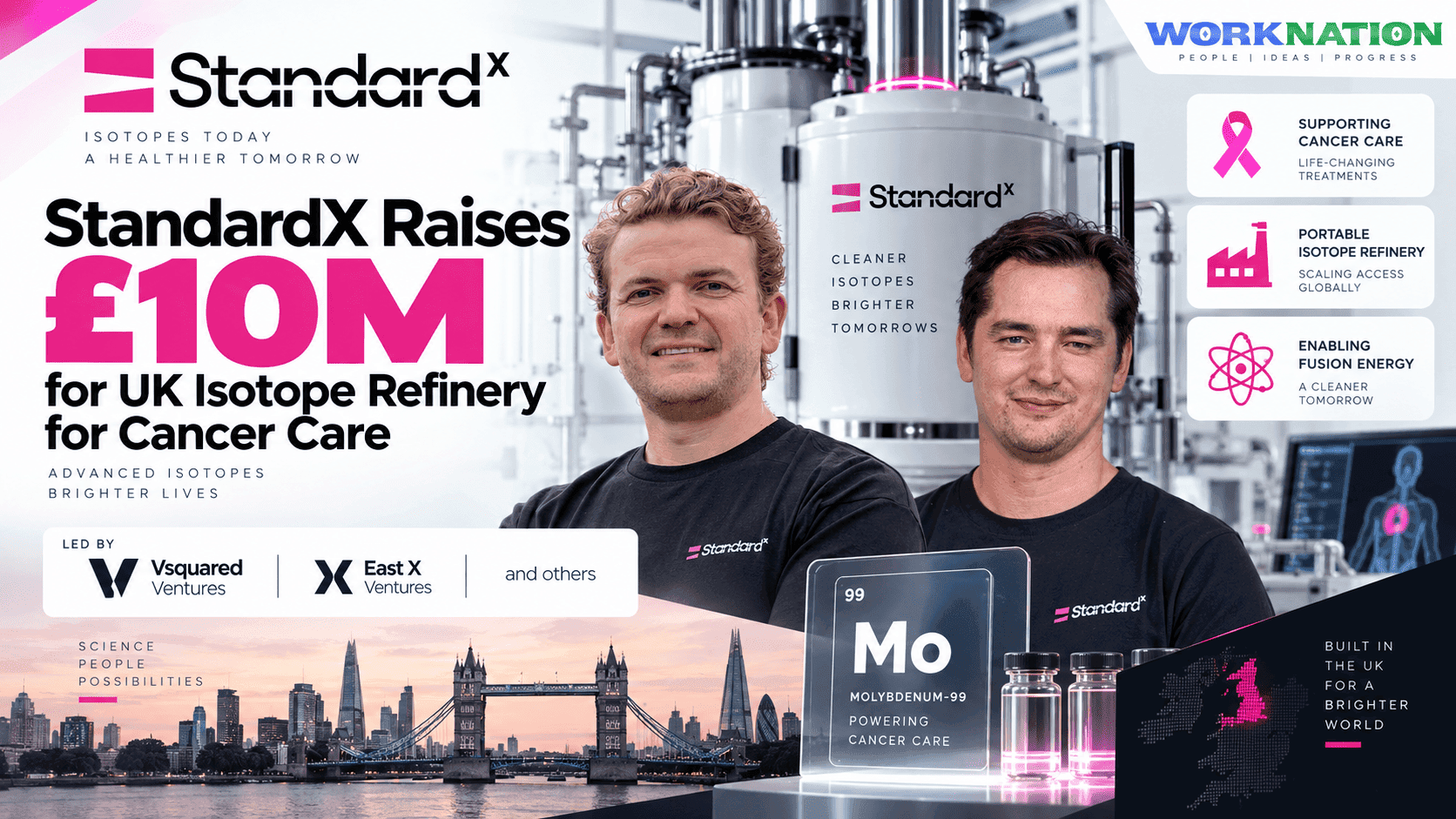
StandardX Raises £10M to Build UK Isotope Refinery for Cancer Care and Fusion
Top Picks
Submit PR
Stay Ahead of the Market
Get the latest startup funding, hiring trends and global opportunities delivered to your inbox every week.
London-based deeptech startup StandardX has raised £10 million in seed funding to develop a new isotope refinery designed to address shortages of radioactive materials used in cancer care and potentially support the future development of fusion energy.
The funding round was led by European deeptech investors Vsquared Ventures and East X Ventures. Firstminute Capital, the UK Innovation and Science Seed Fund, Brevan Howard Macro Venture, and Geometry also participated.
Founded in 2025 by nuclear engineers Richard Pearson and Ross Allen, StandardX is working to change how medical isotopes are produced and supplied. The company's approach centres on a compact particle accelerator that could allow different isotopes to be produced commercially from a single portable platform.
The startup says its objective is to reduce dependence on a fragmented, reactor-dependent global supply chain that currently limits the availability of several important isotopes.
Tackling isotope shortages in cancer care
Isotopes are used across modern medicine, including cancer diagnosis, targeted radiotherapy, and emerging forms of immunotherapy.
However, the production of many medically important isotopes remains concentrated in a limited number of reactors and cyclotrons around the world. This creates vulnerabilities in the supply chain and can make it difficult for hospitals and researchers to obtain specific isotopes when they are needed.
StandardX argues that the problem is becoming increasingly important as demand for cancer treatments grows.
The company points specifically to targeted alpha therapy, an approach that uses radioactive isotopes to target cancer cells. According to StandardX, shortages of the required isotopes have contributed to clinical trials being halted in the UK and Europe.
The company's proposed solution is a flexible production system capable of producing different isotopes rather than relying on dedicated infrastructure for individual materials.
StandardX is developing a compact particle accelerator in London that it says could enable commercial isotope production using a standardised portable design.
The idea is to bring production closer to hospitals and research facilities while allowing output to change depending on demand.
That flexibility could be particularly relevant for radioactive materials where supply requirements vary significantly between different medical applications.
The model is still being developed and has not yet been demonstrated at large commercial scale. StandardX plans to provide its first isotopes to a medical research partner in 2027, with industrial-scale production targeted for 2029.
A new approach to isotope production
The global isotope market includes a range of production technologies, with existing companies using combinations of nuclear reactors, particle accelerators, and cyclotrons.
StandardX believes its approach can differentiate itself by using a standard and portable refinery design capable of producing multiple isotopes.
The company is not the only startup working on isotope supply.
In the United States, NorthStar Medical Radioisotopes is developing isotope production infrastructure using both reactor and accelerator technologies. Nusano, another US-based company in the sector, raised $41 million in seed financing in 2018 and subsequently completed a Series C round in 2024.
StandardX's strategy is focused on flexibility rather than concentrating on only a small number of isotopes or relying on one production method.
The company believes portable production could allow isotope output to be located closer to end users and adjusted as medical demand changes.
That could potentially reduce some of the logistical challenges associated with transporting radioactive materials through an internationally concentrated supply chain.
However, the company still needs to prove that its technology can operate reliably and economically at the scale required by the medical market.
From cancer treatment to fusion energy
StandardX's ambitions extend beyond healthcare.
The company is also developing its platform with future fusion energy applications in mind, particularly the production of tritium.
Tritium is a radioactive isotope of hydrogen used as fuel in certain fusion reactor concepts. StandardX says there are only around 25 kilograms of tritium in the world, while a single commercial fusion plant could require tens of kilograms each year.
If fusion energy moves toward large-scale commercial deployment, access to sufficient tritium could become an important industrial requirement.
StandardX says it has already entered supply agreements with fusion developers, although the names of those companies have not been publicly disclosed.
For the startup, this creates a second potential market for the same underlying isotope production platform.
Medical applications provide a nearer-term market, while fusion could represent a longer-term opportunity if commercial fusion deployment expands.
East X Ventures has a particular connection to the fusion ecosystem. The investment firm was one of the co-leads of Proxima Fusion's €411 million fundraising earlier in 2026.
Theodore Mollinger, general partner at East X, described StandardX's medical isotope business as a potential standalone opportunity while pointing to tritium as a future requirement for fusion.
This creates a business model in which StandardX does not need to wait for commercial fusion to develop before pursuing its initial market.
Building the first refinery in London
The new £10 million round will be used to establish the infrastructure needed to move StandardX's technology toward commercial production.
The company plans to secure an industrial site in London where it can build its first refinery system.
StandardX also plans to expand its team to more than 15 scientists and engineers. Its existing and planned team includes people with experience at organisations including SpaceX, The London Clinic, Oxford, Cambridge, Fermilab, and the UK Atomic Energy Authority.
The £10 million seed round represents all of the capital StandardX has raised to date.
The company expects to send its first isotopes to a medical research partner in 2027 before targeting industrial-scale production in 2029.
Those milestones will be important tests for the company's technology and commercial strategy.
Growing demand for medical isotopes
StandardX's fundraising comes as demand for medical isotopes continues to grow.
The global medical isotopes market was valued at $7.26 billion in 2025 and is projected to reach $10.05 billion by 2030, according to figures cited in the source article. That represents an estimated compound annual growth rate of 6.6%.
Cancer incidence and growing adoption of targeted radiotherapy are among the factors driving demand.
The challenge is that expanding demand does not automatically translate into greater isotope availability. Production infrastructure is specialised, radioactive materials have complex handling requirements, and supply can depend on a relatively small number of facilities.
StandardX is therefore attempting to address a supply-side problem rather than developing a new cancer treatment itself.
Its technology is intended to provide the raw radioactive materials that researchers, hospitals, and pharmaceutical companies need for existing and emerging applications.
A dual opportunity in medicine and energy
The company's strategy ultimately connects two markets with very different timelines.
Cancer care represents the immediate application. StandardX plans to begin supplying medical research with isotopes in 2027, with industrial production targeted for 2029.
Fusion represents the longer-term opportunity.
If commercial fusion plants become widespread, demand for tritium could increase substantially. StandardX's ability to produce isotopes through a flexible refinery platform could potentially position it within that future supply chain.
The company will need to execute on several technical and commercial milestones before that opportunity becomes meaningful.
It must demonstrate its accelerator and refinery technology, establish reliable production, obtain the necessary regulatory approvals, build relationships with medical and industrial customers, and scale production economically.
For now, the £10 million seed round gives StandardX the capital to build its first industrial infrastructure and expand its technical team.
The company's next major milestone will be getting its first isotopes into the hands of its medical research partner in 2027. From there, the transition toward industrial-scale production in 2029 will determine whether its portable refinery model can move from an ambitious concept to commercially deployed infrastructure.
Have a Funding Round or Exciting Update to Share?
Submit your press release to get featured on WorkNation and reach founders, investors, and tech leaders.