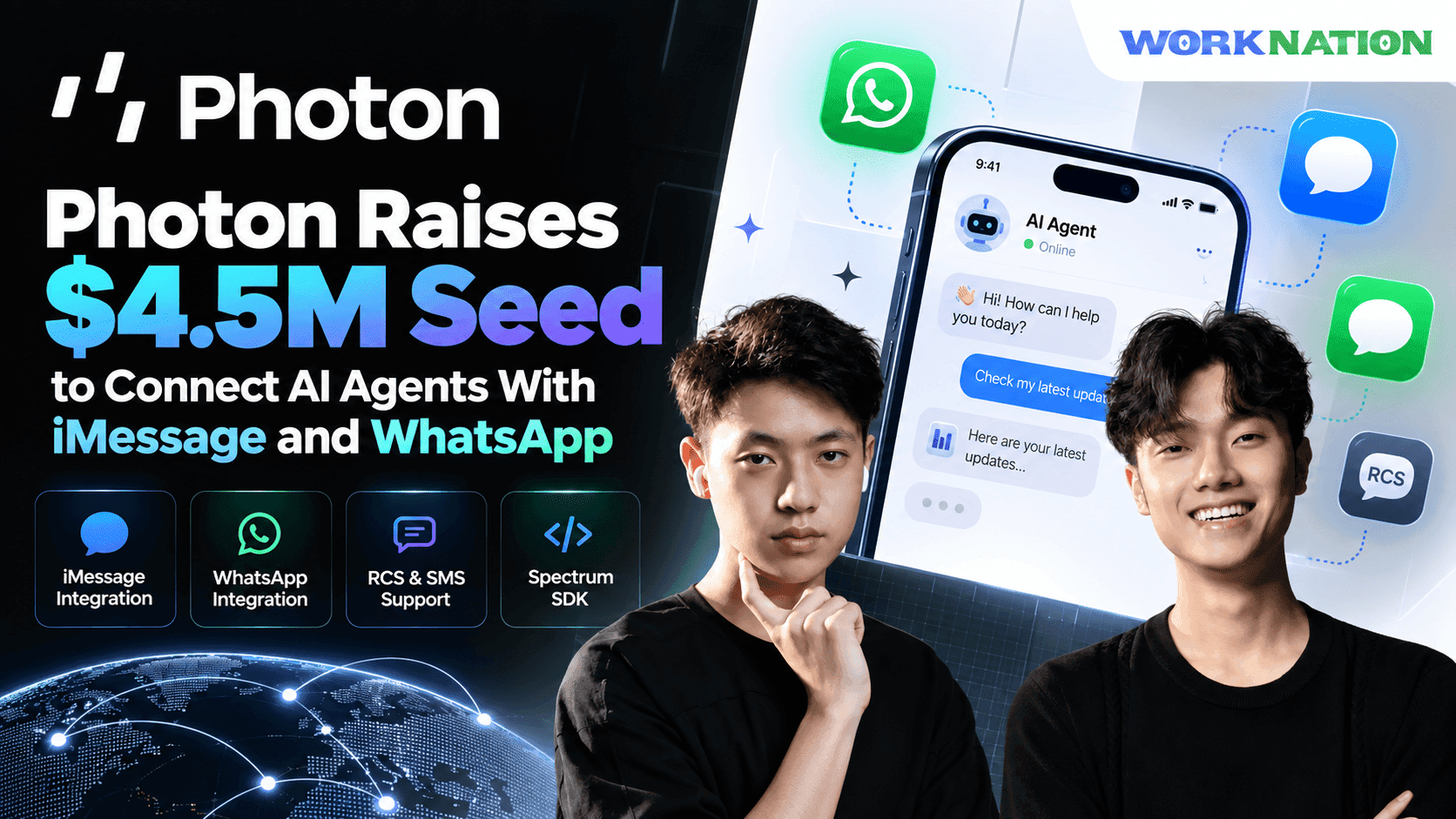
Photon Raises $4.5M to Bring AI Agents Into iMessage and WhatsApp
Top Picks
Submit PR
Stay Ahead of the Market
Get the latest startup funding, hiring trends and global opportunities delivered to your inbox every week.
Photon, a San Francisco-based messaging infrastructure startup, has raised $4.5 million in seed funding to help developers deploy AI agents directly into the messaging channels where people already communicate.
The round was co-led by Gradient and A*, with participation from Vercel, HongShan, Z Fellows, Llama Ventures, Karman and angel investors.
Photon plans to use the funding to scale its iMessage business messaging capabilities for regulated industries, continue developing its Spectrum SDK and onboard additional design partners.
The company did not disclose its valuation or total funding raised to date.
Building Infrastructure for AI Agents in Messaging
Founded by Daniel Tian, co-founder and CEO, and Ryan Zhu, Photon is focused on a relatively simple problem: AI agents can be powerful, but users still need to access them through interfaces they already use.
Messaging platforms such as iMessage, RCS, SMS and WhatsApp already have massive user adoption. However, developers face significant technical and platform restrictions when attempting to connect AI agents to these channels.
Photon's goal is to provide the infrastructure layer that makes those connections easier.
Its Spectrum SDK gives developers a single interface for connecting AI agents across multiple messaging channels, including iMessage, RCS, SMS and WhatsApp.
Instead of building and maintaining separate integrations for every messaging platform, developers can use Photon to connect an agent across multiple channels.
Why iMessage Is Particularly Difficult
Apple's messaging ecosystem presents a significant challenge for developers building AI agents.
Apple does not provide a public iMessage API for general agent use. Its Messages for Business product is designed around approved business conversations.
This creates a major limitation for developers that want to build agents capable of interacting with users directly through iMessage.
Photon is attempting to solve that infrastructure problem by acting as an adapter between AI agents and messaging platforms.
The company says the problem becomes increasingly important as AI agents move beyond standalone chat interfaces and begin performing tasks on behalf of users.
The company argues that users should not necessarily have to install another application just to interact with an AI agent.
Instead, agents could appear inside the messaging environments people already use every day.
Bringing Mini-Apps Into iMessage
Photon is also developing richer experiences inside messaging conversations.
In June, the company launched what it describes as the first mini-app API on iMessage.
The technology allows agents to send buttons, forms and live interfaces that render directly within a conversation.
This means users can potentially complete tasks without leaving the messaging thread.
Photon says its mini-app functionality requires iOS 26.
The approach could expand the role of messaging from simple text-based interactions into a platform where AI agents can actually execute workflows.
For example, rather than an agent simply answering a question, an agent could present a form, request information, offer options or guide a user through a transaction inside the conversation.
Rapid Growth and Developer Adoption
Photon says it now powers the chat experience for more than 1 million end users, achieved in less than a year.
The company also says it has 500 paying customers and churn below 3%.
Message volume reportedly grew fivefold in September, while revenue increased 10x between May and August.
Photon did not disclose its actual revenue figures, meaning the reported 10x growth cannot be evaluated against a publicly known starting revenue base.
The company has also developed integrations across the broader developer ecosystem.
Photon is the official iMessage adapter for Vercel's Chat SDK and the default iMessage layer for Nous Research's Hermes Agent.
It also has integrations with Mastra, Convex, Render and Telnyx.
The company says it is SOC 2 Type II certified and HIPAA-compliant, supporting its focus on regulated industries.
Vercel and AI Infrastructure Connections
The participation of Vercel is particularly notable because of Photon’s role in the developer ecosystem.
Vercel has become a major platform for developers building modern web applications and AI-powered products. Photon being integrated into Vercel's Chat SDK gives developers another potential route for bringing AI-powered applications into messaging environments.
Other investors in the round also have significant exposure to AI and technology startups.
Gradient, the AI-focused seed fund that originated within Google, has backed companies including Lambda, Oura and Writer.
A*, co-founded by Eventbrite co-founder Kevin Hartz, has also backed companies such as Ramp and Mercor.
HongShan, meanwhile, was formerly known as Sequoia China.
Gradient partner Vig Sachidananda said Photon is bringing AI capabilities to messaging channels that have already reached more than a billion users, while allowing developers to meet users where they already communicate.
Competition Is Emerging
Photon is entering a market where other companies are also attempting to connect AI agents with messaging platforms.
Linq announced a $20 million Series A led by TQ Ventures in February 2026. The company provides a similar infrastructure layer for iMessage, RCS and SMS.
Linq said AI agents on its platform had reached 134,000 monthly active users and generated more than 30 million messages per month.
The growth of iMessage-native AI assistants is also creating demand for infrastructure in this category. Poke, for example, launched with a $15 million seed round and built its assistant directly around iMessage.
Larger messaging infrastructure companies are also entering the AI-agent market.
Bird, which serves customers including Meta, PayPal and Klarna, secured $450 million in debt in September and launched an agent toolkit.
WhatsApp is another major area of competition, with startups such as Wassist and Jelou building AI-agent experiences around the platform.
The Platform Risk
Photon's opportunity also comes with a significant challenge.
The company does not own the messaging channels it is building on.
Apple controls iMessage. Meta controls WhatsApp. Other companies control RCS and related infrastructure.
That means changes to platform policies or APIs could potentially affect Photon and the companies building on its infrastructure.
The issue is particularly relevant for WhatsApp, where Meta changed its Business API terms in January 2026 to restrict general-purpose AI chatbots while continuing to allow task-specific business bots.
Photon's announcement does not disclose how its business would respond if Apple or Meta introduced tighter restrictions or changed access requirements.
The company also has not disclosed how much of its business comes from each messaging channel.
A New Layer for the Agent Economy
Photon's rapid user growth suggests there is growing demand for infrastructure that allows AI agents to operate outside traditional applications.
More than 1 million end users in less than a year gives the company an early position in an emerging market.
But the larger question is whether messaging infrastructure will remain an independent layer in the AI agent ecosystem.
As Apple, Meta and AI model providers continue developing their own agent capabilities, they could eventually provide more of the infrastructure themselves.
Photon is betting that developers will still need an independent layer that handles the complexity of connecting agents to multiple messaging platforms.
The $4.5 million seed round gives the company additional capital to develop that infrastructure, expand its iMessage capabilities and work with more businesses in regulated industries.
If AI agents increasingly become part of everyday communication, the ability to deploy those agents where users already spend their time could become an important part of the next generation of software infrastructure.
Have a Funding Round or Exciting Update to Share?
Submit your press release to get featured on WorkNation and reach founders, investors, and tech leaders.