Varda Raises $251M to Scale In-Space Pharmaceutical Manufacturing
Top Picks
Submit PR
Stay Ahead of the Market
Get the latest startup funding, hiring trends and global opportunities delivered to your inbox every week.
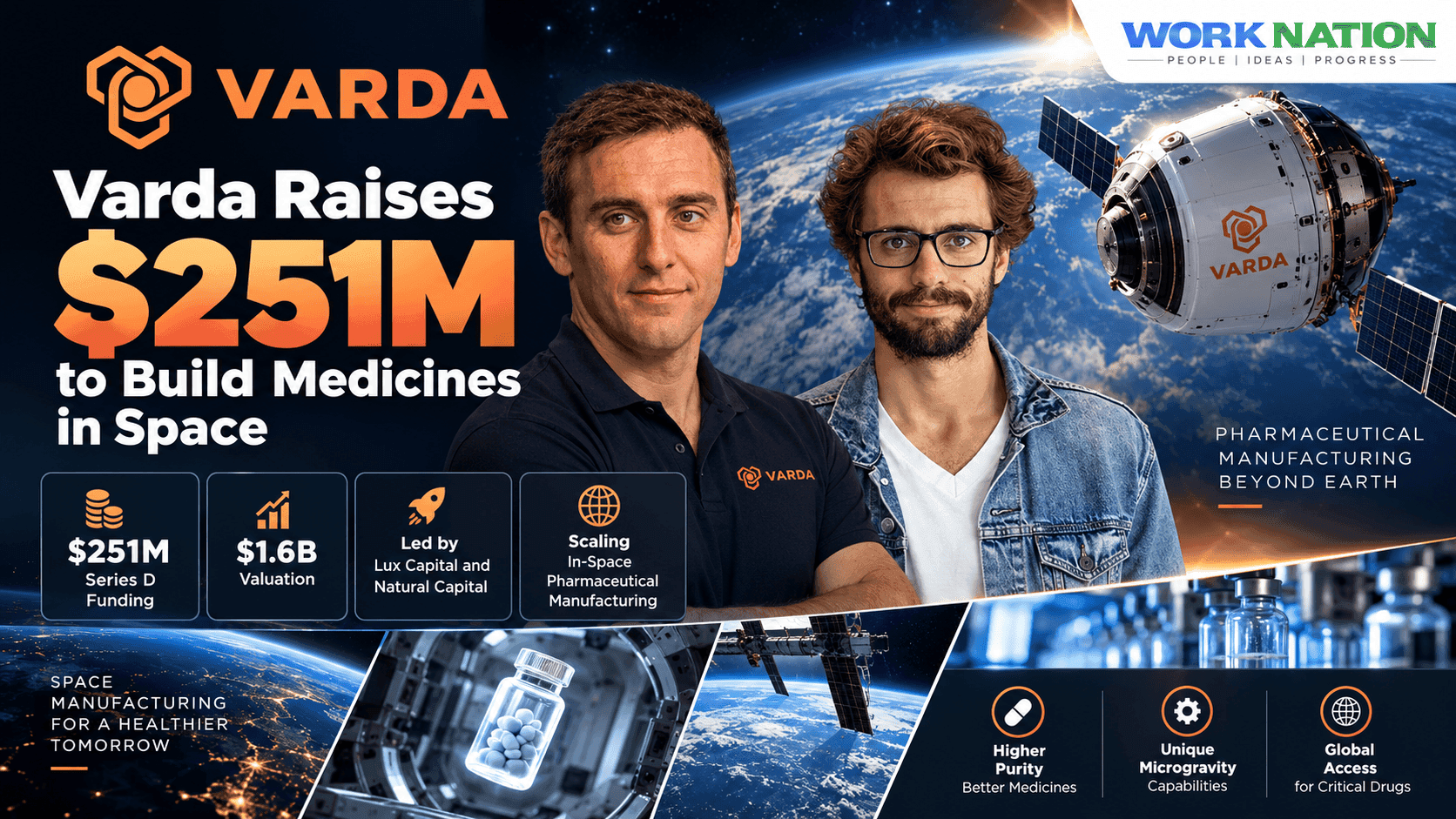
Varda Space Industries has raised $251 million in a Series D round as the El Segundo-based spacetech company works toward a long-term goal: manufacturing medicines in orbit and returning them to Earth.
The funding round was announced on September 30, 2026, and was led by Lux Capital and Natural Capital. The round values Varda at $1.6 billion and brings the company's total funding to $598 million.
Founders Fund, Khosla Ventures, Caffeinated Capital, General Catalyst, 8090 Industries, Giant Step, and Also Capital also participated in the round.
Building pharmaceutical manufacturing in space
Varda was founded in 2021 by Will Bruey and Delian Asparouhov. Bruey serves as CEO, while Asparouhov is president.
The company's approach is based on using microgravity as a manufacturing environment.
Its W-Series spacecraft carry pharmaceutical processing equipment into low Earth orbit. Once the processing is complete, the spacecraft return the manufactured material to Earth inside a reentry capsule.
During reentry, the capsule reaches speeds of up to Mach 25 before returning the material for use and analysis on Earth.
The underlying idea is that the absence of gravity can change how certain pharmaceutical ingredients crystallise. These different crystallisation conditions could potentially enable drug formulations that are difficult or impossible to produce under Earth's gravity.
Varda points to decades of microgravity research conducted aboard the International Space Station as evidence supporting the potential of the approach.
The company is now attempting to move that research concept toward a repeatable commercial manufacturing process.
Six successful reentry missions
Varda says it has completed six successful reentry missions since its first launch in 2023.
The company plans to significantly increase that cadence, with more than a dozen additional launches and reentries planned through 2028.
The upcoming missions are not limited to pharmaceutical manufacturing.
The W-8 mission is carrying sensors and thermal protection materials as part of a US military study, while W-9 is carrying a Department of Defense payload focused on navigation during hypersonic flight.
The company's capsules are also being used by customers beyond the pharmaceutical sector, including semiconductor and national security customers, according to Payload.
This broader customer base gives Varda an opportunity to develop its spacecraft, reentry systems and manufacturing infrastructure while continuing to pursue its pharmaceutical objective.
Pharmaceutical partnerships are developing
Varda's pharmaceutical ambitions have also led to partnerships with drug developers.
In May 2026, the company announced a collaboration with United Therapeutics to study microgravity-enabled formulations of treatments for rare pulmonary diseases.
The partnership is significant to Varda's broader strategy because the company's ultimate objective is not simply to demonstrate that materials can be processed in orbit. It wants pharmaceutical companies to use its orbital manufacturing infrastructure to create products that can eventually reach patients.
That remains a major step beyond successfully launching and recovering a spacecraft.
A growing in-space manufacturing sector
Varda is not the only company pursuing manufacturing beyond Earth.
Space Forge, a UK-based company focused on semiconductor materials, raised £22.6 million in a Series A round in May 2025. Its approach also centres on using the space environment to manufacture materials that can benefit from microgravity.
Another company, London-based BioOrbit, is focused specifically on pharmaceuticals. Founded in 2023, BioOrbit raised £9.8 million in a seed round in April 2026 to work on crystallising protein-based drugs in orbit, particularly cancer antibodies.
The broader space economy is also attracting significantly more private capital. According to a report from Relm Insurance and Seraphim cited by Reuters, private investment in space companies reached $23 billion in the year to June, compared with $9.7 billion during the previous year.
However, in-orbit manufacturing remains an early-stage market. Limited launch and return capacity remains a constraint, while some companies are still operating small pilot programmes.
The development of reusable space transportation could become important for companies such as Varda because manufacturing in orbit requires not only getting equipment into space, but also reliably returning the resulting products to Earth.
A long-term pharmaceutical bet
Varda's latest funding follows several earlier rounds.
The company raised a $9 million seed round in December 2020 and a $42 million Series A in July 2021. It then raised a $90 million Series B in April 2024, followed by a $187 million Series C in July 2025.
The new Series D takes total funding to $598 million.
Lux Capital has backed Varda since its seed round, while Natural Capital led the company's Series C before returning as a lead investor for the latest round.
There are also direct links between Varda's founders and some of its investors. Delian Asparouhov is a partner at Founders Fund, while Will Bruey co-founded Also Capital.
What comes next for Varda
The biggest challenge for Varda now is moving from successful spacecraft missions to commercially viable pharmaceutical manufacturing.
The company has demonstrated that it can launch hardware into orbit and recover it. It has also established a growing flight cadence and pharmaceutical partnerships.
The next question is whether a pharmaceutical formulation produced in microgravity can demonstrate enough value for drugmakers to pay for the process, and ultimately whether such products can progress through the necessary regulatory pathway.
For Varda, the latest $251 million round provides capital to increase launch and reentry cadence, expand pharmaceutical partnerships and continue working toward its stated goal of producing the first medicine manufactured in space.
The broader question is even bigger: can low Earth orbit become a practical manufacturing environment for products that are difficult to produce on Earth?
Varda is now putting substantial capital behind the attempt to find out.
Have a Funding Round or Exciting Update to Share?
Submit your press release to get featured on WorkNation and reach founders, investors, and tech leaders.