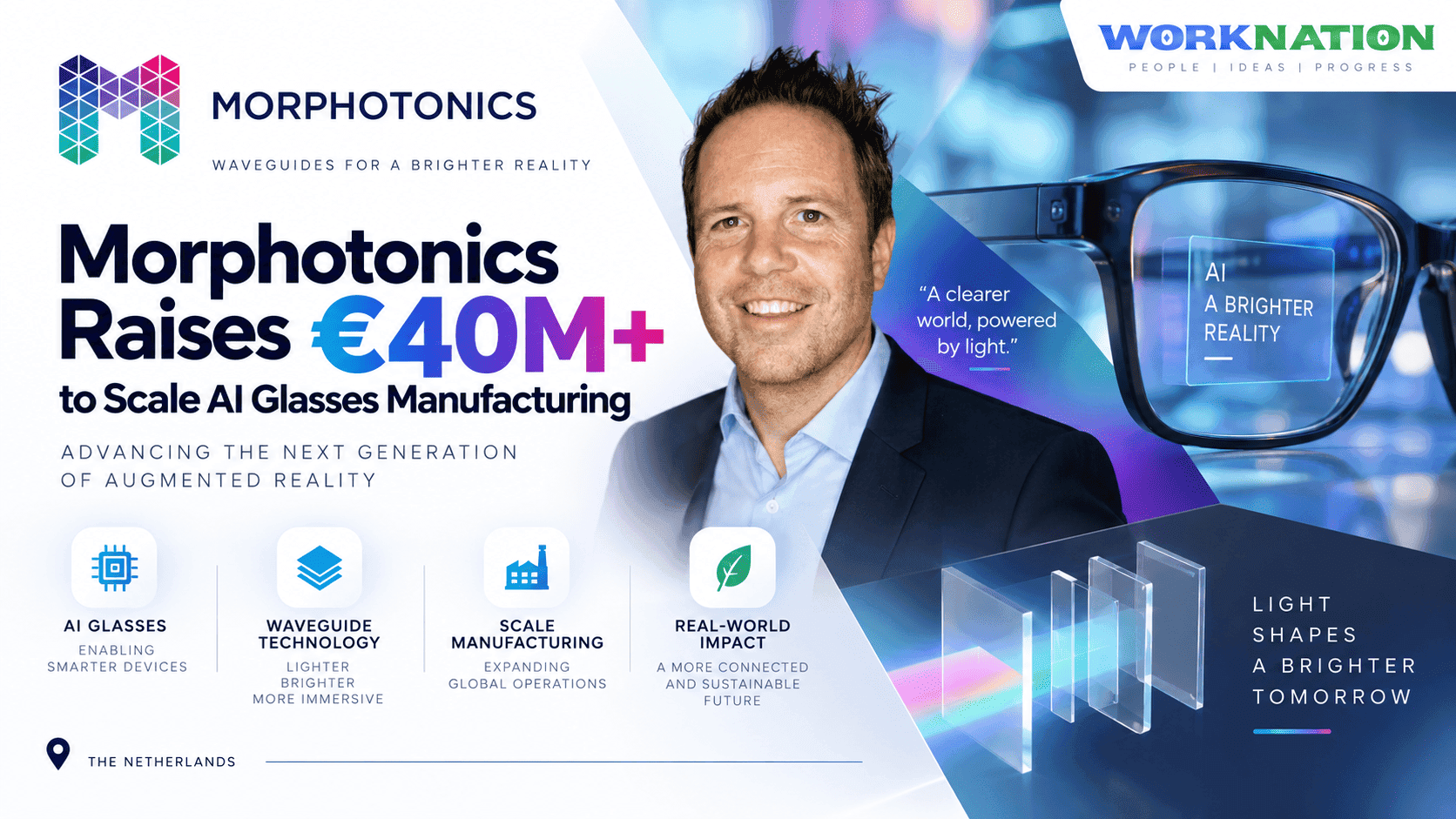
Morphotonics Raises €40M+ to Scale AI Glasses Manufacturing
Top Picks
Submit PR
Stay Ahead of the Market
Get the latest startup funding, hiring trends and global opportunities delivered to your inbox every week.
Morphotonics, a Dutch deep-tech company developing manufacturing equipment for optical waveguides, has raised more than €40 million in its Series B round as it looks to scale production technology for the emerging AI glasses market.
The Veldhoven-based company develops machines used to manufacture waveguides, the optical components that project digital information into a wearer's field of vision. As AI-powered glasses move toward higher-volume consumer production, Morphotonics is targeting one of the key manufacturing challenges behind these devices: producing advanced optical components at scale and at a cost suitable for consumer electronics.
The expanded Series B brings in new investor Invest-NL alongside returning backers including 3M Ventures, Innovation Industries and the Brabant Development Agency (BOM). The round also includes support from the European Innovation Council Fund and the European Investment Bank.
According to Morphotonics, revenue tripled in 2025 compared with 2024.
Building the manufacturing layer for AI glasses
AI glasses are increasingly moving beyond experimental prototypes.
Devices such as Meta's Ray-Ban Display demonstrate the growing interest in glasses that combine conventional eyewear with digital displays and AI-powered capabilities.
But producing the optical components required for these products at consumer scale remains a significant manufacturing challenge.
One of the critical components is the waveguide.
Waveguides are thin optical structures that allow digital images to be projected into the wearer's field of vision while maintaining a transparent form factor.
For the technology to work in consumer glasses, these structures need to be manufactured with extremely precise patterns across large surfaces.
The challenge is not simply creating the optical design.
Manufacturers need to reproduce these structures quickly, consistently and with very low defect rates while keeping production costs under control.
Morphotonics is building the industrial equipment intended to address that challenge.
From Philips optical technology to deep tech
Morphotonics was founded in 2014 by Onno Lint, Rob van Erven, Jan Matthijs ter Meulen and Bram Titulaer.
The founding team came out of Philips' optical-disc division, a group involved in the development and manufacturing of compact-disc technology.
That background gave the founders experience working with highly precise optical manufacturing processes.
Today, the company operates from Veldhoven in the Netherlands' Brainport high-tech cluster.
Hugo da Silva became CEO in 2024, while Jan Matthijs ter Meulen now serves as CTO.
The company has since developed its own technology for manufacturing optical waveguides at high volume.
The waveguide manufacturing challenge
Waveguides rely on extremely small structures etched or patterned into their surfaces.
These structures can operate at nano- and microscale dimensions.
Producing them consistently across large panels creates several manufacturing challenges.
The process needs to maintain precision while also achieving high throughput.
A production system that can create a technically impressive waveguide but cannot manufacture enough units at an acceptable cost may not be suitable for mass-market electronics.
Morphotonics is therefore focusing on the manufacturing process itself.
Its technology is designed to reproduce optical patterns across large substrates while reducing the cost and complexity associated with producing waveguides.
Nanoimprint lithography
Morphotonics uses nanoimprint lithography as the basis for its manufacturing approach.
The process involves pressing a patterned mould into a liquid resin and then curing the material with ultraviolet light.
The resulting structure reproduces the desired optical pattern.
The process can then be repeated across large substrates.
Morphotonics has developed its Cypris platform specifically for high-volume waveguide manufacturing.
The company says several Cypris platforms have already been installed with manufacturers around the world.
The technology is intended to move waveguide manufacturing from specialized production toward a process capable of supporting larger consumer-electronics volumes.
A different position in the AI glasses supply chain
Morphotonics is not designing complete AI glasses.
It is also not primarily developing the optical components themselves.
Instead, it is building the manufacturing equipment that other companies can use to produce those components.
That puts Morphotonics closer to an equipment supplier within the AI glasses supply chain.
The distinction is important because the company can potentially support multiple optical designs and device manufacturers without needing to build a consumer hardware brand of its own.
Its focus is the industrial infrastructure required to turn optical designs into manufactured components.
Competition across European deep tech
Morphotonics is operating alongside several European deep-tech companies developing different technologies for the next generation of smart glasses and optical systems.
Swave Photonics, for example, has been developing holographic display technology designed to eliminate the need for conventional waveguides.
Finnish company Dispelix is developing single-layer waveguide technology.
Another European company, eyeo, is addressing a different part of the optical stack by working on technology intended to improve the amount of light reaching camera sensors.
Morphotonics is taking a different position by focusing on the equipment used to manufacture waveguides.
Rather than competing directly on the optical design of a wearable device, it is attempting to become part of the manufacturing infrastructure required to produce those optical components.
Revenue growth
Morphotonics says its revenue tripled during 2025 compared with 2024.
The growth comes as interest in AI-powered eyewear increases among technology companies and consumer electronics manufacturers.
The company says its latest funding will allow it to expand Cypris production capacity while accelerating product development.
It also plans to expand its engineering, commercial and after-sales teams.
The objective is to move further from technology development toward broader industrial deployment.
New investment from Invest-NL
Invest-NL is joining Morphotonics as a new investor in the expanded Series B.
Existing investors including 3M Ventures, Innovation Industries and BOM are also continuing to support the company.
The European Innovation Council Fund and European Investment Bank are also involved in the financing.
Invest-NL investment manager Johan Stins said the investment would support Morphotonics' move from technology development toward broader industrial deployment.
For Morphotonics, that transition represents an important stage in its development.
Deep-tech companies often spend years developing and validating manufacturing technology before reaching meaningful commercial scale.
The company is now attempting to turn its technology into a larger industrial business.
Funding the next stage of manufacturing
The more than €40 million raised will be used across several areas.
Morphotonics plans to increase production capacity for its Cypris platform and continue developing its manufacturing technology.
The company also intends to expand its engineering organization, commercial operations and after-sales support.
These investments are designed to support customers as they deploy Morphotonics' equipment at higher volumes.
The company will need to support not only the machines themselves but also installation, maintenance and technical assistance as more manufacturing facilities adopt the technology.
The broader AI glasses opportunity
The potential market for AI-powered glasses is expanding as technology companies explore wearable devices that combine cameras, displays, microphones, connectivity and AI.
According to the source, Counterpoint Research expects smart eyewear to reach approximately $44 billion in revenue by 2032.
The broader consumer wearables market is projected to generate more than $1 trillion in cumulative revenue between 2026 and 2032.
If those markets continue to expand, the companies providing the underlying manufacturing infrastructure could become increasingly important.
AI models can be updated through software.
Optical components require physical manufacturing processes that must be engineered, tested and scaled.
That makes manufacturing technology an important part of the transition from prototypes to mass-market devices.
Scaling beyond the laboratory
Morphotonics' latest funding reflects a broader shift from developing optical technology in laboratories toward creating manufacturing systems capable of supporting consumer electronics production.
The company is now working to increase the production capacity of Cypris and expand its customer base.
Its technology will need to demonstrate that it can maintain precision and reliability while operating at the scale required by consumer electronics manufacturers.
That will be particularly important if AI glasses move from early adopters toward mainstream products.
What comes next
The more than €40 million Series B gives Morphotonics capital to expand its manufacturing technology and prepare for increased demand from the AI glasses market.
Founded by former Philips engineers Onno Lint, Rob van Erven, Jan Matthijs ter Meulen and Bram Titulaer, the company has spent more than a decade developing technology around optical manufacturing.
With Hugo da Silva now leading the company as CEO and ter Meulen serving as CTO, Morphotonics is entering a new phase focused on industrial scale.
The company is betting that the future of AI glasses will depend not only on better AI and better optical designs, but also on the ability to manufacture sophisticated waveguides quickly, consistently and economically.
If AI glasses become a major consumer electronics category, the manufacturing systems behind their optical components could become an important part of the supply chain.
For Morphotonics, the next challenge is turning that opportunity into large-scale industrial deployment.
Have a Funding Round or Exciting Update to Share?
Submit your press release to get featured on WorkNation and reach founders, investors, and tech leaders.