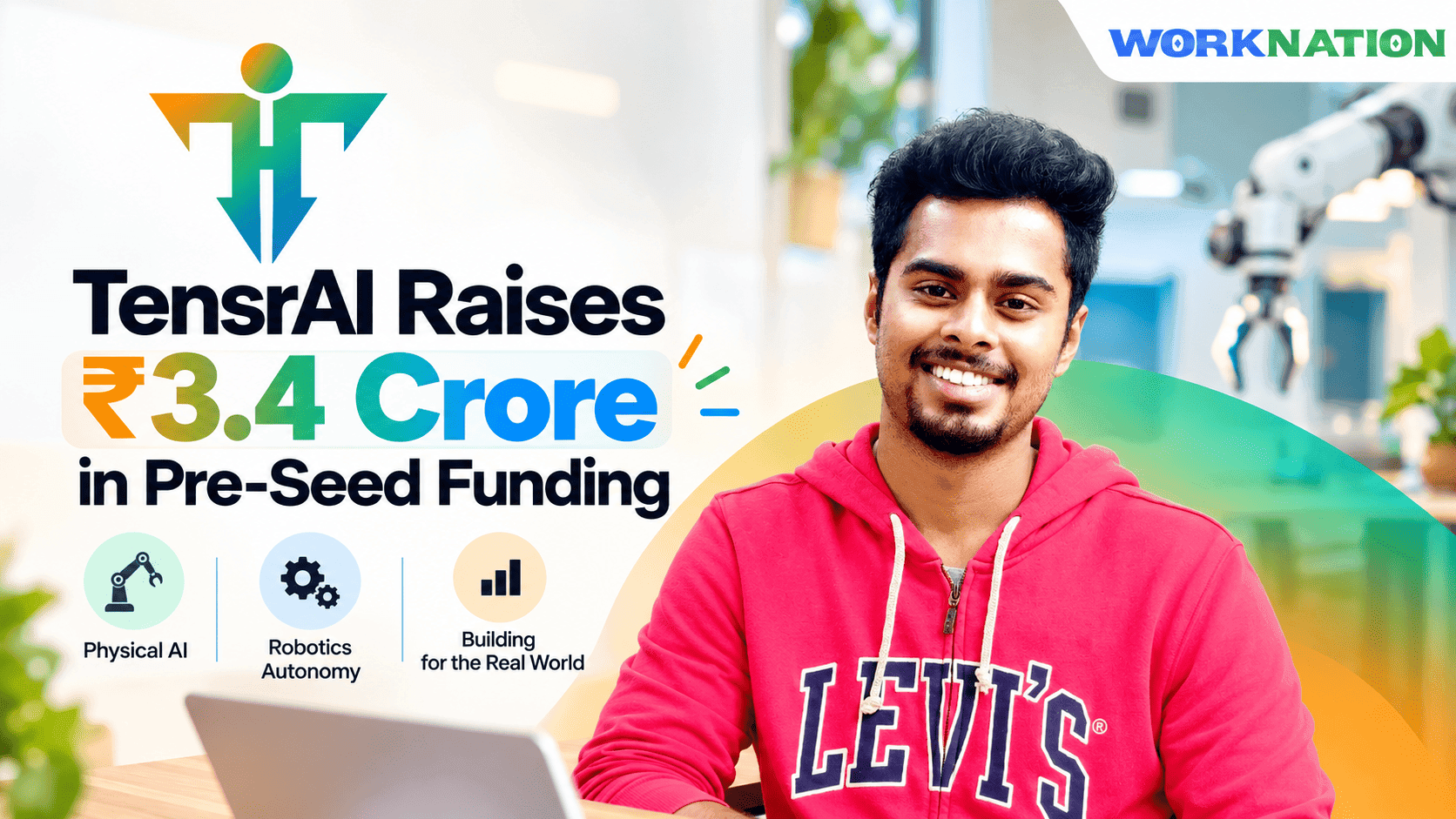
TensrAI Raises ₹3.4 Crore to Bring Physical AI to Industrial Machines
Top Picks
Submit PR
Stay Ahead of the Market
Get the latest startup funding, hiring trends and global opportunities delivered to your inbox every week.
Hyderabad-based Physical AI startup TensrAI has raised ₹3.4 crore in a pre-seed funding round from India Accelerator, Finvolve, Hyderabad Angels and other angel investors. The company plans to use the fresh capital to accelerate technology development, strengthen its engineering and deployment capabilities, and expand into domestic and international markets.
Founded by Sai Nikhil Rao Gona, Venkata Sai Charan Chalamalasetty, Harshith Uppalapati and Vivek Datta, TensrAI is developing a unified autonomy platform designed to help industrial and commercial robots, vehicles and machines perform physical tasks with limited human intervention.
Its approach focuses on bringing autonomous capabilities to both newly developed machines and existing equipment through a retrofittable technology platform.
Bringing autonomy to existing machines
TensrAI is developing a unified autonomy platform that combines several technologies to help machines understand their surroundings, make decisions and execute physical tasks.
The platform brings together vision-first navigation, AI-based localisation, vision-language model (VLM)-powered reasoning, autonomous mobility, robotic arm manipulation and vision-language-action (VLA)-based teach-and-deploy capabilities.
These technologies are designed to allow machines to perceive their environment, reason through tasks, learn skills and carry out operations with limited human intervention.
An important part of the company's approach is retrofitting. Instead of requiring businesses to replace existing equipment with entirely new autonomous machines, TensrAI aims to add autonomous capabilities to machinery already in operation.
This could reduce the cost and complexity of introducing robotics into industrial and commercial environments.
Targeting factories, warehouses and commercial spaces
TensrAI is targeting applications across multiple environments where repetitive and labour-intensive activities can be automated.
Its potential use cases include autonomous material handling and cleaning across:
Factories and industrial facilities.
Warehouses and logistics operations.
Airports and hospitals.
Shopping malls and commercial campuses.
The company is also developing a general-purpose mobile manipulator that combines autonomous mobility with robotic arms.
This system is intended to perform tasks across material handling, cleaning, manufacturing and construction. By combining movement with robotic manipulation, the platform aims to support more complex physical operations than machines designed for a single fixed task.
A multi-revenue business model
TensrAI plans to generate revenue through multiple business models rather than relying only on robot sales.
Its proposed revenue streams include:
Robot sales: Selling autonomous robotic systems to businesses.
Autonomy retrofitting: Adding autonomous capabilities to existing machines and equipment.
Robot-as-a-Service (RaaS): Providing robotic capabilities through a service-based model.
Customised solutions: Developing systems for specific industrial and commercial requirements.
This approach gives the startup multiple ways to serve businesses with different automation needs and investment capabilities.
The company also plans to expand into international markets, although it has not disclosed specific countries or expansion timelines in the announcement.
Why Physical AI is attracting attention
Physical AI combines artificial intelligence with robotic systems and machines, allowing them to understand and interact with the physical world.
Unlike software-based AI applications that primarily process information or generate digital outputs, Physical AI systems are designed to translate perception and reasoning into real-world actions.
For industrial businesses, this creates opportunities to automate tasks involving movement, navigation, manipulation and equipment operation.
TensrAI is positioning its unified autonomy platform around this opportunity, with a focus on enabling different types of machines to perform physical tasks through a common technology layer.
How TensrAI plans to use the funding
The ₹3.4 crore pre-seed funding will support three key priorities:
Accelerating the development of its autonomy technology.
Strengthening engineering and deployment capabilities.
Supporting expansion into domestic and international markets.
As an early-stage company, TensrAI's next challenge will be demonstrating that its platform can work reliably across different machines and operating environments.
Retrofitting existing equipment could offer a practical route to adoption, but successful deployments will depend on how well the technology handles different hardware configurations, physical environments and operational requirements.
The company's progress will therefore depend on product development, real-world deployments and its ability to turn multiple proposed revenue streams into a sustainable business.
With its pre-seed funding, TensrAI is looking to build the technology and deployment capabilities needed to bring autonomous operations to a wider range of industrial and commercial environments.
Have a Funding Round or Exciting Update to Share?
Submit your press release to get featured on WorkNation and reach founders, investors, and tech leaders.