Fragment Raises $56M to Automate Procurement Exceptions With AI Agents
Top Picks
Submit PR
Stay Ahead of the Market
Get the latest startup funding, hiring trends and global opportunities delivered to your inbox every week.
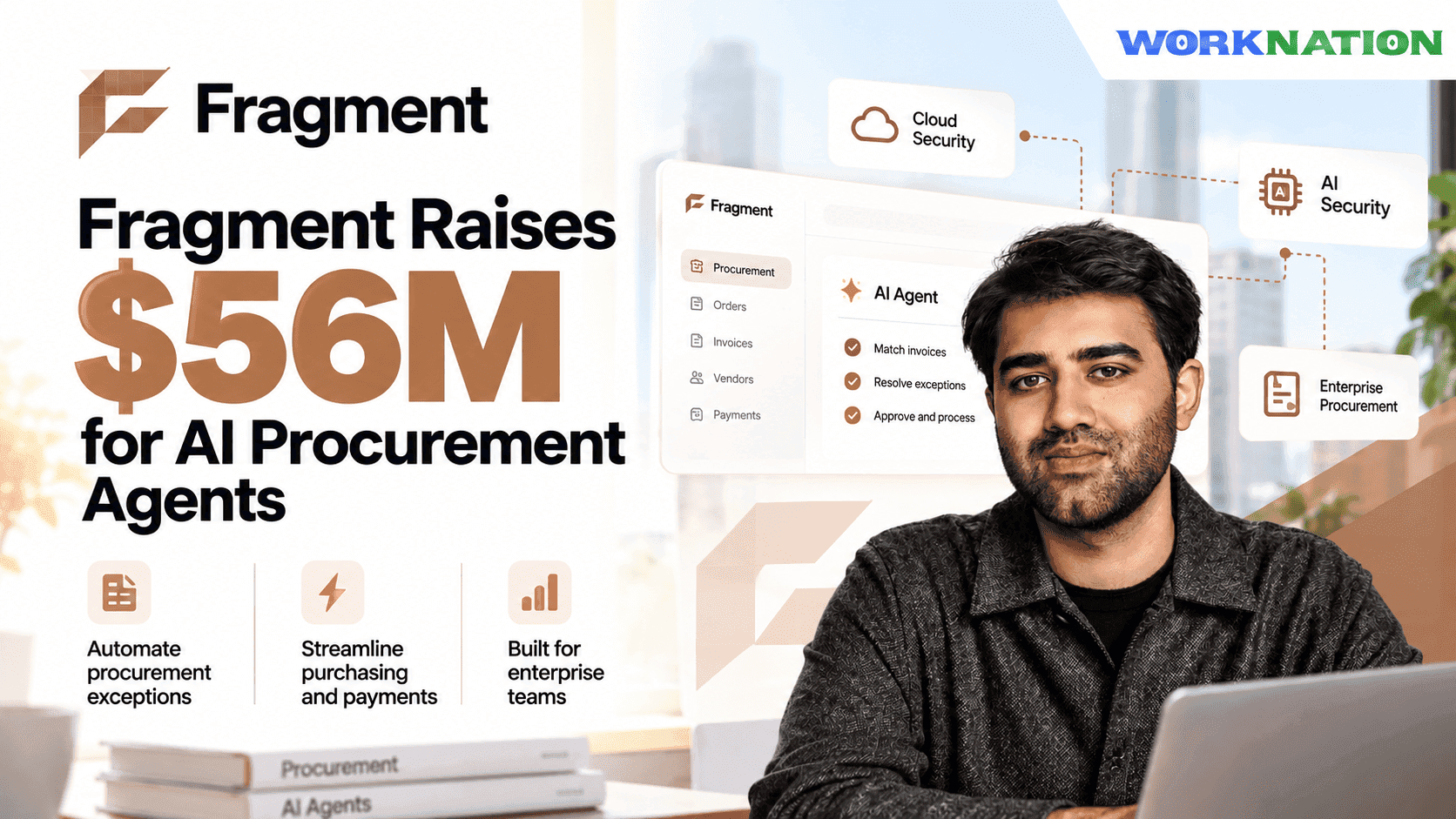
San Francisco-based startup Fragment has emerged from stealth with $56 million in funding to automate complex procurement work using AI agents. The company is developing software that can investigate and resolve purchasing and payment exceptions across existing enterprise systems, targeting a persistent problem for large manufacturers and distributors.
The funding includes a Series A led by 8VC and a seed round co-led by General Catalyst and A*. The company also attracted angel investors including Roelof Botha, Nikesh Arora, Jeff Wilke, Eric Wu and Dennis Cinelli.
Founded by Pranav Mulgund and Naveen Kashyap, Fragment is focused on a part of enterprise procurement that conventional software has struggled to automate: the exceptions that require employees to gather information from disconnected systems, interpret business policies and coordinate a resolution.
Why procurement exceptions remain difficult to automate
Procurement teams manage a complex flow of purchase orders, invoices, suppliers, payments and changing business requirements. A mismatch between an invoice and a purchase order, a sudden shortage or a tariff change can trigger a series of manual checks involving multiple systems and departments.
Fragment's source estimates that around 20% of transactional procurement is still handled manually. This creates a significant opportunity for automation, particularly for large enterprises with complicated supplier networks and operational processes.
The challenge is not simply generating a recommendation. Enterprise data is often spread across systems that were not designed to work together. Employees must piece together the relevant information, understand the company's internal rules and determine which action is permitted.
Pranav Mulgund encountered supply chain operations early in his career, later worked as a physics researcher and led part of Zoom's product team. He co-founded Fragment with Naveen Kashyap, with whom he had previously worked on agentic products.
Their approach is to build AI agents that can understand the operational context behind an exception and carry out an approved resolution, rather than merely flagging a problem for an employee to handle.
How Fragment's Autonomous Context Engine works
Fragment's core technology is its Autonomous Context Engine, or ACE. The system brings together information from existing enterprise systems and captures the policies, relationships and operational knowledge employees use to make decisions.
Its agents then review procurement exceptions, determine an appropriate course of action and execute the resolution when authorised to do so.
For example, when an invoice does not match its purchase order, an agent can investigate the discrepancy and resolve it if the company's policies permit that action. This moves the technology beyond basic workflow automation and recommendation tools toward the execution of operational work.
Fragment says ACE works with a company's existing data, avoiding the need for data migration or lengthy integration projects. That approach could help reduce the implementation burden for enterprises operating large, established technology environments.
According to Fragment's website, its average customer has seen between $5 million and $10 million in impacted costs, while exceptions have fallen by approximately 50% in the first few weeks. The company also reports that more than 90% of exceptions are resolved without human intervention. These are company-reported figures, and the article does not independently verify them.
Mulgund, Fragment's co-founder and CEO, said the company's ambition is to make complex operational work a capability of software itself. He argues that automating discrepancy resolution would allow procurement professionals to spend more time on supplier relationships, business decisions, margin protection and supply continuity.
Fragment's position in the AI procurement market
Fragment is entering a competitive market where multiple startups are applying AI agents to purchasing, supplier negotiations and enterprise procurement.
Zip raised $190 million in a Series D round in October 2024 at a reported $2.2 billion valuation. Levelpath, which focuses on indirect spend, raised more than $55 million in June 2025. Pactum raised $54 million in June 2025 for AI agents that negotiate with suppliers.
Other competitors include Didero, which raised $30 million in a Series A round in February to develop AI agents for manufacturers and distributors, and Freehand, which raised $75 million in July and has reported deployments involving supply chain spend at Meta and Unilever.
Fragment differentiates itself by focusing on direct procurement and resolving exceptions within customers' existing systems. Its commercial model also differs from conventional enterprise software pricing: rather than charging by user seat or headcount, it charges according to the amount of work its agents perform.
That approach ties pricing more directly to automated activity. However, it also creates a challenge as the product matures. If agents reduce exceptions substantially, Fragment may need to expand into additional workflows to maintain customer value and revenue growth.
The market opportunity is attracting attention. A market estimate cited by the source projects the AI procurement platform market to grow from $4.99 billion in 2026 to $19.74 billion by 2031. This is a forecast, not a confirmed future outcome.
How Fragment plans to use the funding
Fragment plans to use the new capital to further develop ACE, expand into source-to-pay workflows and support additional deployments with major global enterprises.
The company's initial customer examples include Graybar and CNX, where its agents handle purchasing and payment exceptions through existing systems. The disclosed customer list remains limited, making broader enterprise adoption an important milestone to watch.
Jack Moshkovich, a partner at 8VC, said Fragment had been built from the outset for enterprises with large-scale operations, extensive dependencies and complex workflows. That enterprise-first approach, according to the investor, gives the company a foundation for broader deployments.
The involvement of experienced technology and investment figures among its backers adds to the round's profile. Angel investors include Roelof Botha and Nikesh Arora, alongside Jeff Wilke, Eric Wu and Dennis Cinelli.
What comes next for Fragment
Fragment's next challenge is proving that enterprises will trust AI agents not only to identify procurement problems but also to execute financial and operational resolutions. Actions involving invoices and payments require strong controls, clear permissions and confidence that agents will follow internal policies.
The company will also need to demonstrate that its reported results can be repeated across a larger customer base. With only two customers named in the source, the scale of adoption remains an open question.
The $56 million raise gives Fragment capital to expand its technology and enterprise deployments. Its long-term opportunity will depend on whether it can reliably automate exception-heavy workflows, build customer trust and extend its platform into adjacent procurement processes as routine exceptions become less frequent.
Have a Funding Round or Exciting Update to Share?
Submit your press release to get featured on WorkNation and reach founders, investors, and tech leaders.